1955 – 1966 – Peugeot 403 – Retro Classics Stuttgart 2015
At a time when European carmakers were redefining post-war mobility, the Peugeot 403 emerged as a carefully balanced response to growing demand for reliable, modern family cars. It combined conservative engineering with a design language that signaled a clear departure from pre-war forms. Over more than a decade of production, it became one of Peugeot’s most recognizable and widely used models.
Technical Details
The Peugeot 403 was powered by a front-mounted inline four-cylinder engine with a displacement of 1,468 cc. This engine used an overhead valve (OHV) configuration and produced approximately 58 horsepower in its early versions, later increased to around 65 horsepower in updated models. Power was transmitted to the rear wheels via a four-speed manual gearbox, initially with a column-mounted gear selector.
The car followed a conventional front-engine, rear-wheel-drive layout, emphasizing durability and ease of maintenance. The chassis featured independent front suspension with coil springs and a rigid rear axle supported by leaf springs. Braking was handled by drum brakes on all four wheels. In 1959, Peugeot introduced a diesel engine option—one of the first in a mass-produced passenger car—highlighting the model’s technical adaptability. The Peugeot 403 offered a top speed of approximately 135 km/h, positioning it as a capable long-distance vehicle for its class.
- Manufacturer: Peugeot
- Model name: Peugeot 403
- Year of manufacturing: 1955–1966
Design
The design of the Peugeot 403 was developed in collaboration with Pininfarina, marking one of the earliest partnerships between Peugeot and the Italian coachbuilder. The result was a clean, modern body that moved away from the rounded, separate-fender look of earlier models.
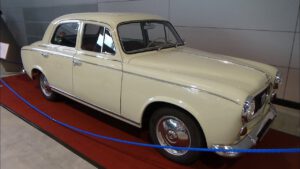
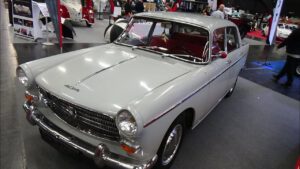
The Peugeot 403 featured a ponton-style body with integrated fenders, smooth surfaces, and a balanced three-box silhouette. The front end was defined by a simple grille and modest chrome detailing, giving the car a restrained but contemporary appearance. Its proportions emphasized practicality, with a relatively tall cabin and generous glass area that improved visibility.
Inside, the design followed Peugeot’s established philosophy of clarity and durability. The dashboard layout was straightforward, with clearly arranged instruments and controls. Materials were selected for longevity rather than luxury, reinforcing the car’s role as a dependable everyday vehicle.
Historical Significance
Introduced in 1955, the Peugeot 403 was the company’s first model to exceed one million units in production, marking a major milestone for the brand. It succeeded the Peugeot 203 and represented a significant step forward in both design and engineering.
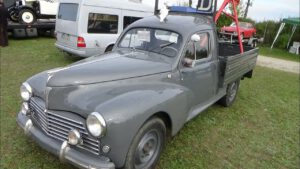
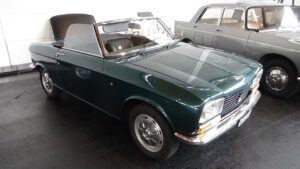
The model range expanded over time to include saloon, estate (Familiale and Commerciale), cabriolet, and pickup variants. This versatility allowed Peugeot to address a wide range of customer needs, from private family transport to commercial use.
One of the most important developments was the introduction of the diesel version in 1959. At a time when diesel engines were largely confined to commercial vehicles, the Peugeot 403 helped establish the concept of diesel-powered passenger cars in Europe. Its durability also made it well suited for export markets, where it gained a reputation for reliability under demanding conditions.
Quirks and Pop Culture
The Peugeot 403 gained international recognition through its association with the television series Columbo. The main character, portrayed by Peter Falk, drove a worn but distinctive Peugeot 403 Cabriolet, which became an integral part of the show’s identity. This exposure gave the model a cultural presence far beyond its original market.
Beyond television, the Peugeot 403 became known for its role as a dependable workhorse. It was widely used as a taxi and in government fleets across Europe and other regions. The diesel variant, in particular, reinforced its reputation for longevity and efficiency.
Today, surviving examples—especially cabriolet versions—are highly valued among collectors. The contrast between the car’s modest origins and its later cultural recognition adds to its appeal.
Display and preservation
This car was filmed at the Retro Classics Stuttgart 2015, held from March 26 to 29. The show set new standards with an expanded 120,000 square meters of exhibition space. A total of 1,430 exhibitors and more than 87,000 visitors filled eight halls, creating a vibrant marketplace where nearly half of attendees made purchases. Strong presences from Mercedes-Benz and Porsche added prestige, with Porsche unveiling rare prototypes. Special displays ranged from BMW M5 anniversaries to American classics with roaring V8 engines.
Conclusion
The Peugeot 403 represents a key phase in Peugeot’s post-war development, combining conservative engineering with a modern design approach. Its robust inline four-cylinder engine, rear-wheel-drive layout, and versatile body styles made it suitable for a wide range of uses. Historically, it marked Peugeot’s transition to large-scale production and introduced diesel technology to passenger cars. Its presence in popular culture and continued visibility at classic car events underline its lasting significance.