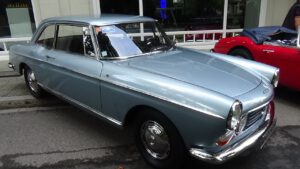
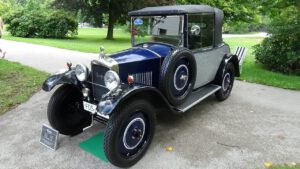
1954 Peugeot 203 – Retro Classics Stuttgart 2019
By the mid-1950s, the Peugeot 203 had become a familiar and trusted presence on European roads. Introduced in the immediate post-war period, it was designed to meet the need for reliable and modern transportation at a time when resources were still limited. The 1954 version reflects a model that had matured through continuous refinement rather than major redesign, maintaining its relevance through consistency and engineering discipline.
Technical Details
The 1954 Peugeot 203 was equipped with a front-mounted inline four-cylinder engine with a displacement of 1,290 cc. The engine featured overhead valves and hemispherical combustion chambers, a relatively advanced design for its class, contributing to efficient fuel combustion and smooth operation. Output was approximately 42 to 45 horsepower, depending on the specific version, allowing for a top speed of around 110–115 km/h.
Power was transmitted to the rear wheels via a four-speed manual gearbox, with the fourth gear functioning as an overdrive to improve fuel efficiency and reduce engine strain at higher speeds. The car used a monocoque body construction, which provided improved rigidity and reduced weight compared to traditional body-on-frame designs.
The suspension system consisted of independent front suspension with coil springs and a rear live axle supported by leaf springs. This setup offered a balance between comfort and durability, particularly suited to the varied road conditions of the time. Braking was handled by drum brakes on all four wheels. The overall engineering emphasized reliability, ease of maintenance, and long-distance usability.
- Manufacturer: Peugeot
- Model name: Peugeot 203
- Year of manufacturing: 1954
Design
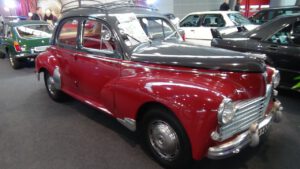
The design of the Peugeot 203 reflects the transition from pre-war styling conventions to more integrated post-war forms. Its body featured smooth, rounded lines with fully integrated fenders, creating a cohesive and modern appearance for the early 1950s.
The front end was characterized by a prominent vertical grille with chrome accents, flanked by rounded headlamps that blended into the front wings. The overall silhouette was slightly bulbous but well proportioned, with a gently curved roofline that contributed to both aerodynamics and interior space.
Chrome detailing was used selectively, emphasizing key elements such as the grille and bumpers without overwhelming the design. The Peugeot 203 was offered in multiple body styles, including saloon, estate, coupé, and cabriolet, demonstrating the flexibility of its platform. Inside, the cabin was designed with practicality in mind, featuring clear instrumentation and durable materials suited to everyday use.
Historical Significance
The Peugeot 203, introduced in 1948, was the brand’s first completely new model after World War II and played a central role in rebuilding Peugeot’s production and market presence. By 1954, the model had already proven its success, with strong sales in both domestic and export markets.
It was also Peugeot’s first monocoque production car, marking a significant step forward in construction techniques. The use of advanced engine features such as hemispherical combustion chambers further demonstrated the company’s focus on engineering efficiency. Over its production run, the Peugeot 203 became one of Peugeot’s most important early post-war models, laying the groundwork for successors such as the 403.
The car’s longevity in production reflects its ability to meet the needs of a wide range of customers, from private owners to professional users. Its reputation for durability contributed to its widespread adoption in various markets, including regions with challenging road conditions.
Quirks and Pop Culture
The Peugeot 203 became closely associated with everyday mobility in post-war France. It was widely used as a family car, a commercial vehicle, and in some cases as a taxi, reinforcing its image as a dependable and versatile automobile.
One of its distinguishing features is the continuity of its design over many years, with only minor visual changes introduced throughout its production. This makes it representative of an era when manufacturers focused on refining existing models rather than frequently replacing them.
While the Peugeot 203 did not achieve significant prominence in international pop culture, it remains an important symbol of France’s economic recovery in the 1950s. Among classic car enthusiasts, it is appreciated for its historical importance and its role in shaping Peugeot’s identity as a producer of reliable vehicles.
Display and preservation
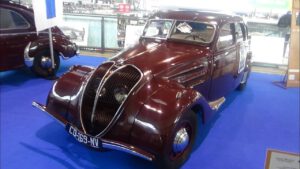
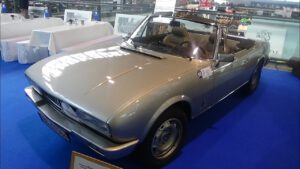
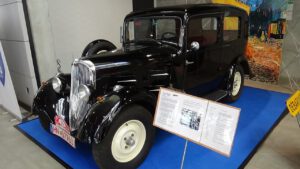
The vehicle was exhibited at Retro Classics Stuttgart in 2019. Spread across nine exhibition halls as well as the outdoor and entrance areas, the 19th edition welcomed more than 90,000 visitors and presented around 4,000 vehicles. Unlike earlier years, the organizers did not focus on a central special exhibition, placing even greater emphasis on the market itself. Around 1,700 of the cars on display were offered for private or trade sale, underlining the event’s strong reputation as a meeting point not only for enthusiasts, but also for collectors and buyers.
Conclusion
The 1954 Peugeot 203 represents a mature and well-developed example of early post-war automotive design. Its combination of advanced engine features, monocoque construction, and practical design allowed it to meet the demands of a recovering market. Rather than relying on radical innovation, it succeeded through consistency and engineering quality. Today, the Peugeot 203 stands as a key model in Peugeot’s history, illustrating how careful development and reliability can define a car’s long-term success.