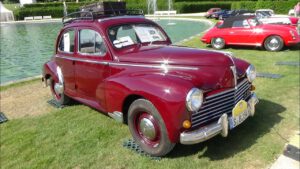
1954 Peugeot 203 – Oldtimer-Meeting Baden-Baden 2016
In the early 1950s, Peugeot was rebuilding its identity around a single, carefully developed model. The Peugeot 203 was not designed to impress through excess, but through consistency—combining modern engineering with everyday usability at a time when reliability mattered more than speed.
Technical Details
The 1954 Peugeot 203 was powered by a front-mounted inline four-cylinder engine with a displacement of 1,290 cc. This unit produced approximately 42 horsepower at around 4,500 rpm, delivering modest but dependable performance suited to post-war driving conditions. The engine featured an overhead valve (OHV) configuration, which represented a modern approach compared to many pre-war designs still in circulation during the early 1950s.
Power was transmitted to the rear wheels through a four-speed manual gearbox. Notably, the fourth gear functioned as an overdrive, allowing for more relaxed engine operation at cruising speeds—an advantage on longer journeys. The drivetrain followed a conventional front-engine, rear-wheel-drive layout, emphasizing durability and ease of maintenance.
The Peugeot 203 used a unitary (monocoque) body construction, making it the first Peugeot to adopt this approach. This design improved structural rigidity while reducing weight compared to traditional body-on-frame construction. Suspension consisted of independent front wheels with coil springs and a rigid rear axle supported by coil springs, tuned for comfort and stability. Hydraulic drum brakes were fitted on all four wheels, providing consistent braking performance for the period.
- Manufacturer: Peugeot
- Model name: Peugeot 203
- Year of manufacturing: 1954
Design
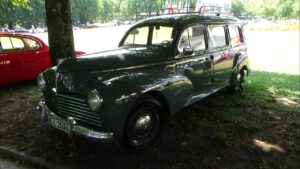
The design of the Peugeot 203 reflected the transition from pre-war styling to a more modern, integrated form. Its body followed the ponton principle, with fenders fully incorporated into the main body structure rather than standing apart as separate elements. This gave the car a smoother and more cohesive appearance.
The front end featured a narrow, vertically oriented grille flanked by rounded headlights integrated into the bodywork. Chrome was used sparingly, emphasizing clarity rather than decoration. The overall proportions were compact yet balanced, with a gently sloping rear that contributed to aerodynamic efficiency.
Inside, the cabin was simple and functional. The dashboard layout was clear and uncluttered, with centrally positioned instrumentation. Materials were chosen for durability rather than luxury, reflecting the car’s role as practical family transport. Large windows provided good visibility and reinforced the sense of openness in the interior.
Historical Significance
The Peugeot 203 was introduced in 1948 as the company’s first entirely new model after the Second World War. At a time when many manufacturers relied on updated pre-war designs, Peugeot committed to a clean-sheet approach, both technically and stylistically.
For several years, the Peugeot 203 was the only model in Peugeot’s lineup, making it central to the company’s recovery and long-term stability. Its adoption of monocoque construction marked a significant step forward in Peugeot engineering, aligning the brand with broader industry trends toward integrated body structures.
Production continued until 1960, with over 680,000 units built. This level of output demonstrated strong demand and confirmed the Peugeot 203’s role as a reliable and accessible car for a wide range of customers. It also laid the groundwork for later models such as the 403 and 404, establishing Peugeot’s reputation for producing durable, technically sound vehicles.
Quirks and Pop Culture
The Peugeot 203 became known for its robustness, particularly in rural and export markets where road conditions were often challenging. Its relatively soft suspension and strong chassis made it well suited to uneven surfaces, contributing to its popularity outside Western Europe.
A notable feature was the long gear lever mounted on the steering column, which freed up space in the front cabin and allowed for a more practical seating arrangement. This configuration was typical of the era but remains a distinctive detail today.
The Peugeot 203 also developed a quiet presence in everyday life rather than in cinema or motorsport. It was widely used as a family car, taxi, and utility vehicle, becoming a familiar part of the post-war European landscape. Its legacy is therefore tied less to specific cultural moments and more to its consistent role in daily mobility.
Display and preservation
This car was filmed at the 40th International Oldtimer-Meeting Baden-Baden. Held from 8 to 10 July 2016, the show transformed the Kurpark into an elegant open-air museum of automotive history. Featuring 376 classic cars spanning nine decades, the event combined concours-level presentation with a uniquely atmospheric setting. Highlights included a special exhibition by Erdmann & Rossi and a tribute to 40 Years of the Golf GTI. As evening fell, nostalgic garden parties with jazz music, fashion shows, and illuminated displays created a refined backdrop, emphasizing both preservation and the living culture of classic motoring.
Conclusion
The 1954 Peugeot 203 illustrates how thoughtful engineering and restrained design can define an entire era. With its overhead-valve engine, monocoque construction, and practical layout, it represented a clear step forward from pre-war automotive concepts. Its design balanced simplicity with modernity, while its historical role ensured Peugeot’s post-war recovery. Rather than standing out through spectacle, the Peugeot 203 earned its place through reliability and longevity, shaping the direction of Peugeot’s future models.