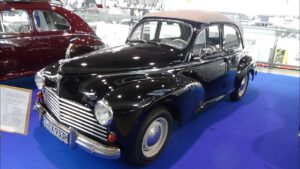
1954 Peugeot 203 C – Retro Classics Stuttgart 2023
By the mid-1950s, the Peugeot 203 C had evolved into a mature and refined version of Peugeot’s first post-war model. Introduced as an update within the successful Peugeot 203 range, the “C” designation signaled incremental improvements rather than a complete redesign. In a market that increasingly valued reliability and usability, the Peugeot 203 C demonstrated how careful refinement could extend the life and relevance of a well-engineered platform.
Technical Details
The Peugeot 203 C retained the core mechanical architecture of the original Peugeot 203 while incorporating detail improvements aimed at durability and drivability. It was powered by a front-mounted inline four-cylinder engine with a displacement of 1,290 cc. Output remained around 42 horsepower, delivered at approximately 4,500 rpm. The engine continued to use a hemispherical combustion chamber design, a relatively advanced feature that contributed to efficient fuel combustion and stable performance.
Power was transmitted to the rear wheels through a four-speed manual gearbox, with the top gear functioning as an overdrive. This setup allowed for more relaxed cruising at higher speeds, reducing engine wear and fuel consumption—important considerations in the 1950s. The car featured a monocoque body construction, which improved structural rigidity and reduced weight compared to earlier body-on-frame designs. Independent front suspension enhanced ride comfort, while hydraulic drum brakes provided consistent and predictable braking performance. These technical elements, while not radical, were well integrated and proven in long-term use.
- Manufacturer: Peugeot
- Model name: Peugeot 203 C
- Year of manufacturing: 1948–1960
Design
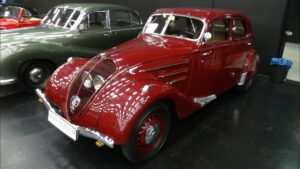
In visual terms, the Peugeot 203 C continued the ponton-style design language introduced with the original Peugeot 203. The body featured smooth, rounded surfaces with integrated fenders, creating a cohesive and modern appearance that contrasted with pre-war styling conventions. By 1954, this design had become familiar, yet it still conveyed a sense of understated modernity.
Subtle updates distinguished the “C” variant from earlier versions. These included minor refinements to trim, detailing, and interior fittings rather than fundamental changes to the body shape. The front grille remained prominent, framed by integrated headlights that contributed to a balanced and harmonious front end. Chrome accents were used sparingly, maintaining a restrained aesthetic.
Inside, the cabin emphasized clarity and practicality. The dashboard layout was straightforward, with clearly arranged instruments and controls. Improvements in materials and finish reflected the gradual economic recovery of the period, offering a slightly more refined environment compared to earlier post-war examples. The overall design approach prioritized usability and durability over visual excess.
Historical Significance
The Peugeot 203 C represents a key phase in the lifecycle of the Peugeot 203, a model that played a central role in Peugeot’s post-war recovery. By the time the “C” variant was introduced in 1954, the Peugeot 203 had already established itself as a reliable and widely accepted vehicle across European markets. Rather than replacing the model, Peugeot chose to refine it, ensuring that it remained competitive in a rapidly evolving automotive landscape.
This strategy proved effective. The Peugeot 203 continued to sell strongly throughout the 1950s, eventually reaching a total production of over 680,000 units by the end of its run in 1960. The car’s success allowed Peugeot to stabilize and grow during a crucial period, laying the groundwork for subsequent models such as the Peugeot 403. The Peugeot 203 C, as a mid-cycle evolution, illustrates how manufacturers of the era balanced innovation with continuity, improving existing designs rather than introducing entirely new ones at short intervals.
Quirks and Pop Culture
The Peugeot 203, including the Peugeot 203 C variant, became a familiar presence in everyday European life during the 1950s. Its reputation for reliability made it popular among a wide range of users, from private owners to professional drivers. In France and other markets, it was commonly used as a taxi and as a commercial vehicle in estate and pickup configurations.
One of the enduring technical curiosities of the model was its hemispherical combustion chamber, a feature more commonly associated with higher-performance engines. In the context of the Peugeot 203, it contributed to efficiency and longevity rather than outright power, reflecting Peugeot’s engineering priorities. While the Peugeot 203 C did not become a pop culture icon in the cinematic sense, it remains strongly associated with the period of post-war reconstruction and economic normalization, serving as a visual marker of everyday mobility in 1950s Europe.
Display and preservation
This car was filmed at the Retro Classics Stuttgart 2023. From 23 to 26 February, more than 82,000 visitors explored seven packed halls covering 105,000 square meters, showcasing the full spectrum of historic mobility. International dealers, restoration experts, and dedicated clubs created a rich and immersive atmosphere, complemented by a lively parts market and vehicle sales exchange. Highlights included special exhibitions celebrating the 60th anniversary of the Porsche 911 and 75 years of Porsche, alongside themed displays of American classics and vibrant club presentations.
Conclusion
The 1954 Peugeot 203 C stands as a refined iteration of one of Peugeot’s most important models. Technically consistent yet thoughtfully improved, it combined an efficient engine, robust construction, and practical engineering solutions. Its design maintained a modern, cohesive appearance, while its continued production success underscored the strength of the original concept. As part of the broader Peugeot 203 story, the Peugeot 203 C illustrates how incremental development and reliability could sustain a model’s relevance in a changing automotive landscape.