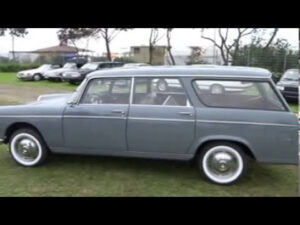
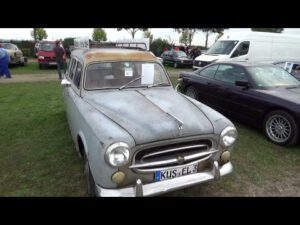
1954 – Peugeot 203 C – Retro Classics Stuttgart 2015
In the mid-1950s, Peugeot refined its first post-war success rather than replacing it outright. The Peugeot 203 C represents the mature stage of a model that had already proven its reliability across Europe and export markets. By 1954, the Peugeot 203 had evolved into a well-developed, dependable car shaped as much by gradual improvement as by original design.
Technical Details
The Peugeot 203 C was powered by a front-mounted inline four-cylinder engine with a displacement of 1,290 cc. This unit featured an overhead valve (OHV) configuration and produced approximately 42 horsepower at around 4,500 rpm. Power was transmitted to the rear wheels through a four-speed manual gearbox, with the fourth gear acting as an overdrive—an advanced feature for its class that improved fuel efficiency and reduced engine wear at cruising speeds.
The drivetrain followed a conventional front-engine, rear-wheel-drive layout. The chassis used a unitary construction, a relatively modern approach for the late 1940s and early 1950s, contributing to structural rigidity and reduced weight. Suspension consisted of independent front wheels with a transverse leaf spring, while the rear featured a rigid axle supported by longitudinal leaf springs. Braking was handled by drum brakes on all four wheels. The car reached a top speed of approximately 115–120 km/h, depending on specification.
- Manufacturer: Peugeot
- Model name: Peugeot 203 C
- Year of manufacturing: 1948–1960
Design
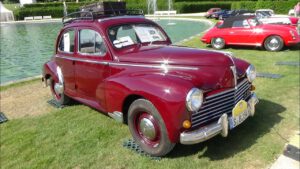
The design of the Peugeot 203 C reflected aerodynamic influences that were still present in early post-war automotive styling. The body featured rounded, flowing lines with integrated fenders, giving it a cohesive and modern appearance compared to pre-war vehicles. The front end was characterized by a prominent grille with horizontal bars and large, rounded headlamps integrated into the body.
The silhouette was defined by a gently sloping roofline and a relatively narrow body, typical of European cars of the period. Chrome detailing was used sparingly, emphasizing function rather than ornamentation. Compared to later, more angular designs, the Peugeot 203 retained a soft, almost organic visual identity.
Inside, the cabin was simple and practical. The dashboard layout was uncluttered, with essential instrumentation and straightforward controls. Materials were chosen for durability, reflecting the car’s role as a reliable everyday vehicle rather than a luxury product.
Historical Significance
The Peugeot 203 was introduced in 1948 as Peugeot’s first entirely new model after the Second World War. It played a crucial role in re-establishing the company’s production capacity and market presence during a period of economic recovery. By the time the Peugeot 203 C appeared, the model had already achieved strong sales and a solid reputation.
The Peugeot 203 became Peugeot’s first car to be produced in large volumes after the war, with total production exceeding 680,000 units. It was also widely exported, particularly to regions where durability and ease of maintenance were essential. The “C” designation reflected ongoing refinements rather than a complete redesign, illustrating Peugeot’s strategy of continuous improvement.
The model’s success laid the foundation for later vehicles such as the Peugeot 403, which would build on its engineering principles while introducing more modern styling and increased performance.
Quirks and Pop Culture
The Peugeot 203 C is less associated with specific media appearances than with its reputation as a dependable, long-lasting vehicle. It became a common sight on European roads in the 1950s, often used by families, tradespeople, and professionals.
One notable technical quirk is the inclusion of an overdrive fourth gear, which was not standard in many cars of its class at the time. This feature contributed to its efficiency and made it well suited to longer journeys. The model’s widespread export also meant that it became part of everyday life in various regions outside Europe, reinforcing its image as a robust and adaptable car.
Today, the Peugeot 203 is appreciated in classic car circles for its balance of simplicity and engineering thoughtfulness. Surviving examples, including the Peugeot 203 C, are often restored and displayed as representatives of early post-war automotive design.
Display and preservation
This car was filmed at the Retro Classics Stuttgart 2015, held from March 26 to 29. The show set new standards with an expanded 120,000 square meters of exhibition space. A total of 1,430 exhibitors and more than 87,000 visitors filled eight halls, creating a vibrant marketplace where nearly half of attendees made purchases. Strong presences from Mercedes-Benz and Porsche added prestige, with Porsche unveiling rare prototypes. Special displays ranged from BMW M5 anniversaries to American classics with roaring V8 engines.
Conclusion
The 1954 Peugeot 203 C represents the fully developed form of Peugeot’s first major post-war model. Its modest but reliable engine, rear-wheel-drive layout, and practical construction made it a dependable choice for a wide range of users. The design retained the flowing lines of early post-war styling, while its historical role established Peugeot’s path toward larger-scale production and export success. As a result, the Peugeot 203 C remains an important reference point in the brand’s mid-20th-century development.