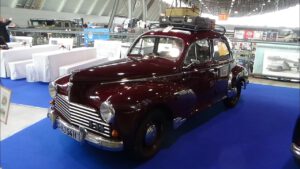
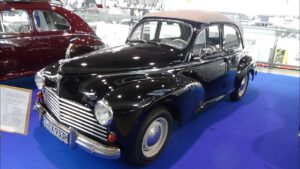
1954 Peugeot 203 A – Oldtimer-Meeting Baden-Baden 2021
In the early 1950s, the Peugeot 203 A was more than a family saloon—it was a symbol of industrial recovery in postwar France. Solid, economical, and technically modern for its time, it became the foundation on which Peugeot rebuilt its reputation. By 1954, the model had matured into a dependable mainstay of French roads.
Technical Details:
The 1954 Peugeot 203 A was powered by a front-mounted inline four-cylinder engine with a displacement of 1,290 cc. This overhead-valve unit produced approximately 42–45 horsepower, depending on specification and market. The engine was designed for durability and efficiency rather than outright performance, delivering steady torque suitable for both urban driving and longer regional journeys.
Power was transmitted to the rear wheels through a four-speed manual gearbox, operated via a column-mounted shift lever in many versions. The drivetrain followed the conventional front-engine, rear-wheel-drive layout common in European family cars of the period.
A notable technical feature of the Peugeot 203 was its monocoque construction. Unlike many prewar designs that relied on separate chassis frames, the 203 used a self-supporting steel body, contributing to improved rigidity and reduced weight. Independent front suspension combined with a live rear axle ensured predictable road manners, while hydraulic drum brakes were fitted on all four wheels. Top speed was typically around 115 km/h (approximately 70 mph), aligning the 203 A with other mid-sized European saloons of the early 1950s.
- Manufacturer: Peugeot
- Model Name: Peugeot 203 A
- Year of Manufacturing: 1954
Design:
The Peugeot 203 introduced a modern ponton-style body when it debuted in 1948, and by 1954 the design remained distinctive yet familiar. The integrated fenders, smooth body sides, and gently rounded roofline gave the car a cohesive appearance that contrasted sharply with prewar styling conventions.
At the front, a narrow vertical grille flanked by round headlamps established a restrained yet recognizable face. Chrome trim was used sparingly, emphasizing practicality over ornamentation. The proportions were balanced rather than dramatic, reflecting the 203’s role as a family car rather than a prestige vehicle.
Inside, the cabin offered a simple but thoughtfully arranged layout. A painted metal dashboard housed centrally positioned instruments, and bench seating in some configurations allowed for flexible passenger accommodation. The interior prioritized durability and ease of use, consistent with Peugeot’s engineering philosophy. The 203 A was available not only as a four-door saloon but also in estate (Break), commercial, and cabriolet versions, highlighting the versatility of the platform.
Historical Significance:
When the Peugeot 203 was launched in 1948, it was Peugeot’s first entirely new postwar design. France’s automotive industry had suffered heavily during World War II, and the 203 played a central role in reestablishing Peugeot as a major manufacturer. By the mid-1950s, the model had become the company’s core product.
The 1954 Peugeot 203 A represents a mature phase in the model’s development. Continuous refinements improved reliability and comfort without altering the fundamental concept. The car gained a reputation for mechanical robustness and fuel efficiency, qualities that made it popular not only in France but also in export markets.
Production of the 203 continued until 1960, with nearly 700,000 units built. Its success laid the groundwork for its successor, the Peugeot 403, and established a template for Peugeot’s future mid-sized saloons.
Quirks and Pop Culture:
The Peugeot 203 became a familiar sight in French towns and countryside alike. It was widely used as a family car, taxi, and even light commercial vehicle, contributing to its strong association with everyday postwar life.
One distinctive design element was the lion emblem mounted prominently on the hood, a traditional Peugeot symbol that reinforced brand identity. The car’s rounded, almost aerodynamic silhouette earned it a reputation for modernity in the late 1940s and early 1950s, even if by 1954 newer models were beginning to adopt sharper lines.
In French cinema and period photography, the 203 frequently appears as background transportation, representing normality and economic recovery rather than glamour. Its understated character has since made it a cherished example of mid-century European automotive design.
Display and preservation:
The vehicle was exhibited at the Oldtimer-Meeting Baden-Baden in 2021. This event, held annually in the spa town’s Kurpark and along the Kaiserallee, is one of Germany’s most picturesque classic car gatherings. In 2021, the 44th edition featured 300 vintage vehicles from 80 different brands, including rare models. The event embraced a 1970s theme, showcasing over 40 vehicles from that era. An innovative highlight was the “automobile fashion show,” where models presented current fashion trends while riding in open-top classic cars through the park. The event concluded with the traditional Concours d’élégance, awarding 120 prizes across 15 categories.
Conclusion:
The 1954 Peugeot 203 A stands as a cornerstone of Peugeot’s postwar resurgence. With its 1.3-litre overhead-valve engine, monocoque construction, and practical design, it combined modern engineering with everyday usability. More than simply a family saloon, the 203 A symbolized stability and progress in 1950s France. Its strong production numbers and lasting reputation for reliability ensure its continued recognition as one of Peugeot’s most important mid-century models.