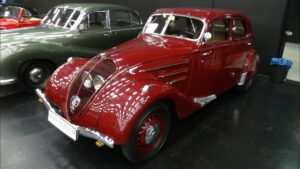
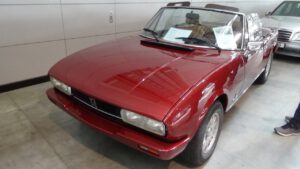
1954 Jaguar XK 120 – Exterior and Interior – Retro Classics Stuttgart 2022
By 1954, the Jaguar XK 120 was no longer a sensation but an established benchmark. What began as a showcase for a new engine had become a fully developed sports car line, refined through production experience and competition exposure. The surprise had faded; the performance remained.
Technical Details:
The 1954 Jaguar XK 120 was powered by Jaguar’s 3.4-liter dual overhead camshaft (DOHC) inline six-cylinder engine, producing approximately 160 horsepower in standard specification. The advanced aluminum cylinder head design allowed for efficient breathing and relatively high engine speeds compared to many contemporaries.
Fuel was delivered via twin SU carburetors, and power was transmitted to the rear wheels through a four-speed manual gearbox, often equipped with optional overdrive for improved long-distance cruising. The drivetrain retained a front-engine, rear-wheel-drive configuration.
The XK 120 utilized a separate ladder-frame chassis, paired with independent front suspension using torsion bars and a rear live axle supported by semi-elliptic leaf springs. Hydraulic drum brakes were fitted on all four wheels.
By 1954, production had transitioned from early alloy-bodied examples to predominantly steel body construction, improving durability while slightly increasing weight. Despite this, the car maintained a top speed close to its advertised 120 mph (approximately 193 km/h) under favorable conditions.
- Manufacturer: Jaguar Cars
- Model Name: Jaguar XK 120
- Year of Manufacturing: 1954
Design:
The 1954 XK 120 retained the flowing proportions that defined the model since its introduction in 1948. The long bonnet, integrated headlamps, and oval grille formed a cohesive and aerodynamic front profile.
The car was available in multiple body styles: the Open Two Seater (OTS), the Fixed Head Coupé (FHC), and the Drophead Coupé (DHC). Each configuration preserved the essential silhouette while offering varying levels of weather protection and refinement.
Chrome detailing was restrained, emphasizing elegance rather than excess. Wire wheels were commonly specified, reinforcing the sporting image.
Inside, the cabin reflected Jaguar’s blend of craftsmanship and functionality. A wood-veneer dashboard housed large, centrally mounted instruments. Leather upholstery and fitted carpeting enhanced comfort without diminishing the car’s performance character.
Historical Significance:
The Jaguar XK 120 played a critical role in establishing Jaguar as a global sports car manufacturer. By 1954, it had achieved considerable success in international markets, particularly in North America.
The model’s 3.4-liter DOHC engine became one of the most influential British powerplants of its era. It would later power the XK 140, XK 150, and Jaguar’s successful racing cars, including the C-Type and D-Type.
The XK 120 also demonstrated that high-speed performance could be offered at a comparatively accessible price, broadening the appeal of British sports cars during the early postwar period.
Quirks and Pop Culture:
The XK 120 has frequently appeared in mid-century motoring imagery as a symbol of refined performance. Its design combined traditional British styling with modern engineering, giving it cross-generational appeal.
One notable distinction among collectors is the difference between early alloy-bodied cars and later steel-bodied examples. While visually similar, the construction materials contribute to variations in weight and rarity.
Today, the 1954 XK 120 remains highly regarded for its balance of speed, elegance, and mechanical sophistication.
Display and preservation:
The vehicle was exhibited at the Retro Classics Stuttgart in 2022. This car show is one of the major events on the classic car calendar in Germany. In 2022, it took place across five exhibition halls. Visitors can enjoy special showcases, hunt for rare parts and books, and buy cars—both private sellers and dealers offer a wide range of classic and youngtimer vehicles. In 2022, there was a noticeable increase in low-mileage youngtimers and classic cars.
Conclusion:
The 1954 Jaguar XK 120 represents the mature phase of one of Britain’s most significant postwar sports cars. With its 3.4-liter DOHC inline six, separate chassis construction, and elegant proportions, it combined performance credibility with refined design. No longer a newcomer by 1954, the XK 120 had become a standard against which other sports cars were measured—solidifying Jaguar’s place in automotive history.