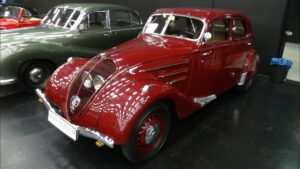
1954 Jaguar XK 120 OTS – Exterior and Interior – Auto Zürich Classic Car Show 2022
Wind, engine note, and a long bonnet stretching ahead—this is how the Jaguar XK 120 OTS is best understood. In 1954, the Open Two Seater remained the most direct expression of Jaguar’s early postwar sports car philosophy. It offered speed without insulation and refinement without excess weight.
Technical Details:
The 1954 Jaguar XK 120 OTS was powered by Jaguar’s 3.4-liter dual overhead camshaft (DOHC) inline six-cylinder engine, producing approximately 160 horsepower in standard specification. The aluminum cylinder head and hemispherical combustion chambers allowed for efficient airflow and sustained high-speed operation.
Twin SU carburetors supplied the fuel-air mixture, and power was transmitted to the rear wheels through a four-speed manual transmission, with optional overdrive available. The drivetrain retained a front-engine, rear-wheel-drive layout, contributing to balanced weight distribution.
The car utilized a separate ladder-frame chassis, paired with independent front suspension using torsion bars and a rear live axle supported by semi-elliptic leaf springs. Hydraulic drum brakes were fitted on all four wheels.
By 1954, most XK 120 OTS models featured steel body construction rather than the earlier aluminum panels. Despite the slight weight increase, the car was capable of approaching its advertised 120 mph (approximately 193 km/h) top speed under suitable conditions.
- Manufacturer: Jaguar Cars
- Model Name: Jaguar XK 120 OTS (Open Two Seater)
- Year of Manufacturing: 1954
Design:
The XK 120 OTS featured a minimalist roadster body that emphasized its sporting intent. The long bonnet, flowing fenders, and low seating position created a balanced and aerodynamic profile.
The oval grille and faired-in headlamps defined the front, while the gently curved rear deck maintained visual cohesion. The OTS configuration included a lightweight folding soft top and detachable side screens instead of roll-up windows, underscoring its focus on performance rather than weather protection.
By 1954, the windscreen was typically a single curved piece rather than the earlier split design, improving visibility and modernizing the appearance.
Inside, the cabin combined sporting function with traditional craftsmanship. A wood-veneered dashboard housed clear, centrally mounted gauges. Leather upholstery and simple trim reinforced the car’s dual identity as both a driver’s machine and a refined British sports car.
Historical Significance:
The Jaguar XK 120 OTS played a central role in building Jaguar’s international reputation. Introduced in 1948 as a demonstration of the new XK engine, it quickly gained recognition for combining advanced engineering with competitive pricing.
By 1954, the model had proven itself in competition and endurance events, reinforcing its credibility. Export sales, particularly to North America, were strong, helping Jaguar expand beyond its domestic market.
The 3.4-liter DOHC engine would continue to power Jaguar’s sports and racing models for years, making the XK 120 OTS a foundational vehicle in the company’s performance lineage.
Quirks and Pop Culture:
The XK 120 OTS is often regarded as the purest expression of the XK 120 family. Compared with the more refined Drophead Coupé, the OTS offered a more immediate and unfiltered driving experience.
One notable distinction among collectors is the transition from aluminum to steel body panels, which occurred during production. While visually similar, early alloy-bodied cars are rarer and particularly sought after.
Today, the XK 120 OTS remains one of the most recognizable British roadsters of the early 1950s, valued for its combination of elegance and genuine high-speed capability.
Display and preservation:
The vehicle was exhibited at the Auto Zürich Classic Car Show in 2022. The 35th edition of Auto Zürich is Switzerland’s leading automotive trade fairs, traditionally hosting numerous world and Swiss premieres. Since 2019, Hall 6 has been exclusively dedicated to classic automobiles, providing a distinguished setting for historic vehicles, while the majority of the exhibition space remained focused on modern mobility solutions. The classic cars presented at Auto Zürich were of remarkably high quality. With approximately 60,000 visitors, Auto Zürich Classic was first introduced in 2019. In 2022, a special exhibition celebrated Ferrari’s 75th anniversary, showcasing more than a dozen Ferrari models.
Conclusion:
The 1954 Jaguar XK 120 OTS represents the distilled essence of Jaguar’s early sports car success. With its 3.4-liter DOHC inline six, separate chassis construction, and lightweight open body, it delivered both performance and refinement in equal measure. By the mid-1950s, it had matured into a proven and respected sports car—one that helped define Jaguar’s enduring identity.