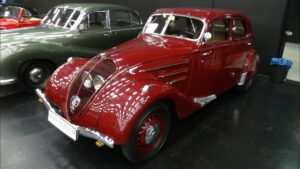
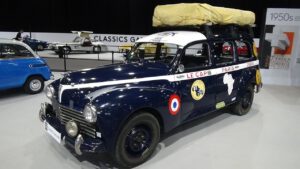
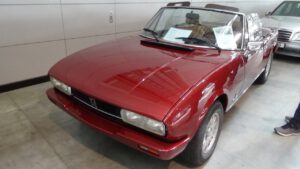
1953 Jaguar XK 120 OTS – Oldtimer-Meeting Baden-Baden 2021
120 miles per hour: printed in the name and tested on open roads. When the Jaguar XK 120 was introduced, its claimed top speed immediately became its defining statement. By 1953, the Open Two Seater (OTS) version had already established itself as one of the fastest production sports cars in the world.
Technical Details:
The 1953 Jaguar XK 120 OTS was powered by Jaguar’s 3.4-liter inline six-cylinder engine, featuring dual overhead camshafts (DOHC). This advanced cylinder head design allowed for efficient breathing and higher revving capability compared to conventional pushrod engines of the era.
In standard form, the engine produced approximately 160 horsepower, delivered through twin SU carburetors. Power was transmitted to the rear wheels via a four-speed manual transmission, with optional overdrive available for extended cruising.
The XK 120 employed a separate chassis frame, combined with independent front suspension using torsion bars and a rear live axle supported by semi-elliptic leaf springs. Hydraulic drum brakes were fitted on all four wheels.
The car’s relatively lightweight construction and aerodynamic body allowed it to reach speeds approaching 120 mph (approximately 193 km/h) under test conditions, justifying its designation. Acceleration was strong for its time, and the DOHC engine would go on to power Jaguar sports and racing cars for years.
- Manufacturer: Jaguar Cars
- Model Name: Jaguar XK 120 OTS (Open Two Seater)
- Year of Manufacturing: 1953
Design:
The XK 120 OTS featured flowing lines and a low-slung stance that emphasized performance. The long bonnet accommodated the 3.4-liter engine, while the short rear deck contributed to balanced proportions.
The front end incorporated a wide oval grille flanked by faired-in headlamps. Early models featured a split windscreen, though by 1953 many examples had adopted a single-piece curved windscreen for improved visibility and refinement.
The OTS configuration emphasized minimalism. A simple folding soft top and detachable side screens provided weather protection when needed, but the car was clearly designed for open-air driving.
Inside, the cabin combined sporting purpose with traditional British craftsmanship. A wood-veneered dashboard housed clear, centrally positioned gauges. Leather upholstery and simple trim reflected the car’s dual identity as both performance machine and grand touring roadster.
Historical Significance:
The Jaguar XK 120 played a crucial role in establishing Jaguar’s international reputation. Introduced in 1948 as a showcase for the new XK engine, it quickly gained recognition for both speed and value.
By 1953, the model had achieved success in competition, including endurance events and rallying. Its performance credentials reinforced Jaguar’s sporting identity and supported export growth, particularly in North America.
The DOHC XK engine became one of the most enduring powerplants in British automotive history, forming the foundation for later models such as the XK 140, XK 150, and even Jaguar’s racing C-Type and D-Type cars.
Quirks and Pop Culture:
The XK 120 OTS has appeared frequently in period photography and film as a symbol of early-1950s sporting elegance. Its long bonnet and low profile made it instantly recognizable.
One notable feature is how closely its real-world performance matched its marketing claim—an unusual achievement in an era when advertised speeds were often optimistic.
Today, the XK 120 OTS is widely regarded as one of the defining British sports cars of the postwar period. Early alloy-bodied examples are particularly valued among collectors.
Display and preservation:
The vehicle was exhibited at the Oldtimer-Meeting Baden-Baden in 2021. This event, held annually in the spa town’s Kurpark and along the Kaiserallee, is one of Germany’s most picturesque classic car gatherings. In 2021, the 44th edition featured 300 vintage vehicles from 80 different brands, including rare models. The event embraced a 1970s theme, showcasing over 40 vehicles from that era. An innovative highlight was the “automobile fashion show,” where models presented current fashion trends while riding in open-top classic cars through the park. The event concluded with the traditional Concours d’élégance, awarding 120 prizes across 15 categories.
Conclusion:
The 1953 Jaguar XK 120 OTS combined advanced engineering with elegant design to create one of the fastest production sports cars of its time. Powered by a 3.4-liter DOHC inline six and shaped by aerodynamic principles, it helped secure Jaguar’s global reputation. More than a marketing statement, the XK 120 proved that performance and refinement could coexist in a road-going sports car.