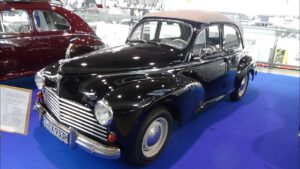
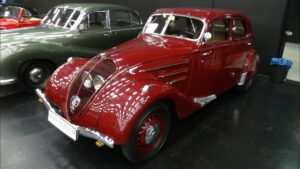
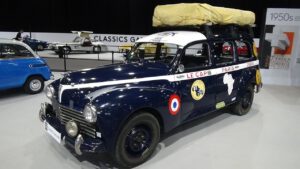
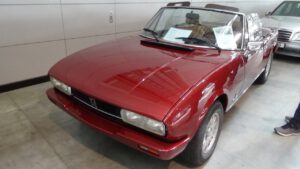
1953 Jaguar MK VII – Auto Zürich Classic Car Show 2021
A large four-door saloon winning international rallies was not the norm in 1953. Yet the Jaguar Mk VII combined polished wood interiors with genuine performance credentials, challenging assumptions about what a luxury sedan could accomplish. It was as capable on a competitive stage as it was in formal settings.
Technical Details:
The 1953 Jaguar Mk VII was powered by Jaguar’s renowned 3.4-liter inline six-cylinder engine, featuring dual overhead camshafts (DOHC). Derived from the XK sports car engine, it produced approximately 160 horsepower in Mk VII specification.
Fuel delivery was managed by twin SU carburetors, and power was transmitted to the rear wheels via a four-speed manual transmission, with optional overdrive available. The combination of advanced valve train design and efficient combustion allowed the Mk VII to achieve strong acceleration for a vehicle of its size.
The car employed a separate chassis frame construction, rather than a monocoque body. Independent front suspension with torsion bars provided improved handling characteristics compared to many contemporaries, while the rear featured a live axle supported by semi-elliptic leaf springs.
Hydraulic drum brakes were fitted on all four wheels. Despite its substantial dimensions, the Mk VII was capable of reaching speeds approaching 160 km/h, making it one of the faster luxury saloons of its era.
- Manufacturer: Jaguar Cars
- Model Name: Jaguar Mk VII
- Year of Manufacturing: 1953
Design:
The Jaguar Mk VII presented a commanding yet elegant silhouette. Its upright grille, flanked by integrated headlamps, echoed Jaguar’s sports car lineage while adapting it to a formal saloon format.
The body featured flowing fender lines and a long bonnet that hinted at the engine’s capabilities beneath. Chrome detailing was restrained compared to American luxury cars of the same period, reinforcing British understatement.
Inside, the Mk VII emphasized craftsmanship. The dashboard and interior panels were finished in polished wood veneer, complemented by leather upholstery and wool carpeting. The cabin layout combined traditional British luxury elements with modern instrumentation.
The overall design balanced authority and refinement, avoiding excess while projecting presence.
Historical Significance:
The Jaguar Mk VII marked Jaguar’s return to large saloon production after the Second World War. It quickly established itself as a competitive and prestigious model within the British automotive market.
In 1953, the Mk VII achieved notable success in rally competition, including victory in the Monte Carlo Rally, demonstrating that a full-sized luxury sedan could compete effectively against lighter, smaller cars.
The model helped solidify Jaguar’s reputation for combining performance engineering with traditional luxury appointments. It also expanded the company’s export presence, particularly in North America.
Quirks and Pop Culture:
The Jaguar Mk VII’s rally success remains one of its most distinctive historical points. Its competitive achievements challenged expectations about the limitations of large saloons.
Visually, the car’s upright grille and substantial proportions have become emblematic of early-1950s British executive motoring. It frequently appears in period films and television productions set in postwar Britain.
Today, the Mk VII is appreciated for its blend of advanced engineering and handcrafted interior detail. Its dual identity—luxury saloon and rally competitor—continues to attract enthusiasts.
Display and preservation:
The vehicle was exhibited at the Auto Zürich Classic Car Show in 2021. As part of the broader Auto Zürich Car Show, the Classic section has grown into a key attraction for lovers of historic vehicles in Switzerland. In 2021, the event took place at Messe Zürich and featured a dedicated hall showcasing a curated selection of vintage automobiles, spanning from pre-war icons to youngtimers. The atmosphere combined elegance with accessibility, allowing visitors to admire rare collector cars alongside enthusiast vehicles. Special displays highlighted Swiss automotive heritage and featured club presentations and dealer exhibits.
Conclusion:
The 1953 Jaguar Mk VII represents a distinctive convergence of performance and prestige. Powered by a 3.4-liter DOHC inline six and housed within a traditionally styled saloon body, it demonstrated that engineering sophistication need not be confined to sports cars. Its rally achievements and export success cemented its place as one of Jaguar’s defining postwar models.