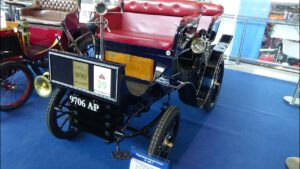
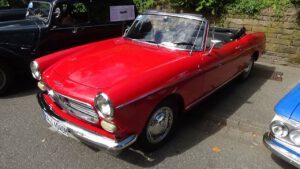
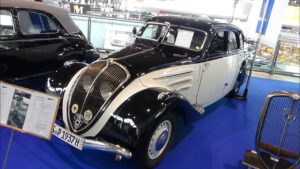
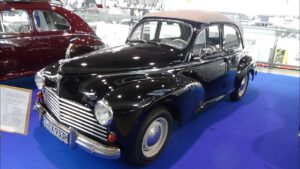
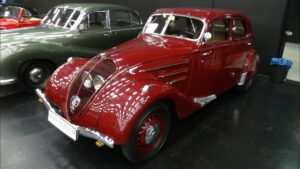
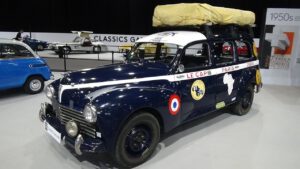
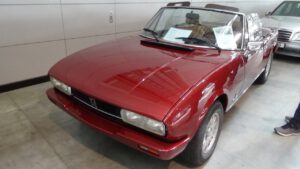
1952 Bentley Speed 8 – Exterior and Interior – Classic Expo Salzburg 2021
By 1952, some Bentleys were moving forward by looking backward. The Bentley Speed 8 did not originate from post-war design thinking but from one of the largest and most ambitious engines Bentley had ever built. Reworked for speed rather than ceremony, it represented a deliberate return to mechanical excess.
Technical Details:
The Bentley Speed 8 was a Special, typically constructed around the formidable Bentley 8-Litre inline six-cylinder engine, originally introduced at the end of the 1920s. With a displacement of 7,983 cc, the engine was among the largest fitted to any European passenger car of its era. In Speed 8 configuration, the engine was often rebuilt, lightened, and tuned for competition or high-speed road use, though exact specifications varied depending on builder and purpose.
The engine employed an overhead camshaft and four valves per cylinder, a sophisticated layout that emphasized torque, breathing efficiency, and mechanical robustness. Power output in Special form was not standardized, but substantially exceeded that of original touring specifications. The focus was on sustained high-speed running rather than peak power figures.
Power was delivered to the rear wheels via a four-speed manual gearbox, frequently paired with revised final-drive ratios to suit racing or fast road use. The chassis was a large steel ladder frame, originally designed to support heavy luxury bodies but well suited to modification once stripped of excess weight.
Suspension generally retained rigid axles with semi-elliptic leaf springs, sometimes reworked with revised damping and spring rates. Braking was by large mechanical or hydraulically assisted drum brakes, often upgraded to cope with higher speeds. The mechanical character of the Speed 8 emphasized stability, momentum, and endurance rather than agility.
- Manufacturer: Bentley
- Model Name: Bentley Speed 8
- Year of Manufacturing: 1952 (Special, non-series construction)
Design:
Design in the Bentley Speed 8 was secondary to proportion and function. Most examples featured open two-seat or single-seat bodies, constructed in aluminum and shaped to reduce weight and frontal area. Long bonnets were unavoidable, dictated by the sheer length of the 8-Litre engine, and became a defining visual feature.
Radiator grilles generally retained Bentley’s upright form but were often reduced in size or subtly reshaped for airflow efficiency. Cycle wings, exposed suspension components, and minimal windscreens were common. The overall appearance was purposeful rather than decorative, with visual mass balanced by stripped detailing.
Interiors were sparse. Seating was basic, instrumentation minimal, and comfort secondary to access and visibility. Unlike post-war luxury Bentleys, the Speed 8’s cabin communicated intent rather than refinement. Every surface reflected the car’s mechanical priority.
Historical Significance:
The Bentley Speed 8 occupies a unique position in Bentley history. Built decades after the original 8-Litre ceased production, it represents a post-war revival of pre-war ambition, carried forward by private individuals rather than the factory.
During the early 1950s, large-capacity engines were increasingly uncommon in European competition. Fuel costs, taxation, and changing engineering philosophies favored smaller, lighter cars. Against this backdrop, the Speed 8 stood apart—not as a modern solution, but as an assertion that scale and torque still had relevance.
These Specials allowed the Bentley 8-Litre to demonstrate qualities it rarely showed in its original limousine form: speed, endurance, and mechanical resilience under stress. In doing so, they preserved the reputation of Bentley’s largest engine at a time when the company itself had shifted firmly toward refined saloons.
Quirks and Pop Culture:
The Bentley Speed 8 has never been widely known outside specialist circles. Its rarity, scale, and non-standardized nature limit its presence in popular media, but they also contribute see it as a spectacle of engineering excess.
One notable quirk is usability. Despite its size, many Speed 8 Specials proved surprisingly capable over long distances, provided roads allowed momentum. Their presence at historic racing events often draws attention not through noise or flamboyance, but through sheer physical presence.
Collectors and historians value Speed 8s less for polish and more for authenticity. Each example reflects a specific philosophy: to extract performance from a platform originally built for authority rather than speed.
Display and preservation:
The vehicle was exhibited at the Classic Expo Salzburg in 2021. As one of Austria’s premier classic car events, the show has established itself as a central meeting point for collectors, restorers, and enthusiasts from across Central Europe. The 2021 edition took place at Messezentrum Salzburg and featured more than 250 exhibitors, along with a strong turnout of over 20,000 visitors. Attendees could explore a broad range of offerings—from historical vehicles and motorcycles to automobilia, spare parts, and literature.
Conclusion:
The 1952 Bentley Speed 8 stands apart from most post-war Bentleys. Rooted in pre-war engineering yet reinterpreted for a different era, it embodies a mechanical philosophy that favored displacement, torque, and endurance over finesse. As a Special, it resists uniform definition, but its intent is clear. The Speed 8 was not about modernization—it was about proving that Bentley’s most ambitious engine could still command respect long after its original purpose had passed.