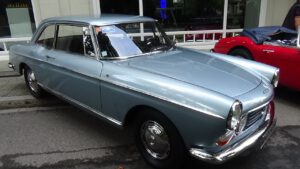
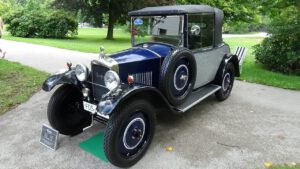
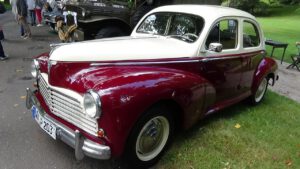
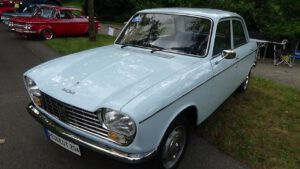
1951 Lancia Aurelia B 50 Convertible – Exterior and Interior – Oldtimer-Meeting Baden-Baden 2022
The Lancia Aurelia range was introduced in 1950 as Lancia’s most ambitious post-war passenger car line and remained in production until 1958. It represented a clear statement of intent: technical innovation would be central to Lancia’s identity in the rebuilding years after World War II. Within this context, the B50 occupied a specific and important niche.
Technical Details:
The Lancia Aurelia B50 was part of a technically advanced model family that redefined drivetrain and chassis engineering in the early 1950s. At its core was Lancia’s newly developed V6 engine, a landmark in automotive history as the first V6 produced in true industrial series. In the B50’s early configuration, this was a 1.8-liter V6 producing 57 PS at 4,700 rpm. The engine was mounted at the front, but unlike conventional layouts of the time, power was transmitted via a driveshaft to a rear-mounted transaxle, where the gearbox and differential were combined into a single unit. This “transaxle” construction significantly improved weight distribution and contributed to balanced handling and stability.
The rear suspension further underlined the Aurelia’s technical ambition. Its independent rear suspension with semi-trailing arms was a world first in 1950, preceding similar solutions in German passenger cars by nearly a decade. Inboard rear brakes, mounted near the differential rather than at the wheels, reduced unsprung mass and improved ride quality. The chassis supported rear-wheel drive and was engineered to work as a cohesive system rather than a collection of separate components. The B50 was offered as an “autotelaio,” a rolling chassis supplied to external coachbuilders, and it was tied specifically to the early 1.8-liter phase of Aurelia production. Later increases in displacement to 2.0 and 2.3 liters, and outputs up to 85 PS, belonged to subsequent variants rather than the original B50 specification.
- Manufacturer: Lancia
- Model name: Lancia Aurelia B50 Convertible
- Year of manufacturing: 1950-1957
Design:
In visual terms, the Aurelia defined what Italian premium middle-class motoring looked like in the 1950s. Even in chassis form, its proportions suggested elegance and restraint rather than excess. The B50 Convertible, typically bodied by Pinin Farina, translated this engineering base into an open, luxury-leaning grand touring car. Italian specialist sources consistently describe these cars as refined four-seater cabriolets, aimed at customers who valued sophistication over ostentation.
The exterior design balanced flowing lines with a sense of structural clarity. A long hood, clean flanks, and carefully integrated bumpers gave the car a poised stance, while generous glass areas emphasized openness and light. Inside, the emphasis was on comfort and craftsmanship rather than decoration for its own sake. The layout reflected Lancia’s tradition of technical rationality paired with understated elegance. As part of the wider Aurelia program, the B50 also served as a foundation for other exclusive open and closed bodies by coachbuilders such as Vignale and Ghia, reinforcing its role as the “outside-coachbuilt” expression of the Aurelia concept.
Historical Significance:
The Lancia Aurelia range was introduced in 1950 as Lancia’s most ambitious post-war passenger car line and remained in production until 1958. It represented a clear statement of intent: technical innovation would be central to Lancia’s identity in the rebuilding years after World War II. Within this context, the B50 occupied a specific and important niche. Alongside the launch of the Aurelia B10 sedan, Lancia deliberately offered special chassis for external coachbuilders, designated B50 and B51, with the B50 intended for lighter, more elegant bodies.
This strategy allowed Lancia to combine industrial engineering with Italy’s renowned coachbuilding tradition. The Aurelia’s constant evolution—through increases in displacement, power, and performance, culminating in a top speed of around 160 km/h in later versions—kept the model competitive and relevant throughout the decade. Production numbers underline both exclusivity and success: while total Aurelia output reached 12,784 units, only 206 B50 chassis were built, making the B50 Convertible a rare but telling example of Lancia’s broader technical and cultural ambitions.
Quirks and Pop Culture:
Unlike some contemporaries, the Lancia Aurelia B50 is less associated with racing victories or film appearances and more with engineering prestige and connoisseur appeal. Its status as an “autotelaio” has made it particularly interesting to historians and collectors, as no two examples are exactly alike. Each coachbuilt body reflects the interpretation of a specific carrozzeria, turning the B50 into a snapshot of early-1950s Italian design culture. The Aurelia name itself has become shorthand among enthusiasts for advanced engineering done quietly and without spectacle, and the B50 plays a key role in that narrative as the bridge between factory production and bespoke craftsmanship.
Display and preservation:
The vehicle was exhibited at the Oldtimer-Meeting Baden-Baden in 2022. Set in the elegant spa gardens of Baden-Baden, this open-air event is one of Germany’s most atmospheric classic car gatherings. The 2022 edition marked the 46th year of the meeting and featured over 350 carefully selected vintage vehicles from across Europe. With its picturesque backdrop and festive ambiance, the event draws thousands of visitors who stroll among historic automobiles, enjoy live music, and take in themed displays. In 2022, American classics and convertibles were especially well represented, reflecting the event’s continued celebration of both international and domestic automotive heritage.
Conclusion:
The 1951 Lancia Aurelia B50 Convertible encapsulates the dual character of the Aurelia program: advanced, forward-thinking engineering paired with elegant Italian coachbuilding. Its V6 engine, rear transaxle, independent rear suspension, and inboard brakes placed it well ahead of many contemporaries, while its role as a Pinin Farina-bodied open grand tourer added cultural and aesthetic weight. Produced in very limited numbers, the B50 remains an important reference point for understanding how Lancia blended industrial innovation with exclusivity in the early post-war years.