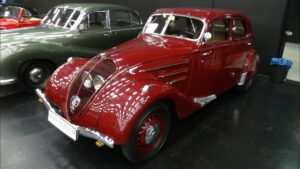
1951 Bentley 3/8 Racer – Exterior and Interior – Classic Expo Salzburg 2021
By the early 1950s, racing Bentleys were no longer factory products but personal projects. The 1951 Bentley 3/8 Racer emerged from this environment, shaped by private ambition rather than corporate strategy. It reflects a moment when Bentley performance lived on through individual interpretation.
Technical Details:
The Bentley 3/8 Racer was not a standardized production model, but a competition-oriented Special, typically based on the Bentley Mark VI chassis and powered by Bentley’s post-war inline six-cylinder engine. The designation “3/8” is commonly used among enthusiasts to describe a modified 4¼-litre (approximately 4.3-litre) Bentley six, often tuned or reworked for competition use rather than standard road specification.
The engine retained Bentley’s characteristic overhead inlet and side exhaust valve (IOE) layout, valued for torque and durability. In racing form, carburation was frequently revised, compression ratios increased, and exhaust systems simplified to improve breathing. Exact power output varied by build and tuning, but the emphasis was on sustained performance rather than peak figures.
Power was transmitted to the rear wheels via a four-speed manual gearbox, often with close-ratio gearing selected for circuit or hill climb use. The chassis remained a separate ladder-frame construction, but unnecessary body structure was removed or replaced with lightweight panels. Suspension typically retained independent front suspension with coil springs and a live rear axle, though spring rates and damping were commonly adjusted for competition.
Braking was by hydraulic drum brakes, sometimes enlarged or modified, reflecting the limitations and ingenuity of privateer engineering in the early 1950s. The result was a car that demanded mechanical sympathy but rewarded commitment with stability and torque-rich acceleration.
- Manufacturer: Bentley
- Model Name: Bentley 3/8 Racer
- Year of Manufacturing: 1951 (Special, non-series construction)
Design:
Design in the Bentley 3/8 Racer was dictated almost entirely by function. Standard Mark VI saloon bodywork was discarded in favor of lightweight, open racing bodies, often hand-formed in aluminum. These bodies typically featured a long bonnet, exposed front wheels, and a tapered tail, echoing pre-war racing forms rather than contemporary road cars.
The radiator grille often retained Bentley’s iconic shape, though simplified and sometimes reduced in height. Lighting equipment was minimal, and interiors were stripped to essentials: a single seat, basic instrumentation, and exposed metal surfaces. Windshields were small or absent altogether.
Every design choice served weight reduction and access for maintenance. Unlike factory racers, there was no attempt at uniformity. Each Bentley 3/8 Racer reflected the preferences of its builder, resulting in visual and structural variation between examples. This individuality is a defining characteristic rather than a flaw.
Historical Significance:
The Bentley 3/8 Racer belongs to the post-war Special movement, a period when private owners adapted large, well-engineered road cars for competition. Bentley, no longer directly involved in racing, nevertheless provided an ideal foundation: robust engines, strong chassis, and a reputation that carried weight in motorsport circles.
In the early 1950s, British club racing, hill climbs, and endurance events relied heavily on such Specials. Purpose-built racing cars were expensive and scarce, while surplus luxury cars offered a practical alternative. The Bentley 3/8 Racer exemplifies this approach—transforming refinement into resilience.
Though never produced in numbers, these racers maintained Bentley’s sporting legacy during a period when the brand itself focused on luxury saloons. Their presence in events reinforced the idea that Bentley performance was not confined to history books, but actively evolving in private hands.
Quirks and Pop Culture:
Because the Bentley 3/8 Racer was never an official model, its cultural footprint is narrow but deep. It appears primarily in specialist histories, historic racing grids, and concours events dedicated to Specials.
One notable quirk is nomenclature. The “3/8” designation is informal and inconsistently applied, leading to confusion among observers. This ambiguity reflects the car’s origins: defined by use rather than by catalog entry.
Today, surviving examples are valued for their authenticity and mechanical honesty. They are frequently accepted at historic motorsport events, where their combination of size, torque, and endurance distinguishes them from lighter, more fragile contemporaries.
Display and preservation:
The vehicle was exhibited at the Classic Expo Salzburg in 2021. As one of Austria’s premier classic car events, the show has established itself as a central meeting point for collectors, restorers, and enthusiasts from across Central Europe. The 2021 edition took place at Messezentrum Salzburg and featured more than 250 exhibitors, along with a strong turnout of over 20,000 visitors. Attendees could explore a broad range of offerings—from historical vehicles and motorcycles to automobilia, spare parts, and literature.
Conclusion:
The 1951 Bentley 3/8 Racer represents a continuation of Bentley’s sporting identity through individual initiative rather than factory direction. Built from standard components but transformed by purpose, it stands as a reminder that post-war performance often emerged from adaptation rather than design offices. Technically imperfect, visually uncompromising, and historically significant, the Bentley 3/8 Racer occupies a distinct place in Bentley history—defined not by production numbers, but by intent.