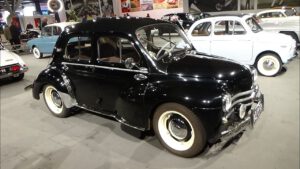
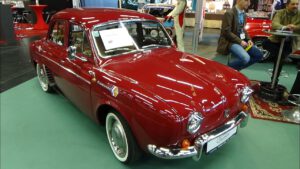
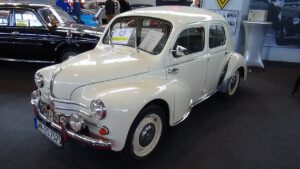
1950 – Renault 4CV – Auto Show AutoRAI Amsterdam 2015
Few European cars symbolize post-war reconstruction as clearly as the Renault 4CV. Compact, affordable, and built in large numbers, it became a familiar presence on French roads within just a few years. Its small dimensions concealed an engineering approach that was both pragmatic and forward-looking, tailored to the economic realities of the late 1940s and early 1950s.
Technical Details
The 1950 Renault 4CV was powered by a rear-mounted inline four-cylinder engine with a displacement of 747 cc. Output is generally cited at around 17 horsepower, later rising slightly in improved versions. The engine was water-cooled and positioned behind the rear axle, driving the rear wheels through a manual three-speed gearbox. This rear-engine, rear-wheel-drive layout allowed for efficient packaging and maximized interior space relative to the car’s compact footprint.
The body utilized a monocoque construction, a modern approach for a small car of the time, contributing to structural rigidity while keeping weight low. Suspension was independent on all four wheels, using coil springs, which provided a level of ride comfort unusual in the entry-level segment. Braking was handled by hydraulic drum brakes, marking a step forward compared to earlier mechanical systems.
The overall technical concept emphasized simplicity, lightness, and ease of production. Fuel consumption was low, and maintenance requirements were modest, both key considerations in the immediate post-war context. The Renault 4CV’s engineering balanced cost efficiency with sufficient performance for urban and regional use.
- Manufacturer: Renault
- Model name: Renault 4CV
- Year of manufacturing: 1950
Design
The design of the Renault 4CV is characterized by compact proportions and rounded forms, reflecting both functional requirements and stylistic trends of the late 1940s. Its smooth, curved body surfaces gave it a friendly and approachable appearance, distinct from the more angular pre-war vehicles it replaced.
The front end was simple, with integrated headlights and minimal chrome detailing, while the absence of a front-mounted engine allowed for a short hood and a more spacious passenger compartment. The rear section was slightly raised to accommodate the engine, subtly influencing the car’s profile without disrupting its overall balance.
Inside, the cabin was straightforward and functional. Seating was arranged to maximize space within the small footprint, and controls were kept simple and accessible. Materials and finishes were modest, reflecting the car’s positioning as an affordable mass-market vehicle. Despite its simplicity, the design achieved a sense of coherence, aligning form closely with function.
Historical Significance
The Renault 4CV occupies a central place in the company’s history and in the broader narrative of European post-war motoring. Development began during the Second World War, under challenging conditions, with engineers working discreetly on a small, economical car that could meet future civilian needs.
Introduced in 1946, the Renault 4CV quickly became a cornerstone of Renault’s recovery. By 1950, production was well underway, and the car had established itself as a key player in the emerging market for affordable personal transport. It was France’s first car to exceed one million units produced, a milestone achieved later in the 1950s.
The Renault 4CV also played a role in shaping Renault’s international presence. It was exported to numerous countries and even assembled outside France, reflecting its broad appeal. Its success demonstrated the viability of compact, efficient cars in a recovering Europe and influenced the direction of subsequent Renault models.
Quirks and Pop Culture
One of the most recognizable aspects of the Renault 4CV is its nickname, “La motte de beurre,” or “the pat of butter,” referring to its rounded shape and the pale yellow color of early production cars. This nickname reflects how quickly the car became embedded in everyday culture.
The rear-engine layout, while advantageous for space and traction, also gave the car distinctive handling characteristics. Drivers needed to adapt to weight distribution different from front-engine vehicles, particularly in cornering situations.
The Renault 4CV also gained attention in motorsport, with modified versions achieving success in events such as the 24 Hours of Le Mans in the small-displacement categories. These achievements added a layer of credibility to an otherwise utilitarian vehicle.
Display and preservation
This car was shown at the AutoRAI Amsterdam 2015, which demonstrated how classic cars can be effectively preserved within a broader automotive context. Welcoming nearly 292,000 visitors, the Netherlands’ largest auto show presented over 500 vehicles from 49 brands at the RAI exhibition centre. While the focus leaned toward contemporary models and new releases, the dedicated “classic car square” ensured historical vehicles remained an integral part of the narrative. Complemented by themed areas such as the Race Hall and InnovationLab, the event highlighted the continuity between past and present—showing that preservation thrives when heritage is integrated into the evolving world of mobility.
Conclusion
The 1950 Renault 4CV represents a pragmatic response to the demands of its time. Its compact rear-engine layout, lightweight construction, and efficient engineering made it accessible to a wide audience. In design, it combined simplicity with a distinctive visual identity. Historically, it played a crucial role in Renault’s post-war recovery and in the broader expansion of affordable mobility in Europe. As a result, the Renault 4CV remains one of the defining small cars of its era.