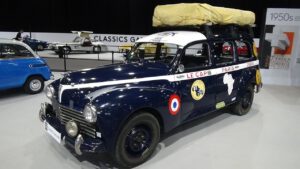
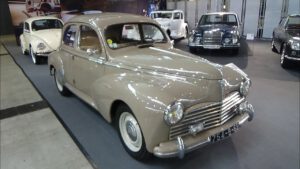
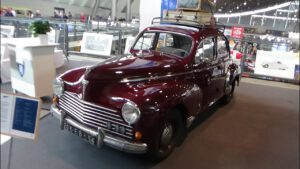
1950 Peugeot 203 Commerciale – Geneva International Motor Show 2024
In the early 1950s, practical transport mattered as much as personal mobility, and the Peugeot 203 Commerciale reflects that priority with clarity. Based on Peugeot’s first postwar passenger car, it adapted a proven platform into a vehicle suited for work, family use, and small-scale transport. Its understated appearance hides a carefully balanced combination of durability and versatility.
Technical Details
The Peugeot 203 Commerciale shared its mechanical foundation with the standard Peugeot 203, featuring a front-mounted inline four-cylinder engine with a displacement of 1,290 cc. Output was approximately 42 horsepower, delivered to the rear wheels through a four-speed manual gearbox. This configuration allowed for a top speed of around 110–115 km/h, depending on load and conditions.
The car was built with a self-supporting steel body, a relatively advanced construction method for Peugeot at the time, contributing to improved rigidity and reduced weight. Suspension consisted of independent front suspension and a rear rigid axle with leaf springs, a setup well suited to carrying cargo while maintaining acceptable ride comfort. Hydraulic drum brakes were fitted on all four wheels. The technical concept emphasized reliability and ease of maintenance, particularly important for commercial users who depended on consistent operation.
- Manufacturer: Peugeot
- Model name: Peugeot 203 Commerciale
- Year of manufacturing: 1950
Design
The Peugeot 203 Commerciale combined the front design of the standard sedan with a reworked rear section optimized for practicality. The front retained the Peugeot 203’s rounded ponton styling, with integrated fenders, a vertically structured grille, and smoothly curved body panels that reflected postwar design trends.
From the B-pillar rearward, the Commerciale differed significantly. The extended roofline and enlarged rear compartment created a more spacious load area, accessible through a split tailgate or rear doors depending on configuration. The overall shape balanced passenger car aesthetics with utility-focused modifications, avoiding the purely boxy forms typical of later commercial vehicles. Inside, the cabin remained simple and functional, with durable materials and a layout designed for ease of use. Large windows improved visibility, an advantage in both urban and rural working environments.
Historical Significance
The Peugeot 203 Commerciale played an important role in the early postwar years, when European economies were rebuilding and demand for versatile vehicles was high. Introduced alongside the Peugeot 203 sedan, it extended the model range into the commercial and mixed-use segment, appealing to small business owners, tradespeople, and families requiring additional cargo space.
At the time, Peugeot focused heavily on a single model line, refining and adapting it for multiple purposes rather than diversifying rapidly. The Commerciale version exemplifies this strategy, demonstrating how one platform could serve a wide range of needs. This approach helped Peugeot stabilize production and establish a strong market presence during a period of limited industrial resources.
The broader Peugeot 203 range achieved significant commercial success, with more than 680,000 units produced. While the Commerciale represented only a portion of that total, its contribution to everyday economic activity was substantial, particularly in local trade and services.
Quirks and Pop Culture
The Peugeot 203 Commerciale is often remembered for its versatility rather than any single defining feature. It occupied a space between passenger car and utility vehicle, making it adaptable to a variety of roles. Owners frequently used it for both professional and private purposes, reflecting the blurred boundaries between work and daily life in the early 1950s.
In France, vehicles like the Peugeot 203 Commerciale became part of the visual landscape of reconstruction. They appeared in markets, workshops, and rural settings, contributing quietly to economic recovery. While it did not gain a strong presence in cinema or popular media, its familiarity made it an enduring symbol of practical mobility.
Display and preservation
We filmed this car at the Geneva International Motor Show in 2024. The fair celebrated its 100th edition from February 26 to March 3 and attracting around 168,000 visitors. While traditionally focused on modern automotive innovation, the show also paid tribute to its heritage with the “Classics Gallery – 100 Years of Icons.” This curated exhibition featured 40 historic vehicles, many of which had originally debuted in Geneva, offering a rare opportunity to experience milestone cars that have shaped both automotive history and the legacy of the show itself.
Conclusion
The 1950 Peugeot 203 Commerciale illustrates how a well-engineered passenger car could be adapted to meet broader societal needs. Its straightforward technical layout, combining a reliable four-cylinder engine with rear-wheel drive and a durable chassis, supported consistent everyday use. The design merged postwar styling with functional modifications, creating a vehicle that was both practical and visually cohesive. Historically, it formed part of Peugeot’s strategy to rebuild and expand through a single, versatile model line. Today, the Peugeot 203 Commerciale stands as a representative example of early postwar utility vehicles that helped reconnect economies and communities.