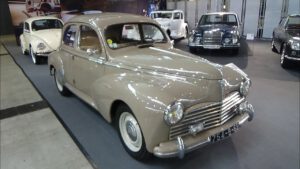
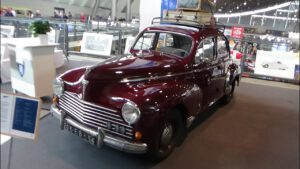
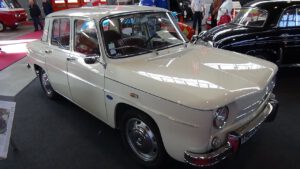
1950 Peugeot 203 A – Retro Classics Stuttgart 2024
At the beginning of the 1950s, Peugeot was producing just one core model, yet that model had to serve an entire market. The Peugeot 203 A reflects this moment with unusual clarity: a car designed to be modern enough for a new era, but robust enough to function in a continent still recovering from war. It is both a technical reset and a practical solution.
Technical Details
The 1950 Peugeot 203 A was equipped with a front-mounted inline four-cylinder gasoline engine with a displacement of 1,290 cc. A defining feature of this engine was its overhead valve (OHV) configuration, which was relatively advanced for a mid-range European car of the late 1940s. Output is generally cited at approximately 42 horsepower at around 4,500 rpm. Power was delivered to the rear wheels through a four-speed manual transmission, with first gear unsynchronized, as was typical for the period.
One of the most important technical aspects of the Peugeot 203 A was its use of a self-supporting steel body (monocoque construction). This marked a significant departure from Peugeot’s pre-war engineering, which had relied on separate chassis frames. The new construction improved torsional rigidity while reducing overall weight, contributing to better handling and efficiency.
The suspension system combined independent front suspension with coil springs and a live rear axle supported by leaf springs. This layout was designed to provide a balance between ride comfort and durability on uneven road surfaces. Braking was handled by hydraulic drum brakes on all four wheels, offering consistent stopping performance compared to earlier mechanical systems. The car’s top speed was typically around 115 km/h, placing it comfortably within the expectations of early post-war European touring cars.
- Manufacturer: Peugeot
- Model name: Peugeot 203 A
- Year of manufacturing: 1948–1952 (example year: 1950)
Design
The Peugeot 203 A introduced a new design language for the brand, moving away from the separate fenders and upright forms of the pre-war period. Its body followed the ponton style, with integrated fenders and smooth, continuous surfaces that gave the car a more modern and cohesive appearance.
The front end was characterized by a narrow, vertically oriented grille, flanked by headlights that were fully integrated into the body. A notable detail of early Peugeot 203 models, including the Peugeot 203 A, was the lion mascot mounted on the hood—an element that would later be removed for safety reasons. This feature gave the car a distinctive identity and reinforced Peugeot’s brand symbolism.
The overall proportions were compact but practical, with a relatively tall roofline that maximized interior space. The four-door “Limousine” body style emphasized usability, making the car suitable for families and professional use. At the rear, the gently curved lines contributed to an aerodynamic, if understated, profile.
Inside, the cabin design was functional and uncluttered. The dashboard featured centrally grouped instruments and straightforward controls, prioritizing usability over decoration. Materials were chosen for durability, reflecting the car’s intended role as a dependable everyday vehicle rather than a luxury product. Large windows ensured good visibility, an important consideration for drivers in varied conditions.
Historical Significance
The Peugeot 203 was introduced in 1948 as the company’s first all-new model after the Second World War. In the early years of its production, including 1950, it was Peugeot’s only passenger car offering. This placed considerable importance on the model, as it had to meet a wide range of customer needs while supporting the company’s financial recovery.
The Peugeot 203 A represents the early production phase of this model line. It established the technical and conceptual foundation that would define Peugeot’s post-war vehicles: modern construction, reliable engineering, and a focus on practicality. The adoption of monocoque construction, in particular, aligned Peugeot with broader industry trends and set the stage for future developments.
Over time, the Peugeot 203 would evolve into various sub-variants, including the later “C” series, but the A version captures the original concept in its most direct form. By the end of production in 1960, more than 680,000 units had been built, demonstrating the model’s widespread acceptance and importance.
Quirks and Pop Culture
One of the most distinctive features of the early Peugeot 203 A is the hood-mounted lion mascot. While visually striking, it was eventually discontinued due to safety concerns, making surviving examples with this feature particularly characteristic of early production cars.
The Peugeot 203 also became known for its durability in demanding environments. It was widely exported and used in regions with limited infrastructure, where its robust engineering and straightforward mechanical layout proved advantageous. This contributed to its reputation as a reliable, long-distance vehicle.
Unlike later Peugeot models, the 203 A did not achieve significant visibility in film or popular media. Its cultural role is instead tied to everyday life in post-war Europe, where it became a familiar presence on roads and in cities undergoing reconstruction.
Display and preservation
The vehicle was presented at Retro Classics Stuttgart 2024, one of Europe’s largest gatherings for historic mobility. From 25 to 28 April 2024, more than 70,000 visitors explored around 80,000 square metres of exhibition space, with over 2,000 classic vehicles displayed across six packed halls. The show combined strong commercial activity with carefully curated anniversary themes, including 50 years of the Porsche 911 Turbo, 60 years of the Ford Mustang, and 70 years of the Mercedes-Benz 300 SL “Gullwing” with a special exhibition on tuning culture from the 1970s to the 1990s.
Conclusion
The 1950 Peugeot 203 A stands as a foundational model in Peugeot’s post-war history. Technically, it combined a modest but capable engine with modern construction methods and proven mechanical solutions. Its design introduced a cohesive, integrated form that marked a clear break from pre-war styling.
Historically, it carried the brand through a critical period, serving as Peugeot’s sole passenger car and establishing a template for future models. While understated in character, the Peugeot 203 A’s balance of innovation, reliability, and practicality ensures its lasting significance as one of the key European cars of the early 1950s.