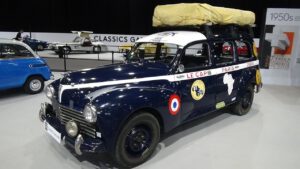
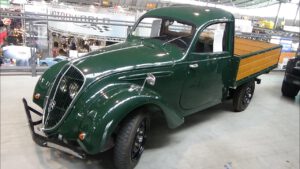
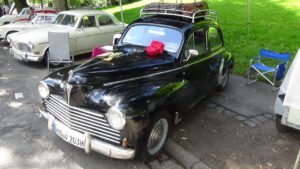
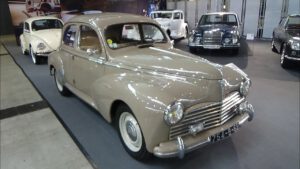
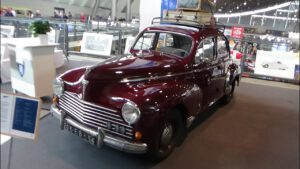
1949 Peugeot 202 UH – Retro Classics Stuttgart 2024
Introduced just before the Second World War and carried into the immediate postwar years, the Peugeot 202 UH reflects a moment when continuity was more important than reinvention. In 1949, it stood as one of Peugeot’s key utility vehicles, bridging prewar engineering with the practical demands of reconstruction-era Europe.
Technical Details
The Peugeot 202 UH was based on the mechanical platform of the Peugeot 202 passenger car, retaining its front-mounted inline four-cylinder engine with a displacement of 1,133 cc. Power output was approximately 30 horsepower, delivered to the rear wheels through a manual gearbox. This modest specification prioritized reliability and ease of maintenance rather than performance, with a top speed typically around 95 km/h depending on body configuration.
The chassis followed a conventional layout with a separate frame, suitable for adapting different body styles, particularly light commercial variants such as the “UH” utility version. Suspension consisted of independent front suspension and a rear rigid axle with leaf springs, a configuration chosen for durability under load. Braking was handled by mechanically operated drum brakes. Overall, the engineering emphasized robustness and adaptability, key attributes for postwar working vehicles.
- Manufacturer: Peugeot
- Model name: Peugeot 202 UH
- Year of manufacturing: 1949
Design
The design of the Peugeot 202 UH retained the distinctive visual identity of the prewar Peugeot 202, characterized by its aerodynamic influences. The front end featured Peugeot’s recognizable grille with closely spaced vertical slats, behind which the headlights were mounted—a design solution that gave the car a streamlined appearance compared to many contemporaries with exposed lamps.
In the UH utility configuration, the bodywork shifted toward practicality. The rear section was adapted for cargo use, often with a boxy or open load area depending on specification. This created a contrast between the rounded, flowing front end and the more functional rear body. The overall proportions remained compact, with narrow width and upright stance typical of late-1930s designs. Inside, the cabin was minimal, focusing on functionality and durability rather than comfort, in line with its commercial purpose.
Historical Significance
The Peugeot 202 UH occupies a transitional place in automotive history. Originally introduced in 1938, the Peugeot 202 was part of a new generation of cars influenced by aerodynamic design trends of the late 1930s. However, production was interrupted by the Second World War, and when it resumed, the model continued largely unchanged due to limited industrial resources.
By 1949, the UH variant represented Peugeot’s effort to meet the urgent need for practical transport in a recovering economy. Light commercial vehicles were essential for small businesses, tradespeople, and local distribution, and the Peugeot 202 platform provided a ready-made solution. Rather than investing in entirely new designs, manufacturers like Peugeot relied on proven prewar models to restart production quickly and reliably.
The end of Peugeot 202 production in 1949 coincided with the introduction of more modern successors such as the Peugeot Peugeot 203, marking a clear shift toward postwar automotive design and engineering. The Peugeot 202 UH therefore stands at the intersection of two eras: the streamlined ambitions of the late 1930s and the pragmatic realities of the late 1940s.
Quirks and Pop Culture
One of the most distinctive features of the Peugeot 202—retained in the UH version—was its hidden headlight design behind the grille. This unusual solution contributed to its aerodynamic appearance and made it instantly recognizable. Among enthusiasts, the model is often remembered for this feature, which set it apart from many contemporaries.
The Peugeot 202 series also gained a reputation for resilience. In the years immediately following the war, vehicles like the Peugeot 202 UH were often used intensively under difficult conditions, from rural transport to small-scale commercial work. Its ability to operate reliably with limited maintenance contributed to its lasting reputation.
While the Peugeot 202 UH itself did not achieve strong visibility in popular media, it remains an important representation of everyday working vehicles in postwar France. Its presence in historical photographs and collections reflects its role in rebuilding daily economic life.
Display and preservation
The vehicle was presented at Retro Classics Stuttgart 2024, one of Europe’s largest gatherings for historic mobility. From 25 to 28 April 2024, more than 70,000 visitors explored around 80,000 square metres of exhibition space, with over 2,000 classic vehicles displayed across six packed halls. The show combined strong commercial activity with carefully curated anniversary themes, including 50 years of the Porsche 911 Turbo, 60 years of the Ford Mustang, and 70 years of the Mercedes-Benz 300 SL “Gullwing” with a special exhibition on tuning culture from the 1970s to the 1990s.
Conclusion
The 1949 Peugeot 202 UH is best understood as a practical continuation of prewar automotive design adapted to postwar needs. Technically simple and durable, it offered reliable performance and flexibility for commercial use. Its design combined aerodynamic styling cues with utilitarian modifications, while its historical role highlights the importance of continuity during a period of economic recovery. As one of the final iterations of the Peugeot 202 line, the UH variant marks the closing chapter of a model that helped bridge two distinct automotive eras.