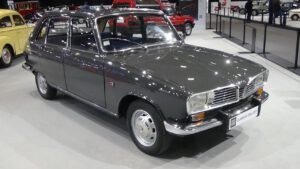
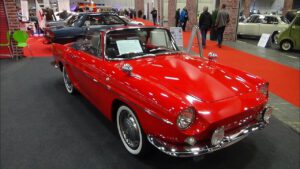
1949 Ford Shoebox – Oldtimer-Meeting Baden-Baden 2021
In 1949, Ford did something rare for a mass manufacturer: it changed the visual language of the American car almost overnight. The new model abandoned exposed fenders and upright forms in favor of a smooth, integrated shape that felt unmistakably modern. Almost immediately, it earned a nickname that said everything about how different it looked—the Ford Shoebox.
Technical Details:
The 1949 Ford Shoebox marked a complete mechanical and structural redesign for Ford’s passenger cars. It was built on a new perimeter frame, which allowed the body to sit lower between the frame rails, contributing to its lower roofline and improved stability. Suspension consisted of independent front suspension with coil springs and a live rear axle supported by leaf springs, a layout chosen for durability and predictable road manners.
Engine options included Ford’s proven flathead V8, displacing 239 cubic inches (3.9 liters) and producing approximately 100 horsepower, as well as an inline six-cylinder engine for economy-focused buyers. Power was transmitted to the rear wheels via a three-speed manual transmission, with Ford’s overdrive unit available as an option. An automatic transmission was not yet offered in 1949, though competitors would introduce them shortly thereafter.
Braking was handled by hydraulic drum brakes on all four wheels, and steering relied on a recirculating ball system. While not a performance car by later standards, the Shoebox delivered smooth cruising, solid road behavior, and mechanical simplicity suited to long-distance American driving.
- Manufacturer: Ford
- Model Name: Ford passenger car (commonly known as “Shoebox Ford”)
- Year of Manufacturing: 1949
Design:
Design was the defining feature of the 1949 Ford. It was Ford’s first truly ponton-style body, with fully integrated front and rear fenders and clean, slab-sided surfaces. The result was a car that looked lower, wider, and more unified than its predecessors.
The front end featured a simple horizontal grille flanked by round headlights, while the hood and body panels flowed smoothly into one another without visual interruption. Chrome was used sparingly, emphasizing horizontal lines rather than vertical ornamentation. The roofline was tall but clean, giving the car its boxy profile—and its enduring nickname.
Inside, the Shoebox continued Ford’s emphasis on practicality. The dashboard was wide and symmetrical, with large gauges and clear controls. Seating was generous, reflecting the car’s role as family transportation. Compared with pre-war designs, visibility improved significantly due to larger windows and thinner pillars.
The Shoebox’s clean surfaces also made it a favorite among customizers. Its uncluttered shape lent itself easily to modification, lowering, and restyling—an influence that would grow over time.
Historical Significance:
The 1949 Ford arrived at a pivotal moment in American automotive history. After years of limited wartime production and conservative updates, consumers were eager for something new. Ford responded with a complete redesign rather than an incremental refresh.
This gamble paid off. The Shoebox was an immediate commercial success, helping Ford regain momentum in a highly competitive market. Its design set a template that many manufacturers would follow throughout the early 1950s, accelerating the transition toward fully integrated body forms.
Beyond sales, the Shoebox reshaped expectations. It demonstrated that modern styling could be applied to affordable, mass-produced cars without sacrificing reliability or accessibility. In doing so, it helped democratize modern automotive design.
Quirks and Pop Culture:
The Shoebox Ford holds a special place in American car culture, particularly within the custom and hot rod scenes. Its simple geometry, strong proportions, and availability made it one of the most modified cars of the post-war era.
By the 1950s, Shoebox Fords were frequently chopped, lowered, and restyled, appearing in early custom car magazines and local shows. This association with personalization and youth culture cemented its reputation beyond its original role as family transportation.
The nickname itself is a cultural artifact. Unlike factory designations, “Shoebox” emerged organically, reflecting how strongly the car’s shape resonated with the public. Few mass-produced cars have been so widely recognized by an unofficial name.
Display and preservation:
The vehicle was exhibited at the Oldtimer-Meeting Baden-Baden in 2021. This event, held annually in the spa town’s Kurpark and along the Kaiserallee, is one of Germany’s most picturesque classic car gatherings. In 2021, the 44th edition featured 300 vintage vehicles from 80 different brands, including rare models. The event embraced a 1970s theme, showcasing over 40 vehicles from that era. An innovative highlight was the “automobile fashion show,” where models presented current fashion trends while riding in open-top classic cars through the park. The event concluded with the traditional Concours d’élégance, awarding 120 prizes across 15 categories.
Conclusion:
The 1949 Ford Shoebox represents more than a new model year—it marks a turning point in automotive design and production. By introducing a clean, integrated body at an accessible price, Ford reshaped the American car landscape and influenced styling for years to come. Mechanically straightforward but visually transformative, the Shoebox earned its place not through luxury or performance, but through timing, design clarity, and cultural impact. Today, it stands as one of the most influential American cars of the post-war era.