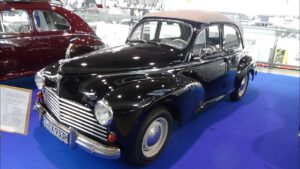
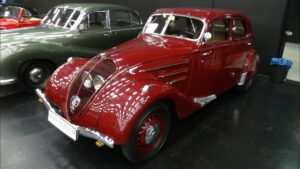
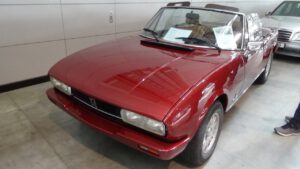
1949 Bentley 4.0 L – Exterior and Interior – Classic Expo Salzburg 2021
In 1949, Bentley was redefining what a luxury car could be. The company moved away from the assumption that every owner would commission bespoke coachwork and instead presented a complete, factory-bodied automobile. The Bentley 4.0 L marked that transition with quiet confidence rather than spectacle.
Technical Details:
The 1949 Bentley 4.0 L was powered by Bentley’s well-established inline six-cylinder engine, commonly known as the 4¼-litre unit, with a displacement of 4,257 cc. Despite the “4.0 L” shorthand often used in period references and later descriptions, the engine’s actual capacity remained unchanged. The design used an overhead inlet and side exhaust valve (IOE) configuration, chosen for its smooth operation, strong low-speed torque, and long-term durability.
Power output figures were not prominently advertised, in keeping with Bentley’s understated philosophy, but contemporary estimates place output at approximately 130 horsepower. The engine was paired with a four-speed manual transmission, sending power to the rear wheels. Gear ratios were selected to favor relaxed cruising rather than rapid acceleration.
A key technical feature of the Bentley 4.0 L was its independent front suspension with coil springs, a major advance over pre-war designs and a significant contributor to ride comfort and stability. The rear suspension used a live axle with semi-elliptic leaf springs. The car rode on a separate steel ladder-frame chassis, providing strength and allowing controlled isolation of road noise and vibration.
Braking was handled by hydraulically operated drum brakes on all four wheels, which provided reliable stopping performance for a car of its size and weight. The overall mechanical package emphasized refinement, composure, and mechanical longevity rather than outright performance.
- Manufacturer: Bentley
- Model Name: Bentley 4.0 L (Mark VI series)
- Year of Manufacturing: 1949
Design:
The design of the 1949 Bentley 4.0 L reflected a deliberate move toward modern series production. Unlike earlier Bentleys supplied primarily as rolling chassis, the Mark VI was offered with a factory-built steel saloon body, manufactured in-house. This represented a fundamental change in Bentley’s business model.
Externally, the car featured balanced, upright proportions with gently rounded surfaces. The tall radiator grille remained a defining Bentley element, flanked by integrated headlamps that gave the front a composed and formal appearance. Chrome detailing was restrained, applied mainly to the grille, bumpers, and window surrounds.
The saloon body offered generous glass areas, improving visibility and creating a lighter cabin atmosphere. The roofline was conservative rather than dramatic, reinforcing the car’s emphasis on dignity and usability. Steel wheels with hubcaps were standard, reinforcing the car’s understated presentation.
Inside, the Bentley 4.0 L prioritized craftsmanship and comfort. Leather upholstery, polished wood veneer, and wool carpets were typical, but the layout was logical rather than ornate. Instrumentation was clear and legible, arranged for ease of use rather than decoration. The interior conveyed quality through materials and execution, not excess.
Historical Significance:
The Bentley 4.0 L of 1949 must be understood as part of Bentley’s broader post-war transformation. Introduced shortly after the company came under Rolls-Royce ownership, the Mark VI was Bentley’s first standard-production model and the first Bentley to be sold primarily as a complete car.
This shift allowed Bentley to increase production volumes and reach new markets, particularly overseas. The steel-bodied saloon reduced dependence on independent coachbuilders and improved manufacturing efficiency at a time when resources were limited and export performance was crucial.
At the same time, the car retained core Bentley values: mechanical integrity, ride comfort, and understated authority. The 4.0 L engine provided ample performance for sustained high-speed touring, making the car suitable for long-distance travel on improving road networks.
While later Bentley models would become larger and more complex, the 1949 4.0 L occupies a pivotal position as the bridge between pre-war bespoke tradition and modern luxury manufacturing.
Quirks and Pop Culture:
Unlike bespoke Bentley specials or later high-performance variants, the Bentley 4.0 L rarely appears in popular culture as an object of drama or excess. Its image has always been tied to discretion and professionalism rather than spectacle.
One notable quirk is how frequently the car is misidentified. The “4.0 L” designation is often used interchangeably with “4¼-litre,” leading to confusion despite referring to the same engine. This ambiguity reflects how Bentley itself prioritized refinement over numerical marketing.
Today, the Bentley 4.0 L is a familiar presence at concours events and touring rallies, where its comfort and reliability are valued. Owners often emphasize its usability, noting that the car remains well suited to long journeys even by modern standards.
Display and preservation:
The vehicle was exhibited at the Classic Expo Salzburg in 2021. As one of Austria’s premier classic car events, the show has established itself as a central meeting point for collectors, restorers, and enthusiasts from across Central Europe. The 2021 edition took place at Messezentrum Salzburg and featured more than 250 exhibitors, along with a strong turnout of over 20,000 visitors. Attendees could explore a broad range of offerings—from historical vehicles and motorcycles to automobilia, spare parts, and literature.
Conclusion:
The 1949 Bentley 4.0 L represents a defining moment in Bentley history. By offering a complete, factory-bodied luxury car, Bentley adapted to changing economic and industrial realities without abandoning its core principles. Technically conservative yet thoughtfully engineered, the car delivered refinement through balance rather than excess. Today, it stands as an example of how tradition can evolve quietly—through careful decisions rather than dramatic reinvention.