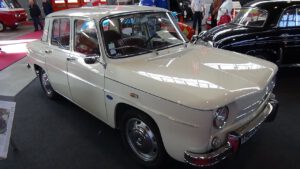
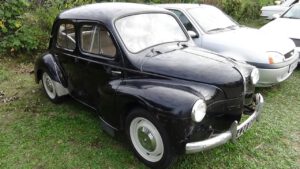
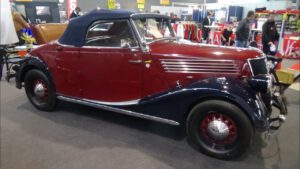
1947–1961 – Renault 4CV – Auto Show Veterama 2014
Few cars carried the burden of rebuilding a nation as directly as the Renault 4CV. Developed in secrecy during the final years of the Second World War, it emerged as France’s first mass-produced postwar car and quickly became a familiar presence on European roads. Its modest size concealed a broader ambition: to make mobility accessible again in a recovering economy.
Technical Details
The Renault 4CV was engineered as a compact, rear-engined passenger car, following a layout that placed a water-cooled inline four-cylinder engine behind the rear axle. Early versions used a 760 cc engine, later increased to 747 cc in production models, delivering approximately 17 to 21 horsepower depending on specification and development stage. While modest in output, the engine was efficient and sufficient for everyday driving, allowing top speeds in the region of 90 km/h.
Power was transmitted to the rear wheels via a three-speed manual gearbox. The rear-engine configuration provided good traction, particularly useful on uneven or slippery surfaces, though it also required careful handling at higher speeds due to weight distribution. The chassis featured independent suspension on all four wheels, a relatively advanced solution for a car of this class and period, contributing to a compliant ride.
The body was constructed from steel and designed for series production, reflecting Renault’s shift toward industrial-scale manufacturing. Hydraulic drum brakes were fitted on all four wheels, ensuring consistent braking performance in line with contemporary standards. Overall, the Renault 4CV combined simplicity with thoughtful engineering, prioritizing reliability and ease of maintenance.
General Information
- Manufacturer: Renault
- Model name: Renault 4CV
- Year of manufacturing: 1947–1961
Design
The design of the Renault 4CV was compact and rounded, shaped by both aerodynamic considerations and production practicality. Its smooth, bulbous form earned it the nickname “La motte de beurre” (“the pat of butter”), particularly in its early yellow paint finish used for initial production models.
The front end was defined by simple, circular headlights and a modest grille, with minimal ornamentation. The absence of a front-mounted engine allowed for a short nose and maximized interior space within a small footprint. At the rear, ventilation slots hinted at the engine placement, while the overall proportions emphasized efficiency.
Inside, the cabin was straightforward and functional. Seating accommodated four passengers, though space was limited by modern standards. Materials and finishes were basic, reflecting the car’s role as affordable transportation rather than a luxury product. The dashboard was uncluttered, with essential controls and instrumentation positioned for ease of use. Large windows provided good visibility, contributing to a sense of openness despite the car’s compact size.
Historical Significance
The Renault 4CV holds a central place in the postwar history of Renault. Its development began during the German occupation of France, when a small team of engineers worked discreetly on a prototype that would meet the anticipated needs of a postwar market. After liberation, the project received official support and entered production in 1947.
It became France’s first mass-produced car after the war and played a key role in reestablishing Renault as a major industrial force. By offering an affordable and practical vehicle, the Renault 4CV contributed to the motorization of a broad segment of the population. Production exceeded one million units, making it the first French car to reach this milestone.
The Renault 4CV also marked Renault’s adoption of the rear-engine layout for small cars, a concept that would influence later models such as the Dauphine. Its success demonstrated the viability of compact, economical vehicles in a rapidly changing Europe, where fuel efficiency and affordability were essential.
Quirks and Pop Culture
The nickname “La motte de beurre” reflects both the car’s rounded shape and its original color, a yellow tone chosen partly due to surplus paint available after the war. This detail became part of the Renault 4CV’s identity and remains a recognizable reference among enthusiasts.
The car also found a place in motorsport, despite its modest specifications. Specially prepared versions of the Renault 4CV competed in rallies and endurance events, highlighting the robustness of its basic engineering. Tuned variants, including those developed by Alpine founder Jean Rédélé, laid the groundwork for later Alpine models, linking the Renault 4CV indirectly to Renault’s sporting future.
In everyday life, the Renault 4CV became a symbol of postwar recovery in France. It appeared widely in films, photographs, and urban scenes of the late 1940s and 1950s, representing a shift toward renewed mobility and economic stability.
Display and preservation
This car was displayed at the Veterama 2014 Mannheim, held from October 10 to 12. The event attracted around 45,000 visitors to its 260,000 square meter grounds. Nearly 4,000 exhibitors from around the world presented their 1,000 vehicles—many from the emerging youngtimer scene. A new highlight was the Show Arena, where pre-1975 vehicles could be presented to the public. From early automotive relics to complete classics, the diversity was remarkable.
Conclusion
The Renault 4CV was more than a small car; it was a cornerstone of postwar European motoring. Technically simple yet thoughtfully engineered, it combined a rear-engine layout, independent suspension, and efficient construction into a practical package. Its design reflected both necessity and ingenuity, while its historical role in rebuilding Renault and mobilizing a nation gives it lasting significance. From its distinctive appearance to its widespread cultural presence, the 4CV remains a clear example of how modest engineering can have a broad and enduring impact.