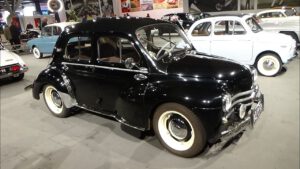
1946-1961 – Renault 4CV – Veterama Mannheim 2015
Conceived during wartime and launched into a rebuilding Europe, the Renault 4CV quickly became more than just a small car. It represented accessibility at a time when personal mobility was still limited for many. Over its long production run from 1946 to 1961, it evolved into one of the defining vehicles of post-war France.
Technical Details
The Renault 4CV was engineered around a rear-mounted inline four-cylinder engine with a displacement of 747 cc. Early versions produced approximately 17 horsepower, while later developments increased output to around 21 horsepower. The engine was water-cooled and positioned behind the rear axle, driving the rear wheels via a three-speed manual gearbox. This layout allowed for efficient use of space and contributed to the car’s compact proportions.
The vehicle employed a monocoque body structure, a relatively advanced construction method for a small car in the late 1940s. This reduced overall weight while maintaining sufficient rigidity. Suspension was independent on all four wheels, using coil springs, which offered a level of ride comfort uncommon in entry-level vehicles of the time. Hydraulic drum brakes were fitted on all four wheels, providing consistent braking performance compared to earlier mechanical systems.
Fuel efficiency was a key characteristic, with low consumption aligning with the economic conditions of the era. The technical concept emphasized simplicity, durability, and ease of maintenance, ensuring that the car could serve a wide range of users in varying conditions.
- Manufacturer: Renault
- Model name: Renault 4CV
- Year of manufacturing: 1946–1961
Design
The Renault 4CV’s design is defined by its compact dimensions and rounded, cohesive forms. Its shape reflects both functional requirements and the stylistic trends of the late 1940s, with smooth curves replacing the angular lines of pre-war vehicles.
The front end is minimal, with integrated headlights and a short hood made possible by the rear-engine layout. The absence of a front-mounted engine allowed designers to prioritize interior space, resulting in a surprisingly roomy cabin for such a small vehicle. The rear section accommodates the engine, subtly influencing the car’s silhouette without disrupting its overall balance.
Inside, the cabin is simple and practical. Seating is upright, maximizing available space, while the dashboard features minimal instrumentation and straightforward controls. Materials are modest, reflecting the car’s role as an affordable vehicle, but the layout is functional and user-friendly. Over time, small refinements improved comfort and usability, though the fundamental design remained consistent throughout production.
Historical Significance
The Renault 4CV was developed during the Second World War under the direction of engineers working discreetly on a small, economical vehicle for post-war use. When it was officially introduced in 1946, it marked a significant shift for Renault, which had previously focused more on larger and more expensive cars.
As production increased, the Renault 4CV became a cornerstone of Renault’s recovery and growth. It was the first French car to exceed one million units produced, a milestone that underscored its widespread appeal. The car was exported to numerous countries and assembled internationally, contributing to Renault’s expanding global presence.
Throughout its production run, the Renault 4CV demonstrated the viability of compact, affordable vehicles in a changing economic landscape. It also influenced the development of subsequent Renault models, including the Dauphine, which built on the same rear-engine concept while offering greater refinement.
Quirks and Pop Culture
The Renault 4CV quickly acquired the nickname “La motte de beurre,” referencing both its rounded shape and the pale yellow color of early production models. This nickname reflects how deeply the car became embedded in everyday French culture.
Its rear-engine layout gave the car distinctive handling characteristics, particularly in terms of weight distribution. While this provided good traction, especially in low-grip conditions, it also required drivers to adapt their driving style.
The Renault 4CV also found success in motorsport, particularly in endurance and small-displacement racing categories. These achievements added an unexpected dimension to its reputation, showing that even a modest economy car could perform competitively.
Display and preservation
This car was displayed at the Veterama Mannheim 2015, held from October 9 to 11 at the Maimarkt grounds. Spanning 260,000 square meters outdoors and 15,000 square meters of indoor space, the event offered everything from rare spare parts to complete classic vehicles. Dealers, restorers, accessory specialists, and publishers created a vibrant marketplace for collectors and hobbyists alike.
Conclusion
The 1946–1961 Renault 4CV stands as a defining example of post-war automotive development. Its compact rear-engine layout, efficient engineering, and practical design made it accessible to a broad audience. Over its long production life, it evolved through incremental improvements while maintaining its core identity. As both a commercial success and a cultural icon, the Renault 4CV played a central role in shaping Renault’s future and expanding personal mobility in Europe.