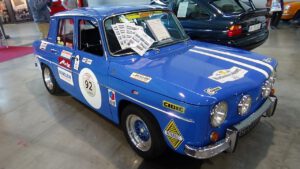
1940 Siata Super Testa 500 Sport Spider – Exterior and Interior – Classic Expo Salzburg 2021
Small Italian manufacturers often pursued performance not by scale, but by ingenuity. The 1940 Siata Super Testa 500 Sport Spider was conceived in that spirit: a lightweight, competition-minded sports car built around modest mechanical components that were carefully reworked for speed. It reflects a pre-war Italian approach in which tuning skill and low mass mattered more than displacement or luxury.
Technical Details:
The Siata Super Testa 500 Sport Spider was based on mechanical components derived from the Fiat 500 “Topolino,” reengineered by Siata for sporting use. Power came from a front-mounted inline four-cylinder petrol engine originally of 569 cc, typically enlarged and extensively modified in Siata “Super Testa” specification. These modifications included revised cylinder heads, higher compression, and improved carburation, resulting in significantly increased output compared to the standard Fiat unit. Period sources generally place power in the region of around 30 horsepower, depending on specification and tuning.
Power was transmitted to the rear wheels through a manual gearbox, retaining a conventional front-engine, rear-wheel-drive layout. The chassis relied on a lightweight ladder frame with rigid axles front and rear, suspended by leaf springs. Braking was by mechanical drum brakes. With a very low curb weight, the Super Testa 500 offered a strong power-to-weight ratio, allowing lively acceleration and competitive performance in small-displacement racing classes.
- Manufacturer: Siata
- Model Name: Siata Super Testa 500 Sport Spider
- Year of Manufacturing: 1940
Design:
The design of the Siata Super Testa 500 Sport Spider was dictated almost entirely by function. Its open spider body was minimal, with narrow proportions, cycle-style front fenders, and a tapered tail that reduced weight and aerodynamic drag. Body panels were typically formed in aluminum over a simple frame, emphasizing lightness over durability or refinement.
The front end was low and compact, often featuring a small grille opening sufficient only for cooling needs. The cockpit was sparse, with two simple seats, a small windscreen or aeroscreen, and basic instrumentation focused on engine speed and vital functions. There was little attempt at visual embellishment. Instead, the car conveyed purpose through its exposed mechanical elements and stripped-down presentation, placing it closer to a racing machine than a roadgoing sports car.
Historical Significance:
Siata—short for Società Italiana Applicazioni Tecniche Auto—was founded in Turin in 1926 and built its reputation by supplying high-performance components for Fiat-based cars. By the late 1930s, the company had moved into producing complete vehicles in small numbers, aimed primarily at competition and enthusiastic private drivers.
The Super Testa 500 Sport Spider belongs to this transitional phase. It illustrates how Italian specialists exploited existing mass-produced components, refining them into competitive sports cars for local racing, hill climbs, and endurance events. Production numbers were very limited, and the outbreak of the Second World War soon brought civilian sports-car development in Italy to a halt. As a result, the Super Testa 500 stands as one of the last expressions of pre-war Italian small-displacement sports engineering.
Quirks and Pop Culture:
The Siata Super Testa 500 is largely absent from mainstream popular culture, but it occupies a respected place among historians of Italian motorsport. One notable quirk is how dramatically its performance depended on tuning and driver skill. With minimal weight and little in the way of driver aids, the car rewarded precise handling but offered few concessions to comfort or safety.
Today, surviving examples are extremely rare and are typically seen only at specialized historic racing events or high-level concours. Among enthusiasts, the Super Testa 500 is valued less as a collectible object and more as a representation of Siata’s engineering philosophy: extracting maximum performance from minimal means.
Display and preservation:
The vehicle was exhibited at the Classic Expo Salzburg in 2021. As one of Austria’s premier classic car events, the show has established itself as a central meeting point for collectors, restorers, and enthusiasts from across Central Europe. The 2021 edition took place at Messezentrum Salzburg and featured more than 250 exhibitors, along with a strong turnout of over 20,000 visitors. Attendees could explore a broad range of offerings—from historical vehicles and motorcycles to automobilia, spare parts, and literature.
Conclusion:
The 1940 Siata Super Testa 500 Sport Spider represents a distilled vision of pre-war Italian sports car design. Built around a heavily modified small-displacement engine and an uncompromisingly lightweight structure, it prioritized agility and mechanical efficiency over refinement. Its significance lies not in production volume or luxury appeal, but in its demonstration of how ingenuity and craftsmanship shaped Italy’s grassroots motorsport culture on the eve of wartime disruption.