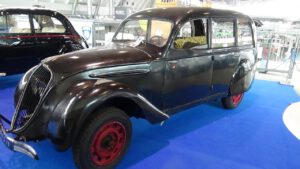
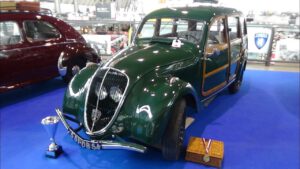
1939 Peugeot 402 B Légère – Exterior and Interior – Auto d’Epoca Padova 2017
Streamlined design was not limited to luxury cars in the 1930s. With the Peugeot 402, and particularly the B Légère variant, Peugeot brought aerodynamic thinking into a more accessible segment. Introduced just before the outbreak of the Second World War, the Peugeot 402 B Légère represents both a technical refinement and a final evolution of a forward-looking pre-war concept.
Technical Details
The 1939 Peugeot 402 B Légère was powered by a front-mounted inline four-cylinder engine with a displacement of 1,991 cc. Output is generally cited at around 55 horsepower, delivered through a rear-wheel-drive layout. This level of performance allowed for a top speed in the region of 120 km/h, placing the car competitively within its class for the late 1930s.
The “B” designation refers to an updated version of the Peugeot 402, which introduced several mechanical improvements over earlier variants. Among these were refinements to engine efficiency and durability, as well as the availability of improved transmission options. A notable feature associated with the broader Peugeot 402 range was the optional Cotal pre-selector gearbox, an advanced system for the time that allowed for smoother and quicker gear changes compared to conventional manual transmissions.
The chassis followed a traditional construction with a steel body mounted on a frame, combined with independent front suspension. Braking was handled by mechanical drum brakes on all four wheels. The “Légère” designation indicated a lighter and slightly more compact version of the Peugeot 402, contributing to improved agility and efficiency.
- Manufacturer: Peugeot
- Model name: Peugeot 402 B Légère
- Year of manufacturing: 1939
Design
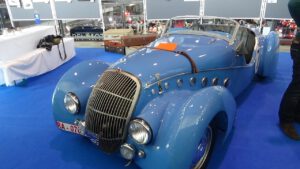
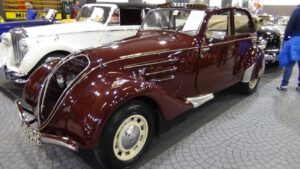
The Peugeot 402 B Légère is immediately recognizable for its aerodynamic styling, heavily influenced by the Streamline Moderne movement of the 1930s. One of its most distinctive features is the integration of the headlights behind the front grille, a design choice that set it apart from many contemporaries and contributed to a cleaner airflow around the front of the car.
The bodywork is characterized by flowing, rounded forms, with gently curved fenders and a sloping rear section. Compared to the standard Peugeot 402, the Légère version appears slightly more compact and balanced, with proportions that emphasize lightness and efficiency. The absence of excessive ornamentation reinforces the car’s modern character.
Inside, the design remained relatively restrained, focusing on functionality and comfort. The dashboard layout was simple and legible, while materials reflected the standards of a mid-range car of the period. Large windows and a relatively upright cabin provided good visibility, complementing the car’s practical usability.
Historical Significance
The Peugeot 402 was introduced in 1935 as part of a broader effort by Peugeot to modernize its lineup in response to changing market expectations and increasing competition. Aerodynamics had become a key area of innovation, influenced by both engineering research and stylistic trends.
The B Légère variant represents one of the final developments of the Peugeot 402 series before production was disrupted by the Second World War. Its lighter construction and refined mechanical package illustrate Peugeot’s ongoing efforts to improve efficiency and performance within an established design framework.
The timing of its production is particularly significant. By 1939, the European automotive industry was on the brink of major disruption, and many innovative projects were cut short. As a result, the Peugeot 402 B Légère stands as one of the last expressions of pre-war French automotive design, combining advanced styling with mature engineering.
Quirks and Pop Culture
The hidden-headlight design of the Peugeot 402 remains one of its most memorable quirks. At a time when exposed headlamps were the norm, integrating them behind the grille gave the car a distinctive and futuristic appearance. This feature is often cited as one of the earliest examples of such an approach in automotive design.
Another point of interest is the optional Cotal gearbox, which used electromagnetic controls to pre-select gears. This system, unusual for its time, is frequently highlighted in discussions of early transmission innovation.
While the Peugeot 402 did not achieve widespread fame in film or popular media, it is well represented in classic car collections and exhibitions. Its design makes it a frequent reference point when discussing aerodynamic trends of the 1930s.
Display and preservation
This car was shown at the Auto e Moto d’Epoca Padova 2017. The event took place from October, 26th to the 29th. Hosted at PadovaFiere, the event attracted over 115,000 visitors and presented more than 5,000 vehicles. Alongside the impressive display blending heritage, modern automotive trends, and passionate collectors, the event hosted Bonhams sales highlighting a shifting market.
Conclusion
The 1939 Peugeot 402 B Légère combines aerodynamic styling, refined engineering, and a focus on efficiency in a way that reflects the ambitions of the late 1930s automotive industry. Its streamlined design, innovative features such as hidden headlights and optional advanced transmission, and its position as one of the final pre-war Peugeot developments give it lasting historical importance. Today, it stands as a clear example of how design and engineering were beginning to converge toward more modern automotive concepts.