1938 Peugeot 402 Darl’Mat Roadster – Exterior and Interior – Oldtimer Meeting Baden-Baden 2015
The 1938 Peugeot 402 Darl’Mat Roadster stands apart within pre-war French automotive production, not for volume but for intent. Conceived as a performance-oriented derivative of a mainstream model, it combined aerodynamic thinking with competition ambitions. Its rarity today reflects how focused and specialized this project was from the outset.
Technical Details
The Peugeot 402 Darl’Mat Roadster was based on the mechanical platform of the standard Peugeot 402 but extensively reworked for performance. It used a front-mounted inline four-cylinder engine with a displacement of 1,991 cc. Through modifications including revised carburation and tuning, output was increased to approximately 70 horsepower, a notable improvement over the standard version. Power was transmitted to the rear wheels via a manual gearbox, maintaining a conventional drivetrain layout. The car featured independent front suspension, a relatively advanced solution for the time, improving handling and road holding. Aerodynamic efficiency played a central role, influencing both performance and top speed, which could reach around 150 km/h depending on configuration.
- Manufacturer: Peugeot
- Model name: Peugeot 402 Darl’Mat Roadster
- Year of manufacturing: 1938
Design
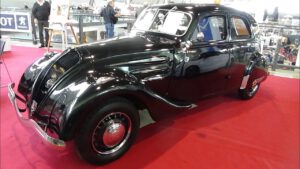
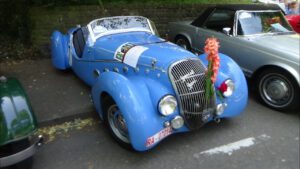
The design of the Peugeot 402 Darl’Mat Roadster reflects the aerodynamic experimentation of the late 1930s. Its flowing, teardrop-shaped body was developed in collaboration with Émile Darl’Mat and coachbuilder Marcel Pourtout. The front end retained Peugeot’s characteristic concealed headlights positioned behind the grille, a defining feature of the Peugeot 402 series, but the overall body was lower, longer, and more sculpted.
The pronounced front fenders, tapering rear section, and integrated wheel arches created a streamlined silhouette that emphasized motion even at rest. The roadster configuration, with its low windscreen and open cockpit, reinforced the car’s sporting intent. Interior design was minimal, focusing on driving rather than comfort, with simple instrumentation and lightweight construction. The result was a cohesive blend of aerodynamic theory and handcrafted coachbuilding.
Historical Significance
The Peugeot 402 Darl’Mat Roadster emerged from a collaboration between Peugeot and Émile Darl’Mat, a Paris-based dealer with strong motorsport ambitions. Rather than developing an entirely new racing car, Darl’Mat sought to transform Peugeot’s existing platform into a competitive endurance racer. This approach aligned with the broader trend of adapting production-based vehicles for competition.
The model gained recognition through participation in events such as the 24 Hours of Le Mans, where specially prepared versions competed in the late 1930s. These cars demonstrated that aerodynamic efficiency and careful tuning could yield competitive performance without radical mechanical redesign. Production remained extremely limited, with only a small number of roadsters, coupes, and cabriolets built, underscoring its status as a niche, performance-driven project rather than a commercial model.
Quirks and Pop Culture
One of the most distinctive aspects of the Peugeot 402 Darl’Mat Roadster is its origin: it was not a factory-led initiative in the traditional sense but driven by a dealer with racing ambitions. This unusual development path gives the car a unique place in Peugeot history.
The model is also closely associated with pre-war endurance racing culture, particularly Le Mans, where its streamlined shape stood out among more conventional competitors. Its rarity has made it a frequent highlight in concours events and classic car exhibitions, often representing the intersection of French design, engineering, and motorsport experimentation.
Display and preservation
This car was displayed at the International Oldtimer-Meeting Baden-Baden 2015. Set against the elegant backdrop of the Kurpark, the show transformed the spa town into a refined celebration of automotive heritage. From July 10 to 12, around 360 classic vehicles were carefully presented in an open-air setting that emphasized both preservation and atmosphere. Honored guest Rolls-Royce marked its 111th anniversary with an exceptional display of 111 luxury automobiles, creating a living exhibition of craftsmanship and history. With approximately 20,000 visitors, the event blended elegance, authenticity, and a deep respect for classic motoring culture.
Conclusion
The 1938 Peugeot 402 Darl’Mat Roadster illustrates how a standard production platform could be transformed into a specialized performance machine through collaboration and focused engineering. Its aerodynamic design, tuned engine, and competition background distinguish it clearly from the regular Peugeot 402 range. With limited production and strong links to pre-war motorsport, it remains a compelling example of how innovation and ambition could reshape a conventional automobile into something far more distinctive .