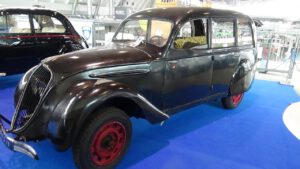
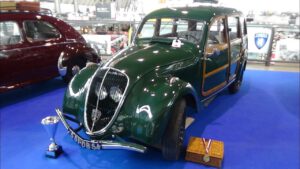
1937 Peugeot 402 DS DarlMat Sport Roadster – Exterior and Interior – Retro Classics Stuttgart 2017
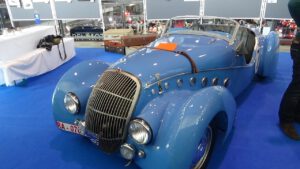
In the late 1930s, Peugeot briefly stepped into a more exclusive and performance-oriented world through its collaboration with Émile Darl’Mat. The Peugeot 402 Darl’Mat Sport Roadster is the most striking result of this partnership—combining aerodynamic thinking, coachbuilt craftsmanship, and competition ambitions in a limited-production automobile that stood apart from Peugeot’s regular lineup.
Technical Details
The 1937 Peugeot 402 DS Darl’Mat Sport Roadster was based on the mechanical foundation of the Peugeot 402 but significantly reworked for performance. It used a front-mounted inline four-cylinder engine derived from the standard 1,991 cc unit, but tuned to produce higher output—typically in the range of 70 to 80 horsepower depending on configuration.
A key technical feature was the use of triple carburetors, which improved fuel delivery and engine responsiveness compared to the standard single-carburetor setup. Power was transmitted to the rear wheels through a manual gearbox, and some examples were equipped with the advanced Cotal pre-selector transmission, offering smoother and faster gear changes.
The chassis was lowered and modified to improve handling, while weight reduction played an important role in enhancing performance. The combination of increased power and reduced mass allowed the Darl’Mat Roadster to achieve higher top speeds than the standard Peugeot 402, making it suitable for endurance racing. These cars were notably entered in events such as the 24 Hours of Le Mans, where their aerodynamic efficiency contributed to competitive performance in their class.
- Manufacturer: Peugeot
- Model name: Peugeot 402 DS Darl’Mat Sport Roadster
- Year of manufacturing: 1937
Design
The design of the Peugeot 402 Darl’Mat Sport Roadster departs dramatically from the standard Peugeot 402 sedan. While it retains the aerodynamic principles of the base model, the body was completely reinterpreted by French coachbuilder Pourtout, working closely with designer Georges Paulin.
The result is a low, flowing roadster with pronounced curves and a strong emphasis on streamlining. The front end integrates the characteristic Peugeot 402 grille with concealed headlights, but the proportions are far more dynamic. The fenders sweep smoothly into the body, and the rear tapers elegantly, reflecting the influence of aerodynamic research.
The windshield is low and raked, reinforcing the car’s sporting intent, while the absence of unnecessary ornamentation enhances its clean, purposeful appearance. Inside, the cabin is minimal and driver-focused, with attention given to weight reduction and functionality rather than comfort.
Historical Significance
The Darl’Mat variants of the Peugeot 402 were the result of an initiative by Émile Darl’Mat, a Peugeot dealer and racing enthusiast who sought to create a more performance-oriented version of the brand’s cars. With Peugeot’s support, a small series of special-bodied sports cars was produced, including roadsters, coupés, and cabriolets.
The 1937 Darl’Mat models gained particular recognition through their participation in endurance racing. At the 24 Hours of Le Mans, they achieved strong results in their class, demonstrating the effectiveness of their aerodynamic design and mechanical tuning. These successes contributed to Peugeot’s reputation in motorsport during the pre-war period.
Production numbers were very limited—only a few dozen examples were built—making the Darl’Mat Roadster a rare and highly sought-after collector’s car today. The project also illustrates how collaboration between manufacturers, dealers, and coachbuilders could lead to innovative and distinctive vehicles in the pre-war era.
Quirks and Pop Culture
One of the most distinctive aspects of the Peugeot 402 Darl’Mat Roadster is its origin. Unlike standard production cars, it emerged from a collaboration between a dealership, a coachbuilder, and the manufacturer itself. This unusual development path gives it a unique place in automotive history.
The involvement of Georges Paulin, who was not only a designer but also a dentist and inventor, adds another layer of intrigue. Paulin was responsible for several aerodynamic designs of the period and played a key role in shaping the car’s appearance.
Today, the Darl’Mat Roadster is frequently featured in concours events and classic car exhibitions, where its combination of rarity, design, and historical context attracts significant attention. It is often regarded as one of the most elegant French sports cars of the 1930s.
Display and preservation
This car was exhibited at the 17th edition of Retro Classics Stuttgart in 2017. Spanning around 130,000 square meters, with 1,600 exhibitors and over 3,000 vehicles, the event attracted some 90,000 visitors. Yet beyond sheer size, a noticeable shift defined the exhibition: pre-war automobiles, once dominant, had dwindled to just a small fraction, making way for younger classics and emerging collectibles. Italian automotive culture was very present in Hall C2. Rare pieces from renowned collections, alongside iconic Maserati models and lesser-seen marques, emphasized careful curation and historical depth. Beyond cars, motorcycles and even tractors were presented with equal attention. With many vehicles offered for sale, the event also reinforced its role as a living marketplace where automotive heritage continues to change hands and remain in active circulation.
Conclusion
The 1937 Peugeot 402 DS Darl’Mat Sport Roadster represents a unique intersection of performance, design, and collaboration. Built on the foundation of the Peugeot 402 but transformed through aerodynamic styling and mechanical enhancements, it offered capabilities far beyond the standard model. Its success in endurance racing, limited production, and distinctive coachbuilt design ensure its lasting significance as one of Peugeot’s most remarkable pre-war creations.