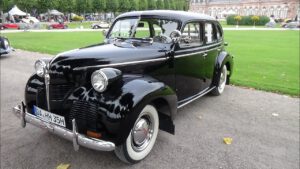
1937 – 1941 Mercedes-Benz 230 Cabrio – Exterior and Interior – Retro Classics Stuttgart 2022
The Mercedes-Benz 230 Cabriolet (W143) marked Mercedes-Benz’s push for more advanced engineering in the late 1930s.
Technical Details:
The Mercedes-Benz 230 Cabriolet (W143) came equipped with a 2,229 cc inline-six engine, delivering 55 horsepower at 3,600 rpm. This powerplant was paired with a fully synchronized 4-speed manual transmission, an upgrade from its predecessor’s three-speed setup. The chassis employed independent suspension on all four wheels—dual transverse leaf springs in front and half swing-axles in the rear—providing superior ride comfort. The car utilized hydraulic drum brakes on all wheels, a rear-wheel drive (FR) layout, and a rigid X-frame chassis that provided exceptional durability. With 16-inch tires on wider rims and double-acting hydraulic rear shock absorbers, the 230 Cabrio could reach a top speed of approximately 110 km/h (72 mph), making it a technically advanced vehicle for its time.
- Manufacturer: Mercedes-Benz
- Model Name: 230 Cabriolet (W143)
- Year of Manufacturing: 1937–1941
Design:
The design of the 230 Cabriolet embodied the luxury and craftsmanship of pre-war Germany. With a long hood, elegant flowing fenders, and the classic upright Mercedes grille—subtly raked for a sleeker silhouette—it exuded sophistication. The vehicle featured integrated spherical headlamps, replacing the earlier transverse lighting bar for a more modern look. A canvas folding roof, polished wooden interior trim, and finely crafted leather seats offered both functionality and opulence. The Cabrio’s side-mounted spare tire, spoked wheels, and sweeping windshield added sporty flair to its otherwise stately appearance. Most units of that series were closed-body versions, which were mainly used in government and taxi services. In addition, there were six-seater open touring cars and three different cabriolets: the two-seater A, the four-seater B, and the four-door D.
Historical Significance:
The 230 Cabrio (W143) marked Mercedes-Benz’s push for more advanced engineering in the late 1930s. Produced from 1937 to 1941, it was introduced as the successor to the Typ 230 (W21). Approximately 20,000 units (including sedans and cabriolets) were produced by 1941, making it a commercial success in its class. It arrived on the eve of World War II, becoming one of the last new Mercedes models before civilian production halted. The car’s all-independent suspension was innovative, bringing big-car comfort to a mid-size luxury model. It catered to affluent buyers who appreciated engineering pedigree – even German military and officials ordered some 230 Cabriolets for staff use during the war. In retrospect, the 230 Cabrio bridged the pre-war and post-war eras: its engineering influenced post-war designs, and its production run (ending in 1941) bookended Mercedes’ pre-war development.
Quirks and Pop Culture:
While not as globally famous as the supercharged Mercedes of its day, the 230 Cabrio holds its own charm. In modern times, it has gained attention through period dramas and vintage car shows – for instance, a similar “Mercedes Cabriolet” appears in scenes of the 1930s-set series Babylon Berlin, underscoring its role as an icon of pre-war Germany. A quirky fact is that the 230 Cabrio was offered in three different cabriolet body styles, giving buyers options from a sporty two-seater to a family four-door convertible – a flexibility rare in today’s market. Collectors nicknamed it the “Baby Mercedes Tourer” for its smaller size compared to the grand 500K/540K. Surviving examples often feature in retro rallies, their elegant lines evoking an era of chauffeur-driven dignitaries. Though overshadowed by later post-war models, the 230 Cabrio remains a classic Mercedes-Benz model cherished by enthusiasts for its engineering innovations and Art Deco-era style.
Display and preservation:
The vehicle was exhibited at the Retro Classics Stuttgart in 2022. This car show is one of the major events on the classic car calendar in Germany. In 2022, it took place across five exhibition halls. Visitors can enjoy special showcases, hunt for rare parts and books, and buy cars—both private sellers and dealers offer a wide range of classic and youngtimer vehicles. In 2022, there was a noticeable increase in low-mileage youngtimers and classic cars.
Conclusion:
The Mercedes-Benz 230 Cabrio (W143) combined advanced engineering with 1930s luxury, making it an important chapter in the marque’s history. Its robust inline-six, fully independent suspension, and choice of elegant cabriolet bodies delivered a lively yet refined driving experience for the well-heeled drivers of its day. With its stylish design and technical firsts, the 230 Cabrio stands as a vintage Mercedes convertible that bridged eras – from pre-war innovation to post-war influence. Today, it is celebrated as a rolling piece of history, symbolizing Mercedes-Benz’s commitment to luxury and engineering excellence even in tumultuous times.
Sources:
Mercedes-Benz Classic Archives: https://www.mercedes-benz.com/en/classic/
Wikipedia – Mercedes-Benz W143: https://en.wikipedia.org/wiki/Mercedes-Benz_W143
Hemmings – Mercedes-Benz Cabrio Overview: https://www.hemmings.com/
German Classic Car Registry: https://www.oldtimer-veranstaltung.de/
Oswald, Werner “Mercedes-Benz Cars 1886–2001”
Ultimate Car Page – W143 Technical Specs: https://www.ultimatecarpage.com/
Schlegelmilch, Rainer W, Lehbrink, Hartmut, von Osterroth, Joch (2013) “Mercedes”, h.f.ullmann publishing GmbH
Kittler, Eberhard (2008), “Typenkompass. Jubiläumsedition. Mercedes-Benz.“ Motorbuch Verlag