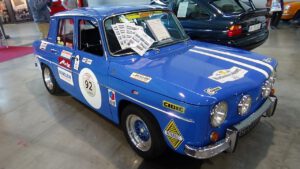
1935 Morris 8 – Exterior and Interior – Oldtimer-Meeting Baden-Baden 2022
At a moment when affordable and practical cars were reshaping transport in Britain, the 1935 Morris 8 arrived as a confident answer to a growing demand. Compact yet fully equipped for its era, it impressed buyers by combining technical modernity with accessible price and broad usability. Within months of launch it became one of the United Kingdom’s most common small cars, helping its maker return to market leadership.
Technical Details:
The 1935 Morris 8 was powered by a Morris UB series 918 cm³ four-cylinder side-valve engine with a three-bearing crankshaft and single SU carburettor, producing around 23.5 bhp at typical operating speeds. The engine drove the rear wheels through a three-speed manual transmission with synchromesh on the higher two gears. Hydraulic drum brakes on all four wheels were fitted as standard, a relatively modern feature at the time, and the suspension used semi-elliptic leaf springs both front and rear on a separate channel-section chassis. The car’s electrical system was a Lucas 6-volt unit with coil ignition. Typical top speeds were around 60 mph with reasonably economical consumption in the high 30s-to-40s mpg (Imperial) depending on variant.
- Manufacturer: Morris Motors Ltd
- Model Name: Morris 8 Series I
- Year of Manufacturing: 1935
Design:
The Morris 8’s design carried clear visual cues of mid-1930s small-car styling, with a compact bodyhape that prioritized interior space efficiency. Early Series I models featured a chrome-plated radiator shell with a honeycomb grille that was largely cosmetic; the real cooling core sat behind it. Wheel options included wire-spoke wheels early on, later transitioning to Easiclean disc types as the series evolved. Interior accommodation was simple but complete for its class, with a full dashboard incorporating a speedometer, oil pressure, fuel level, and ammeter gauges. The seating layout could vary from two-seat tourer to four-door saloon, and options included features such as a “sunshine” roof. Functional elements like an electric windscreen wiper outclassed some competitors that still used vacuum-powered devices.
Historical Significance:
Introduced for the 1935 model year at a time when small family cars were rapidly expanding in the British market, the Morris 8 was conceived to rival other compact contemporaries such as the Ford Model Y and the Austin 7. Its launch marked a strategic success for Morris Motors; over 164,000 units of the Series I were produced before its replacement by updated Series II and Series E variants, making it one of the company’s best-selling pre-war cars. The 8’s sales performance helped Morris regain and sustain its position as Britain’s largest car manufacturer by volume in the late 1930s, anchoring its economic recovery strategy during unsettled times. The Morris 8 also contributed to automotive technology diffusion by mainstreaming hydraulic brakes for small cars and integrating relatively complete instrumentation for ordinary owners—features not universally available on cars of similar price at the time.
Quirks and Pop Culture:
The 1935 Morris 8 earned affection among early motorists not just as an economical runabout but also as a recognizable fixture of British roads. Its varied body styles—ranging from two- and four-door saloons to tourers—meant the 8 appeared across different facets of life, from town use to seaside touring. In later decades, restored examples became popular at classic car events, appreciated for their period charm and mechanical simplicity. Vintage models also surfaced in cultural references; for instance, a Morris Eight tourer was noted for appearances in media reflecting mid-20th century British rural life, enjoying a renewed visibility among enthusiasts and period dramatizations.
Display and preservation:
The vehicle was exhibited at the Oldtimer-Meeting Baden-Baden in 2022. Set in the elegant spa gardens of Baden-Baden, this open-air event is one of Germany’s most atmospheric classic car gatherings. The 2022 edition marked the 46th year of the meeting and featured over 350 carefully selected vintage vehicles from across Europe. With its picturesque backdrop and festive ambiance, the event draws thousands of visitors who stroll among historic automobiles, enjoy live music, and take in themed displays. In 2022, American classics and convertibles were especially well represented, reflecting the event’s continued celebration of both international and domestic automotive heritage.
Conclusion:
The 1935 Morris 8 offered a compelling blend of technical competence, thoughtful design, and accessible usability. Powered by a modest yet reliable engine, equipped with advanced (for its class) brakes and instrumentation, and offered in multiple body configurations, it quickly became a best-seller. Its success in the highly competitive pre-war automotive market helped cement Morris Motors’ leadership in Britain and ensured the 8’s place in the history of affordable motoring. Today, the Morris 8 remains a valued presence among classic car collectors and a testament to mid-20th-century automotive practicality.