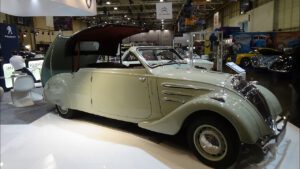
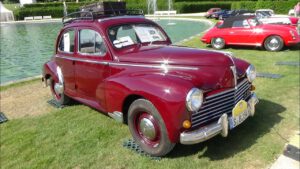
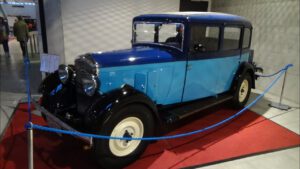
1934 Peugeot 402 Eclipse – Exterior and Interior – Techno Classica Essen 2015
The idea of a car that could transform from a closed coupé into an open cabriolet at the push of a mechanism was already realized in the 1930s. The 1934 Peugeot 402 Eclipse stands as one of the earliest production cars to feature a retractable hardtop—an innovation that would only become widespread decades later.
Technical Details
From a technical perspective, the Peugeot 402 Eclipse was based on the broader Peugeot 402 platform introduced in 1935, although development of the Eclipse system began earlier in the mid-1930s. The car was powered by a front-mounted inline four-cylinder engine with a displacement of approximately 1,991 cc. Output figures are generally cited around 55 horsepower, delivered through a manual transmission to the rear wheels. This configuration allowed for a top speed in the region of 120 km/h, placing the car comfortably within the performance expectations of mid-range vehicles of its era.
The defining technical feature, however, was the electrically operated retractable hardtop. Designed by Georges Paulin, a dentist and automotive enthusiast, and engineered in collaboration with coachbuilder Carrosserie Pourtout, the system allowed the steel roof to fold and retract into the rear compartment. This mechanism was complex for its time, involving electric motors, articulated joints, and careful packaging within the body structure. The integration of this system required structural reinforcement, as removing a fixed roof reduced overall body rigidity. As a result, the Eclipse combined conventional chassis engineering with an unusually advanced body mechanism for the period.
- Manufacturer: Peugeot
- Model name: Peugeot 402 Eclipse
- Year of manufacturing: 1934–1940
Design
The design of the Peugeot 402 Eclipse reflects the streamlined aesthetic that defined late-1930s automotive styling. The body features smooth, flowing lines, with integrated fenders and a pronounced aerodynamic profile. One of its most distinctive visual elements is the covered front grille, behind which the headlights are mounted—an approach that contributed to improved airflow and gave the car a clean, modern appearance.
In coupé form, the Eclipse presents a cohesive, enclosed silhouette with a gently sloping roofline. When the roof is retracted, the transformation into an open car significantly alters its proportions, emphasizing the long hood and rear deck. The transition between these two configurations was carefully considered, ensuring that the car retained visual balance in both states.
Inside, the cabin was typical of Peugeot’s mid-range offerings of the time, with a focus on functionality and restrained comfort. Materials and finishes reflected the standards of the late 1930s, while the overall layout remained conventional despite the car’s innovative roof system.
Historical Significance
The Peugeot 402 Eclipse occupies a unique position in automotive history as one of the first production cars to feature a retractable hardtop. The concept was developed by Georges Paulin, whose design was patented in 1934. Peugeot recognized the potential of the idea and brought it into limited series production, making the Eclipse a rare example of pre-war innovation reaching the market.
This development must be understood within the broader context of the 1930s, a period marked by rapid experimentation in automotive design and engineering. Streamlining, new body constructions, and increasing attention to aerodynamics were shaping the industry. The Peugeot 402 itself embodied these trends, while the Eclipse variant added a further layer of technical ambition.
Production numbers for the Eclipse were relatively low, reflecting both the complexity of the mechanism and the niche market for such a vehicle. The outbreak of the Second World War brought an end to production, limiting its immediate influence. However, the concept would resurface decades later, notably in post-war convertible-coupé designs.
Quirks and Pop Culture
One of the most notable quirks of the Peugeot 402 Eclipse lies in its origin story. Georges Paulin, the inventor of the retractable hardtop, was not an automotive engineer by profession but a dentist. His involvement in car design highlights the experimental and interdisciplinary nature of the automotive world in the interwar period.
Another striking aspect is how far ahead of its time the Eclipse concept was. While retractable hardtops became popular in the late 20th and early 21st centuries, the Peugeot 402 Eclipse had already demonstrated the feasibility of such systems in the 1930s. This temporal gap has contributed to its reputation as a pioneering design.
Although the car did not achieve widespread cultural visibility in films or mass media, it is frequently referenced in automotive history as a precursor to later convertible-coupé models. Among collectors and historians, it is regarded as a technical curiosity that anticipated future trends.
Display and preservation
This car was filmed at the Techno Classica Essen 2015. Held from April 15 to 19, the 27th edition of the motor fair transformed the Essen showgrounds into a vibrant hub of automotive heritage. With around 190,000 visitors, the event showcased an extraordinary spectrum of classic and prestige vehicles across both indoor halls and open-air spaces. Over 1,250 exhibitors and 220 clubs highlighted their restoration work, rare parts, and preservation expertise. Numerous anniversaries—from the Porsche 356 to the Citroën DS—added historical depth, reinforcing the fair’s role as a global marketplace and living archive of classic motoring culture.
Conclusion
The 1934 Peugeot 402 Eclipse combines conventional pre-war engineering with an unusually forward-looking concept. Its four-cylinder engine and rear-wheel-drive layout reflect established practice, while its retractable hardtop represents a significant innovation in automotive design. Visually aligned with the streamlined aesthetics of the late 1930s, the car stands out for its dual identity as both coupé and convertible.
Historically, the Eclipse demonstrates how experimentation in the interwar period could produce ideas that would only gain broader acceptance decades later. Though produced in limited numbers, it remains an important reference point in the evolution of convertible design—an early example of a solution that would later become a recurring theme in automotive engineering.