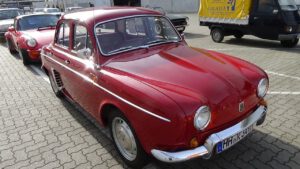
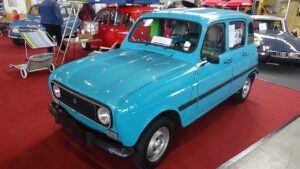
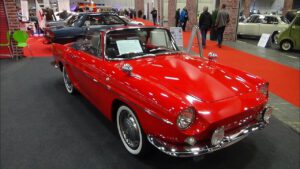
1929 Fiat 514 – Exterior and Interior – Retro Classics Stuttgart 2022
The Fiat 514 entered the market at a time when European carmakers were refining the idea of the compact family car rather than reinventing it. Introduced as a replacement for the Fiat 509, it was designed to be mechanically dependable, economically viable, and suitable for large-scale production. In 1929, the 514 represented Fiat’s intention to stabilize and standardize its passenger-car range as motoring became a normal part of middle-class life.
Technical Details:
The Fiat 514 was powered by a front-mounted inline four-cylinder petrol engine with a displacement of 1,438 cc. The side-valve unit produced approximately 28 horsepower, an output that favored smooth operation and durability over performance. Power was transmitted to the rear wheels through a four-speed manual gearbox, notable for offering four forward ratios at a time when many competitors still relied on three-speed units. The drivetrain followed a conventional front-engine, rear-wheel-drive layout. The chassis was based on a ladder-frame construction with rigid axles front and rear, suspended by semi-elliptic leaf springs. Braking was handled by mechanically actuated drum brakes on all four wheels. The technical configuration emphasized ease of maintenance, predictable handling, and suitability for varying road conditions, particularly in southern and eastern Europe.
- Manufacturer: Fiat
- Model Name: Fiat 514
- Year of Manufacturing: 1929–1932
Design:
In design terms, the Fiat 514 reflected late-1920s conventions rather than experimentation. Its proportions were upright and compact, with a clearly defined hood, passenger compartment, and rear section. The radiator grille was vertical and restrained, framed by separate headlamps mounted on a crossbar, reinforcing the car’s conservative appearance. Fenders were rounded and clearly articulated, while running boards connected the front and rear visually and functionally.
The Fiat 514 was offered in multiple body styles, including two- and four-door saloons, torpedo versions, and cabriolet configurations, allowing buyers to select a balance between practicality and openness. Interiors were straightforward, prioritizing durability and clarity. Instrumentation was limited but legible, and materials were chosen for robustness rather than decoration. Overall, the design communicated reliability and familiarity, qualities that were central to Fiat’s appeal at the time.
Historical Significance:
The Fiat 514 was developed during a period of consolidation for the European automotive industry. Following rapid expansion in the early 1920s, manufacturers increasingly focused on rationalizing production and reducing costs. For Fiat, the 514 played an important role in maintaining a competitive presence in the lower middle-class segment, particularly as economic conditions became more uncertain toward the end of the decade.
Production of the Fiat 514 extended beyond Italy. Assembly took place in several countries under license, including Germany, Poland, and France, reflecting Fiat’s early strategy of international industrial cooperation. This approach allowed the 514 to reach markets where import duties or local regulations favored domestic assembly. With approximately 30,000 units produced, the model was not a mass phenomenon on the scale of some contemporaries, but it contributed meaningfully to Fiat’s European footprint during the interwar years. The 514 also helped bridge the gap between Fiat’s earlier small cars and the more modern, mass-produced models that would follow in the 1930s.
Quirks and Pop Culture:
The Fiat 514 is not strongly associated with popular culture, but it developed a quiet reputation as a dependable everyday car. In some markets, it was favored by professionals such as doctors and small business owners who valued reliability and manageable running costs. A technical quirk often noted by enthusiasts is the four-speed gearbox, which gave the 514 more flexibility on hilly terrain than many rivals with fewer ratios.
Today, surviving examples are more commonly encountered in continental Europe than in Italy alone, reflecting the car’s international production history. At classic car events, the Fiat 514 is often appreciated for its honest engineering and understated presence rather than rarity or spectacle.
Display and preservation:
The vehicle was exhibited at the Retro Classics Stuttgart in 2022. This car show is one of the major events on the classic car calendar in Germany. In 2022, it took place across five exhibition halls. Visitors can enjoy special showcases, hunt for rare parts and books, and buy cars—both private sellers and dealers offer a wide range of classic and youngtimer vehicles. In 2022, there was a noticeable increase in low-mileage youngtimers and classic cars.
Conclusion:
The 1929 Fiat 514 was a product of careful industrial thinking rather than bold innovation. With its four-cylinder engine, four-speed gearbox, and conservative chassis design, it delivered dependable transportation suited to a wide range of conditions. Its restrained styling and international production strategy illustrate Fiat’s effort to stabilize and expand its reach during a period of economic and technological transition. As such, the Fiat 514 stands as a representative example of how European manufacturers approached practical motoring at the close of the 1920s.