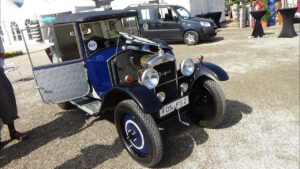
1926 Peugeot Quadrilette 172R – Exterior and Interior – Retro Classics meets Barock Ludwigsburg 2015
The Peugeot Quadrilette 172R reflects a pragmatic response to the economic realities of the 1920s. Designed as a lightweight and affordable vehicle, it offered a simplified approach to motoring at a time when car ownership was still out of reach for many. Its compact proportions and unconventional layout make it one of the more distinctive Peugeot models of the interwar period.
Technical Details
The Peugeot Quadrilette 172R was powered by a front-mounted inline two-cylinder engine with a displacement of approximately 720 cc. This small-capacity engine produced modest power—around 10 horsepower—sufficient for lightweight mobility rather than performance. Power was transmitted to the rear wheels through a manual gearbox, following a simple and robust mechanical layout. The car featured a very lightweight chassis and minimal bodywork, contributing to low fuel consumption and ease of maintenance. Suspension relied on basic leaf spring arrangements, while braking was handled by mechanically operated drum brakes. The emphasis was clearly on simplicity, low cost, and functional reliability.
- Manufacturer: Peugeot
- Model name: Peugeot Quadrilette 172R
- Year of manufacturing: 1926
Design
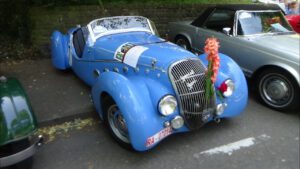
The design of the Peugeot Quadrilette 172R was defined by economy and minimalism. Its most notable feature was the tandem seating arrangement, where the passenger sat directly behind the driver rather than beside them. This unusual configuration allowed the car to remain extremely narrow, reducing material use and improving efficiency.
The bodywork was sparse, with exposed wheels, simple fenders, and a compact, upright grille. The overall form was lightweight and utilitarian, lacking the visual mass of larger contemporary cars. The narrow track and reduced width gave the Peugeot Quadrilette a distinctive appearance, closer in spirit to a cyclecar than a conventional automobile. Inside, the cabin offered only essential controls, with no concessions to luxury or extensive comfort.
Historical Significance
The Peugeot Quadrilette was introduced in the early 1920s as part of a broader movement toward affordable motoring in Europe. In the aftermath of the First World War, economic constraints and changing social conditions created demand for smaller, more economical vehicles. The Peugeot Quadrilette addressed this need directly, offering a low-cost alternative to larger and more complex cars.
The 172R variant represents a later development within this concept, refining the original idea while maintaining its core principles. It also reflected taxation policies in France at the time, which favored smaller engine capacities and lightweight vehicles. By producing cars like the Peugeot Quadrilette, Peugeot was able to reach a broader customer base and strengthen its position in the emerging market for accessible transportation.
Quirks and Pop Culture
The tandem seating arrangement remains the most memorable and unusual aspect of the Peugeot Quadrilette. While practical in terms of reducing width and cost, it created a driving experience quite different from conventional cars, with the passenger positioned directly behind the driver.
The Peugeot Quadrilette is often associated with the “cyclecar” movement of the 1920s, a category of small, lightweight vehicles that blurred the line between motorcycles and automobiles. Although it did not achieve widespread recognition in modern pop culture, it is frequently highlighted in automotive history as an example of innovative thinking driven by economic necessity.
Display and preservation
This car was filmed at the 12th edition of Retro Classics meets Barock. Set against the ornate gardens of Ludwigsburg, the 2015 show offered a refined celebration of automotive heritage. From June 5th to 7th, around 25,000 visitors gathered in the grounds of the Blühendes Barock, where historic vehicles were displayed against the striking backdrop of the royal palace. The event combined a prestigious Concours d’Elegance with a vibrant festival atmosphere, featuring 47 exceptional premium cars and around 140 classic vehicles. Awards for authenticity, design, and even period-correct fashion added a distinctive cultural dimension, culminating in a gala evening and fireworks.
Conclusion
The 1926 Peugeot Quadrilette 172R stands as a clear expression of early efforts to democratize car ownership. Its small two-cylinder engine, lightweight construction, and unconventional tandem layout reflect a focus on efficiency and affordability above all else. While modest in performance and equipment, it played an important role in expanding access to personal mobility. Today, the Peugeot Quadrilette is remembered less for technical sophistication than for its inventive approach to solving the challenges of its time.