1926 – Peugeot Quadrilette – Retro Classics meets Barock Ludwigsburg 2016
Conceived as one of Peugeot’s smallest and most economical cars, the Peugeot Quadrilette reflects a period when simplicity and affordability defined automotive progress. Its narrow track and lightweight construction gave it an appearance closer to a cyclecar than a conventional automobile, yet it played a clear role in expanding access to motorized transport.
Technical Details
The 1926 Peugeot Quadrilette was powered by a small-displacement inline two-cylinder engine, typically around 667 cc. This compact unit produced approximately 9 to 10 horsepower, sufficient for a lightweight vehicle designed primarily for urban and short-distance use. The engine was mounted at the front and drove the rear wheels through a manual gearbox, following a conventional drivetrain layout despite the car’s minimal proportions.
The Peugeot Quadrilette’s engineering emphasized weight reduction and efficiency. Its chassis was extremely light, allowing modest power output to translate into usable performance. Top speed figures were generally around 60 km/h, aligning with its intended role as an economical personal vehicle rather than a touring car.
Suspension relied on simple, robust solutions typical of the mid-1920s, including rigid axles and leaf springs. Braking was provided by mechanical drum brakes, usually acting on the rear wheels only in earlier configurations, reflecting the transitional state of braking technology at the time. Overall, the technical concept focused on accessibility, low running costs, and ease of maintenance.
- Manufacturer: Peugeot
- Model name: Peugeot Quadrilette
- Year of manufacturing: 1926
Design
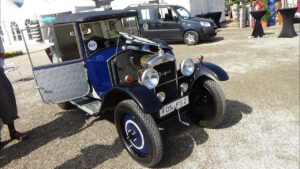
The design of the Peugeot Quadrilette was defined by minimalism and narrow proportions. One of its most distinctive features was its reduced track width, which gave the car a noticeably slim profile compared to standard automobiles of the period. This configuration contributed to lower material usage and reduced weight, reinforcing its economical purpose.
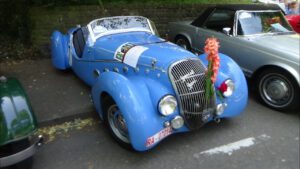
The body was compact and upright, with separate fenders, exposed wheels, and a simple front grille. The overall appearance reflected the transition from cyclecars to more standardized automobiles, combining elements of both categories. Open-body configurations were common, including two-seater layouts with minimal weather protection.
Inside, the cabin was basic, offering only essential controls and instrumentation. Seating was arranged in a simple configuration, sometimes staggered slightly due to the narrow width of the car. Comfort features were limited, but the layout made efficient use of space within the compact dimensions.
Historical Significance
The Peugeot Quadrilette was introduced in the early 1920s as part of a broader movement toward small, affordable vehicles in Europe. In the aftermath of the First World War, economic conditions created demand for inexpensive transportation, leading manufacturers to explore lightweight and simplified designs.
Peugeot positioned the Peugeot Quadrilette as an entry-level car, targeting customers who might otherwise consider motorcycles or cyclecars. Its production contributed to the brand’s ability to reach a wider audience during a period of economic recovery.
By the mid-1920s, including 1926, the Peugeot Quadrilette had established itself as a practical solution for basic mobility. However, as automotive technology advanced and consumer expectations grew, the limitations of such minimalist designs became more apparent. This shift eventually led manufacturers, including Peugeot, to move toward more conventional small cars with greater comfort and capability.
Quirks and Pop Culture
One of the most notable quirks of the Peugeot Quadrilette was its narrow track, which sometimes resulted in unusual seating arrangements. In certain versions, the passenger seat was positioned slightly behind or offset from the driver’s seat to accommodate the car’s slim body. This gave the vehicle a distinctive interior layout rarely seen in later automobiles.
The Peugeot Quadrilette is often associated with the broader cyclecar movement of the 1920s, a category that blurred the line between motorcycles and cars. While it did not achieve the cultural prominence of later mass-market vehicles, it represents a specific moment in automotive history when experimentation with size, cost, and usability was widespread.
Today, the Peugeot Quadrilette is remembered more for its concept than for widespread cultural references. Its simplicity and unusual proportions make it a recognizable example of early efforts to democratize car ownership.
Display and preservation
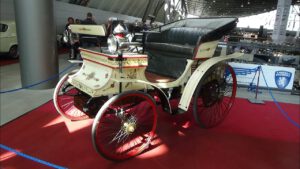
This car was filmed in Ludwigsburg. “Retro Classics meets Barock” 2016 offered a refined interpretation of classic car display, set against the grand courtyard of the Royal Palace. Limited to vehicles built between 1886 and 1968, the Concours d’Élégance emphasized authenticity, craftsmanship, and historical relevance. The baroque backdrop, enhanced by evening illuminations and artistic performances, elevated the presentation into a cultural experience. Highlights such as the rare Facel Vega gathering underscored the exclusivity of the event. Rather than sheer quantity, the focus lay on careful selection and elegant staging—demonstrating how preservation can merge seamlessly with heritage and atmosphere.
Conclusion
The 1926 Peugeot Quadrilette illustrates a focused attempt to make motoring accessible through simplicity and efficiency. Its small two-cylinder engine, lightweight construction, and minimal design reflect the economic realities of its time. While later developments would render such extreme minimalism obsolete, the Peugeot Quadrilette played a meaningful role in broadening access to personal transportation. It stands as a reminder that early automotive progress was not only about speed or luxury, but also about affordability and practical innovation.