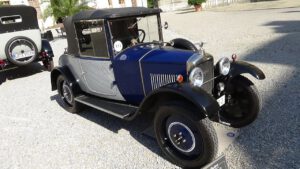
1926 Peugeot Quadrilette 172R – Retro Classics meets Barock Ludwigsburg 2018
Small, lightweight, and built for a very specific moment in European motoring, the Peugeot Quadrilette reflects how manufacturers adapted to economic constraints after the First World War. The 172R version, introduced in the mid-1920s, shows how incremental development could refine a minimalist concept into a more usable everyday car. Despite its modest ambitions, it played a clear role in keeping individual mobility accessible in interwar France.
Technical Details
The 1926 Peugeot Quadrilette 172R was engineered as a compact and economical vehicle, designed to comply with the French “cyclecar” tax class, which imposed limits on engine size and weight. It was powered by a small front-mounted inline four-cylinder engine with a displacement of approximately 720 cc. Power output is generally cited around 14 horsepower, delivered through a simple rear-wheel-drive layout. This configuration was sufficient to reach modest speeds of around 60–65 km/h, aligning with the car’s intended use for short-distance and urban mobility.
The mechanical layout remained deliberately simple. The lightweight chassis and minimal bodywork contributed to low fuel consumption and ease of maintenance. Braking systems were mechanical and relatively basic, reflecting the standards of the early 1920s. Compared to earlier Peugeot Quadrilette versions, the 172R introduced improvements in stability and usability, including a more conventional seating arrangement rather than the earlier tandem layout. The car’s engineering philosophy emphasized affordability, efficiency, and compliance with regulatory constraints rather than performance or technical innovation.
- Manufacturer: Peugeot
- Model name: Peugeot Quadrilette 172R
- Year of manufacturing: 1926
Design
Visually, the Peugeot Quadrilette 172R remained closely tied to its cyclecar origins, with compact proportions and a narrow track that reflected its lightweight construction. The body was typically open, often in a two-seat configuration, with minimal protection from the elements. Compared to the earliest Peugeot Quadrilette, the 172R adopted a more conventional side-by-side seating layout, which made it more practical for everyday use and aligned it more closely with standard automobiles of the time.
The front end featured a simple, upright grille and exposed headlights, while the fenders were lightly shaped and separate from the main body. The overall form was functional rather than decorative, with little emphasis on ornamentation. Inside, the cabin was sparse, offering only essential controls and instrumentation. The design conveyed a sense of mechanical honesty, where every element served a clear purpose.
Historical Significance
The Peugeot Quadrilette series emerged in the early 1920s as a response to economic realities in post-war Europe. Many buyers could not afford full-sized automobiles, and taxation systems in countries like France encouraged the development of small, lightweight vehicles. Peugeot positioned the Peugeot Quadrilette as an accessible entry point into motoring, targeting customers who needed basic transportation rather than luxury or performance.
The 172R represented a later evolution of this concept. By moving away from the earlier tandem seating arrangement and improving usability, Peugeot made the car more appealing to a broader audience. This shift reflected a wider transition in the automotive market, where cyclecars gradually gave way to more conventional small cars. While production numbers were modest compared to later Peugeot models, the Peugeot Quadrilette helped the company maintain a presence in the lower end of the market during a challenging economic period.
Quirks and Pop Culture
One of the most notable quirks of the early Peugeot Quadrilette models was their tandem seating layout, where the passenger sat behind the driver—an unusual configuration even at the time. The 172R’s move to side-by-side seating marked a clear departure from this concept, making it feel more like a “real” car and less like a transitional vehicle between motorcycle and automobile.
The Peugeot Quadrilette also reflects a broader cultural moment in which lightweight vehicles were seen as practical solutions rather than compromises. While it did not achieve the iconic cultural status of later small cars, it remains a recognizable example of the cyclecar era, often appearing in classic car collections and exhibitions as a representation of early mass-mobility efforts.
Display and preservation
This car was filmed at the Retro Classics meets Barock event. In June 2018, the historic courtyard of Ludwigsburg Palace once again became a stage for automotive heritage. Around 20,000 visitors experienced a unique fusion of engineering passion and baroque elegance. Highlights included the Concours d’Élégance, celebrating automotive beauty, alongside special showcases dedicated to Jaguar and Hispano-Suiza. Historic fire engines, guided palace tours, and the presence of private classic cars within the courtyard completed this refined celebration of preservation and display.
Conclusion
The 1926 Peugeot Quadrilette 172R stands as a concise example of how automotive design adapted to economic and regulatory pressures in the 1920s. Its small engine, lightweight construction, and simplified engineering made it accessible and practical, while its updated layout improved everyday usability. Although it belongs to a transitional category of vehicles, the Peugeot Quadrilette played a meaningful role in broadening access to motoring and illustrates an important phase in Peugeot’s early history.