1926 Peugeot Quadrilette 172R – Oldtimer-Meeting Baden-Baden 2019
In the mid-1920s, Peugeot addressed a growing demand for affordable, lightweight automobiles with a model that emphasized simplicity and efficiency. The Peugeot Quadrilette 172R represents the later evolution of this concept, refining a formula that had already proven successful earlier in the decade. Compact in size and modest in performance, it was designed to make individual mobility accessible to a broader segment of the population.
Technical Details
The Peugeot Quadrilette 172R was powered by a front-mounted inline four-cylinder engine with a displacement of approximately 720 cc. Power output is generally cited at around 10 horsepower, a modest figure even by the standards of the time, but sufficient for a lightweight vehicle intended for short-distance and urban use.
The drivetrain followed a conventional layout, with power transmitted to the rear wheels via a manual gearbox. The car’s low weight was a key factor in its usability, allowing it to achieve adequate performance despite limited engine output.
Construction relied on a simple chassis with a lightweight body, reflecting the need to minimize both production costs and fuel consumption. The suspension setup used rigid axles and leaf springs, a standard solution in the 1920s, while braking was provided by mechanical drum brakes, typically acting on the rear wheels only in earlier configurations.
The 172R version represented an evolution of earlier Peugeot Quadrilette models, with improvements in drivability and overall robustness while maintaining the same fundamental engineering approach.
- Manufacturer: Peugeot
- Model name: Peugeot Quadrilette 172R
- Year of manufacturing: 1926
Design
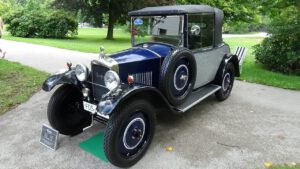
The design of the Peugeot Quadrilette 172R was defined by its compact proportions and minimalistic approach. Its narrow body and short wheelbase gave it a distinctive, almost delicate appearance compared to larger contemporary cars.
One of its most characteristic features was the tandem seating arrangement used in earlier Peugeot Quadrilette versions, where the passenger sat behind the driver. By the time of the 172R, side-by-side seating became more common, improving practicality while slightly widening the body.
The front featured a simple, upright grille with exposed headlamps mounted on either side. The fenders were separate and clearly defined, following the design conventions of the 1920s. The overall form was functional rather than decorative, with little emphasis on ornamentation.
The open body style, often in a torpedo or roadster configuration, reinforced the car’s lightweight and economical character. Inside, the layout was extremely basic, with minimal instrumentation and controls focused solely on driving functions.
Historical Significance
The Peugeot Quadrilette series was introduced in the early 1920s as Peugeot’s response to the need for affordable small cars in post-World War I Europe. At a time when many automobiles remained expensive and inaccessible, the Peugeot Quadrilette provided a practical alternative.
The 172R variant represents the later stage of this development, incorporating lessons learned from earlier models while maintaining the original concept. It played a role in establishing Peugeot’s reputation for producing accessible and reliable vehicles.
These small cars were particularly important in expanding car ownership beyond wealthier customers. By reducing size, weight, and complexity, Peugeot was able to offer a vehicle that met the economic realities of the time.
The Peugeot Quadrilette would eventually be replaced by more advanced small cars, but its influence can be seen in Peugeot’s continued focus on compact, efficient vehicles throughout its history.
Quirks and Pop Culture
One of the most notable aspects of the Peugeot Quadrilette is its unusual seating arrangement in early versions, which earned it a distinctive place in automotive history. The tandem layout was primarily a solution to tax regulations and cost constraints, as narrower cars could fall into more favorable categories.
The car’s extremely compact size also contributed to its identity. Compared to larger vehicles of the era, it appeared almost minimalistic, reinforcing its role as an entry-level automobile.
While it did not achieve widespread recognition in popular media, the Peugeot Quadrilette is often referenced in discussions of early mass mobility in Europe. It represents a period when manufacturers experimented with unconventional layouts to make cars more accessible.
Display and preservation
The vehicle was exhibited at the Oldtimer-Meeting Baden-Baden in 2019, one of Germany’s most elegant open-air gatherings for historic automobiles. Held from 12 to 14 July in the Kurpark, the event presented more than 350 exclusive classic cars spanning nine decades of motoring history and attracted over 20,000 visitors. The 2019 edition paid tribute to Bentley’s centenary with a special guest display dedicated to the British marque. As a traditional Concours d’élégance, the meeting concluded with awards for 120 outstanding vehicles, while jazz, fashion elements, and evening garden festivities added to its distinctive atmosphere.
Conclusion
The 1926 Peugeot Quadrilette 172R stands as a clear example of early efforts to democratize automobile ownership. With its small-displacement engine, lightweight construction, and straightforward engineering, it prioritized affordability and practicality over performance. Its design reflected the constraints and creativity of the 1920s, while its historical role highlights Peugeot’s contribution to expanding access to personal transportation. Today, it remains an important reference point for understanding the development of small cars in the early automotive era.