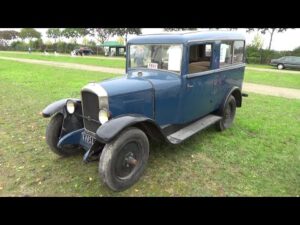
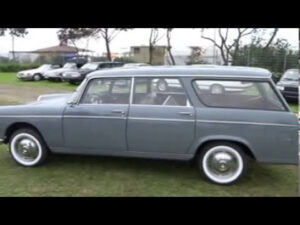
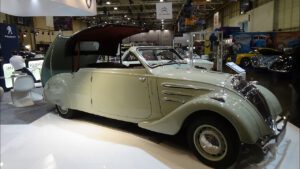
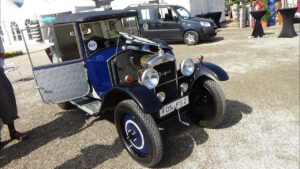
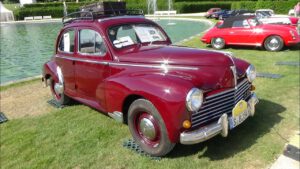
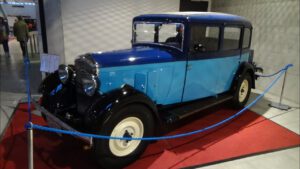
1926 Peugeot 177 Taxi – Auto Show Veterama 2014
In the mid-1920s, Peugeot was already an established manufacturer, refining its approach to reliable, mid-sized automobiles. The 1926 Peugeot 177 reflects this phase, combining conventional engineering with incremental improvements aimed at everyday usability.
Technical Details
The Peugeot 177 was powered by a front-mounted inline four-cylinder engine with a displacement of approximately 1,393 cc. Output figures are generally cited in the range of 25 horsepower, consistent with the car’s positioning as a practical touring vehicle rather than a performance model.
The drivetrain followed a traditional layout, with power transmitted to the rear wheels via a manual gearbox. This front-engine, rear-wheel-drive configuration was standard for the era and offered predictable handling characteristics. The car’s top speed was typically around 75–80 km/h, sufficient for intercity travel in the 1920s.
The chassis was constructed using a ladder-frame design, supporting various body styles. Suspension relied on rigid axles with leaf springs at both front and rear, a durable and widely used solution at the time. Braking systems were mechanical, operating on the rear wheels and, in later versions, increasingly on all four wheels as braking technology evolved during the decade.
Overall, the technical concept emphasized robustness and simplicity, ensuring that the vehicle could operate reliably under the varied road conditions of the period.
- Manufacturer: Peugeot
- Model name: Peugeot 177
- Year of manufacturing: 1926
Design
The design of the Peugeot 177 reflects the transitional styling of the mid-1920s, moving away from the more upright, carriage-like forms of earlier automobiles toward more integrated and balanced proportions.
The body typically features a long hood, separate fenders, and a clearly defined passenger compartment, with running boards connecting the front and rear wheel arches. The radiator grille is upright and prominent, forming a central visual element at the front of the car.
Depending on configuration, the Peugeot 177 was available in several body styles, including touring cars and closed sedans. Open versions emphasize the car’s horizontal lines and lightness, while closed bodies provide greater protection and a more formal appearance.
Inside, the cabin is simple and functional, with minimal instrumentation and controls. Materials are basic but appropriate for the time, focusing on durability and practicality rather than luxury. The overall design conveys a sense of mechanical clarity, where each element serves a clear purpose.
Historical Significance
The Peugeot 177 belongs to a generation of cars produced during a period of steady growth in the European automotive industry. By the 1920s, Peugeot had already built a reputation for producing dependable vehicles, and models like the Peugeot 177 helped consolidate this position.
The car was part of Peugeot’s broader strategy to offer a range of vehicles suited to different customer needs, from small, economical models to larger touring cars. In this context, the Peugeot 177 occupied the mid-range segment, appealing to customers who required more space and performance than entry-level vehicles could provide.
This period also saw increasing standardization in automotive engineering, with manufacturers refining production methods and improving reliability. The Peugeot 177 reflects these trends, offering a well-balanced combination of proven technology and incremental innovation.
Quirks and Pop Culture
Unlike later Peugeot models, the Peugeot 177 is not strongly associated with specific appearances in popular media. Its significance lies more in its representation of everyday motoring in the 1920s.
One notable aspect is the variety of body styles available, often produced in collaboration with coachbuilders. This means that surviving examples of the Peugeot 177 can differ noticeably in appearance, even though they share the same mechanical foundation.
Another characteristic typical of cars from this era is the driving experience itself. With mechanical brakes, modest power output, and basic suspension, operating a Peugeot 177 requires a level of involvement and anticipation that differs significantly from modern vehicles. These traits are now appreciated by enthusiasts as part of the car’s historical character.
Display and preservation
This car was displayed at the Veterama 2014 Mannheim, held from October 10 to 12. The event attracted around 45,000 visitors to its 260,000 square meter grounds. Nearly 4,000 exhibitors from around the world presented their 1,000 vehicles—many from the emerging youngtimer scene. A new highlight was the Show Arena, where pre-1975 vehicles could be presented to the public. From early automotive relics to complete classics, the diversity was remarkable.
Conclusion
The 1926 Peugeot 177 illustrates a period in which automotive design and engineering were becoming more standardized while still retaining elements of earlier craftsmanship. Its four-cylinder engine, rear-wheel-drive layout, and ladder-frame construction reflect established practices, while its design shows the gradual evolution toward more integrated forms.
Though not widely known today, the Peugeot 177 played a role in maintaining Peugeot’s reputation for reliable, practical vehicles during a formative period in automotive history. It remains a representative example of mid-1920s motoring, defined by simplicity, durability, and steady technical progress.