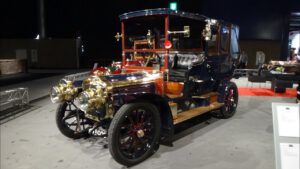
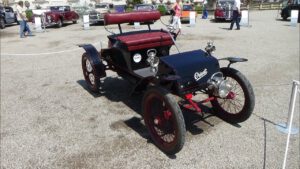
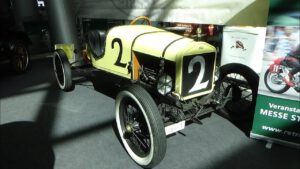
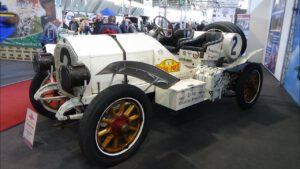
1925 Renault NN Torpedo – Exterior and Interior – Classic Expo Salzburg 2019
The Renault NN Torpedo belongs to the phase when Renault was shifting from prestigious, relatively exclusive automobiles toward more standardized and broadly accessible motoring. In 1925, that transition was already visible: the NN was compact, practical, and built in significant numbers, yet it still reflected an era when body styles such as the Torpedo carried real social and aesthetic meaning. A 1925 Renault NN Torpedo is therefore not just an early touring car. It is a clear marker of Renault’s move toward mass production and everyday usability.
Technical Details
The Renault NN was engineered as a small front-engined, rear-wheel-drive car positioned in the French 6 CV tax class. Renault’s heritage archive states that the model was produced from 1924 to 1929 and attributes its success in large part to its durable 6 CV engine and to the breadth of the range. In the NN, power came from a compact inline four-cylinder engine of around 951 cc, coupled to a manual gearbox and driving the rear axle in the conventional Renault layout of the period. The mechanical conception was not radical, but it was coherent: modest displacement, manageable operating costs, and a chassis suitable for several different bodies, including the Torpedo. That adaptability was one reason the NN became Renault’s most popular model of its time.
The technical appeal of the 1925 Renault NN lay less in novelty than in balance. It was intended to be a dependable light car for daily transport, but one with enough versatility for varied uses and body configurations. Renault’s archive emphasizes the range’s reputation for robustness, and that quality mattered in the mid-1920s, when road conditions were inconsistent and buyers still expected a car to cope with rougher surfaces and longer distances than urban use alone. The car’s compact scale also mattered. Compared with Renault’s larger pre-war and immediate post-war models, the NN represented a more rational approach to car ownership, one increasingly aligned with broader middle-class demand.
The Torpedo body sat on a separate chassis, a normal construction method for the period and one that made body variation easier. While Renault’s surviving online archive on the NN is more descriptive than tabular, the broader pattern is clear: the NN was conceived as a standardized mechanical base that could accept different bodies without changing its essential engineering logic. For a 1925 Renault NN Torpedo, that means a light open touring body mounted on a conventional ladder-type chassis, powered by a small four-cylinder engine and driven through the rear wheels. In technical terms, it was a practical machine rather than a showpiece, and that practicality was central to its commercial success.
- Manufacturer: Renault
- Model name: Renault NN Torpedo
- Year of manufacturing: 1925
Design
The Torpedo body style gave the Renault NN a distinctly open and mobile character. Renault’s heritage material explicitly lists the Torpedo among the key body options offered on the NN range, alongside interior-drive, faux cabriolet, and cabriolet variants. That matters because the NN was not simply sold as a mechanical product; it was presented as a flexible family of cars adapted to different needs and tastes. In Torpedo form, the NN took on the appearance of a light touring car, with an open passenger compartment, upright windshield, separate or semi-integrated fenders, and a body whose visual lightness matched the car’s modest dimensions.
The overall design reflected the transitional aesthetics of the 1920s. Unlike the more enclosed and aerodynamically smoother cars that would follow in the 1930s, the NN Torpedo still displayed its structure openly. The hood, passenger section, and rear body were clearly legible as separate volumes, and the running boards visually linked the front and rear wings. This gave the car a straightforward, almost architectural clarity. Nothing about the design was excessive. The NN Torpedo communicated function first, but it did so with a certain elegance typical of light French touring cars of the period.
Inside, the Renault NN was notably simple. Renault’s own description of the interior stresses how little clutter there was: two floor-mounted levers, minimal instrumentation, and even optional provision for a speedometer and clock rather than standard fitment. That interior economy tells us a great deal about the design philosophy. The NN was built to be useful and affordable, not luxurious. Yet that restraint is part of its charm today. In Torpedo form especially, the open cabin, simple dashboard, and lightly furnished seating give the car an immediacy modern automobiles cannot reproduce.
Historical Significance
The Renault NN is historically important because it marks a decisive broadening of Renault’s market identity. Earlier in its history, Renault had been strongly associated with larger and more representative vehicles. The NN, introduced in 1924, belongs to the period when the company increasingly addressed a wider public through more standardized, affordable production. In your uploaded sample material, the Renault NN is explicitly framed as evidence of Renault’s shift toward large-scale manufacturing and away from its earlier emphasis on smaller production runs for more elite customers. That interpretation fits well with Renault’s own heritage description of the NN as its most popular model of the era.
Production significance is central here. Renault states that the NN range, built from 1924 to 1929, would long remain its most popular model. This was not just because of price, but because the car combined durability with a broad choice of bodies. In other words, Renault succeeded not by making the cheapest possible car, but by making a technically consistent one that could be sold in multiple forms to different customers. The Torpedo variant belongs directly to that strategy. It allowed buyers to have a light and socially attractive touring body while relying on the same basic platform as more practical versions.
The NN also matters in the wider history of European motoring because it reflects how the car was becoming normalized as an everyday object rather than a specialist luxury good. A 1925 NN Torpedo sits early in that process, at a moment when ownership was still aspirational but increasingly attainable. It therefore helps explain how Renault built the industrial and cultural foundations that later supported truly mass-market models such as the 4CV. In historical terms, the NN was one of the company’s stepping stones from prestige manufacturer to broad-based producer.
Quirks and Pop Culture
One of the most engaging quirks of the Renault NN concerns its dashboard. Renault’s heritage page notes that the interior was so minimal that the speedometer and clock were optional, with removable circles in the dashboard provided for buyers who wanted them fitted. That detail is revealing not only as a curiosity, but as a reminder of how differently people understood driving in the 1920s. Today a speedometer is taken for granted; on the NN, it could still be treated as an extra.
The sheer breadth of body styles is another point of interest. Renault marketed the NN with a variety of bodies, and the Torpedo was among the most evocative because it preserved the touring-car spirit of the early motor age while being attached to a more standardized, popular model. That gave the NN Torpedo a dual identity: it was both practical transport and an object still connected to the leisure and display culture of open motoring. This is part of what makes it appealing in classic-car culture today. It is a modest car, but not an anonymous one.
Within Renault’s historical memory, the NN also benefits from representing an early chapter in the democratization of the brand. It does not enjoy the mythic status of later icons such as the 4CV, Dauphine, or Alpine-linked models, but it has a quieter importance. Among enthusiasts of early French cars, the NN is often valued precisely because it shows Renault before full industrial modernity had flattened bodywork into standard forms. In Torpedo guise, that older variety remains highly visible.
Display and preservation
The vehicle was exhibited at Classic Expo Salzburg in 2019, when the fair celebrated its 15th anniversary from 18 to 20 October. The event occupied ten spacious halls as well as the inner courtyard, which also served as the starting point for the Salz & Öl Rallye. More than 1,000 vehicles were presented, ranging from privately offered classics to dealer cars, club displays, parts-market finds, and auction entries. Special exhibitions marked 60 years of the Steyr-Puch Haflinger, 60 years of Mini, and 100 years of Zagato, while the relaxed atmosphere gave the show a distinctly Austrian character.
Conclusion
The 1925 Renault NN Torpedo is best understood as a small but revealing car from a period of transition. Technically, it was conventional and pragmatic, with a compact four-cylinder engine, rear-wheel drive, and a separate chassis that could support multiple bodies. In design terms, the Torpedo body gave it openness, clarity, and the lightly elegant air of a true touring car. Historically, the NN helped Renault broaden its audience and establish itself as a maker of popular, standardized automobiles. Its quirks, from the optional speedometer to the sparse dashboard, now make that world feel especially close. The 1925 Renault NN Torpedo is therefore more than an early Renault body variant. It is a concise expression of how the company moved into modern mass motoring without yet losing the visual individuality of the coachbuilt age.