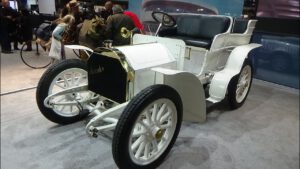
1923 Ford Model T Speedster – Exterior and Interior – Classic Expo Salzburg 2021
The design of the Ford Model T was marked by versatility rather than visual experimentation. It was offered in a wide range of body styles, including touring car, roadster, coupé, limousine, and the so-called “town car.” There was even a truck version, the Model TT. This broad selection allowed the same basic vehicle to serve private owners, businesses, and public services alike.
Technical Details:
From a technical perspective, the Ford Model T was defined by robustness and mechanical simplicity rather than refinement or frequent innovation. It was powered by a four-cylinder engine with a displacement of 2.9 liters and an output of 20 horsepower. This engine was designed to be extremely low-maintenance, a crucial factor for customers who often had limited technical knowledge or access to professional servicing. Notably, the Model T did without several components that later became standard in automotive engineering. It had no conventional gearbox, no fuel pump, no water pump, and no oil filter. This reduction in complexity made the car easier to operate and maintain, especially in rural areas where infrastructure was limited.
Equally important was how the Ford Model T was built. It was the first car to be produced on a moving assembly line, a process optimized by Henry Ford to dramatically increase production speed and consistency. At peak output, up to 9,000 cars per day were produced. This industrial approach allowed Ford to sell the Model T at a price that enabled mass ownership, while still ensuring durability and reliability. The technical philosophy behind the Ford Model T prioritized function, standardization, and ease of repair, establishing a template for mass-produced automobiles worldwide.
- Manufacturer: Ford Motor Company
- Model name: Ford Model T Speedster
- Year of manufacturing: 1923
Design:
The design of the Ford Model T was marked by versatility rather than visual experimentation. It was offered in a wide range of body styles, including touring car, roadster, coupé, limousine, and the so-called “town car.” There was even a truck version, the Model TT. This broad selection allowed the same basic vehicle to serve private owners, businesses, and public services alike. Some farmers went even further, using the Model T as a cost-effective alternative to a tractor. Agricultural tools were commercially available that could be adapted directly to the car, underscoring its flexible design concept.
Despite the many body styles, Ford kept the technical foundation identical across the range. From an aesthetic standpoint, the Ford Model T was deliberately restrained. Ford did not aim to position the brand as luxurious or sporty, but as a maker of practical mid-range vehicles. For production reasons, especially to reduce manufacturing time and cost, Ford standardized the color to black for a significant period. Black nitrocellulose paint dried faster than other colors, making it ideal for assembly-line production. The result was a visually uniform but highly recognizable car, whose appearance became synonymous with early mass mobility.
Historical Significance:
The historical impact of the Ford Model T extends far beyond its technical specification. It fundamentally altered American society and, later, many other parts of the world. While the Model T was developed and first produced in the United States, it quickly became an international product. Ford established factories in Cork in Ireland, Manchester in England, Copenhagen in Denmark, as well as in Brazil, Argentina, Australia, and the Canadian province of Ontario. This global production network helped spread Ford’s manufacturing philosophy and made the Model T a worldwide symbol of affordable mobility.
The Ford Model T was produced continuously until 1927 and, remarkably, did not undergo major technical changes during its long lifespan. Instead, its body shapes became more elegant over time and its equipment evolved to meet rising customer expectations. By the time production ended, more than 15 million units had been sold. In Europe, including Germany, local production only began relatively late, when the Ford Model T had already reached its peak in the United States. Nonetheless, its influence was profound. The Ford Model T enabled the development of rural regions, connected communities, and laid the foundation for modern car-based societies.
Quirks and Pop Culture:
The Ford Model T quickly earned the nickname “Tin Lizzy,” a term that reflected both its simple construction and its familiarity. For millions of people, the Ford Model T became synonymous with mobility itself. It allowed families to live outside crowded city centers and commute to work, contributing to the rise of suburban living. This shift in daily life gave the Ford Model T a cultural significance that extended well beyond the automotive world.
Its adaptability also became part of its legend. The fact that farmers could convert the Model T into a tractor substitute, using purpose-built attachments, highlighted its role as a multi-purpose machine. Rather than appearing primarily in glamorous contexts, the Ford Model T entered popular memory as a practical companion to everyday life, work, and movement.
Display and preservation:
The vehicle was exhibited at the Classic Expo Salzburg in 2021. As one of Austria’s premier classic car events, the show has established itself as a central meeting point for collectors, restorers, and enthusiasts from across Central Europe. The 2021 edition took place at Messezentrum Salzburg and featured more than 250 exhibitors, along with a strong turnout of over 20,000 visitors. Attendees could explore a broad range of offerings—from historical vehicles and motorcycles to automobilia, spare parts, and literature.
Conclusion:
The Ford Model T stands as a defining vehicle of the early 20th century. Technically simple yet thoughtfully engineered, it combined a durable engine with an unprecedented production system. Its design emphasized versatility and practicality, offering numerous body styles built on a single standardized platform. Historically, it reshaped societies by making individual mobility affordable on a massive scale and by spreading industrial production methods around the globe. Through its cultural presence as the “Tin Lizzy,” the Ford Model T became more than just a car—it became a tool that changed how people lived, worked, and traveled.