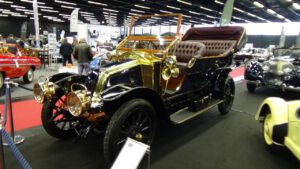
1917 Buick D45 Tourer – Exterior and Interior – Retro Classics Stuttgart 2022
By the late 1910s, the American automobile industry had entered a phase of rapid expansion and technical consolidation. Manufacturers were refining proven engineering solutions while increasing production volumes to meet growing demand. Buick, already one of the key brands within General Motors, had established a reputation for robust engines and dependable touring cars. The 1917 Buick D45 Tourer reflects this period, combining solid mechanical engineering with the practicality required for everyday motoring in the early twentieth century.
Technical Details
The 1917 Buick D45 Tourer was powered by a front-mounted inline six-cylinder engine, one of Buick’s defining technical features during this era. Buick had been an early adopter of six-cylinder engines in American automobiles, emphasizing smooth power delivery and reliability. The engine used overhead valve technology, a design pioneered by Buick and considered advanced compared with the side-valve engines used by many competitors at the time.
Displacement for Buick six-cylinder engines in this class was typically around 3.7 liters (approximately 226 cubic inches), producing roughly 40 horsepower. This output provided solid performance for a touring car of the period and allowed the vehicle to handle both city streets and longer rural journeys.
Power was transmitted to the rear wheels through a manual transmission, usually a three-speed gearbox. The drivetrain followed the conventional front-engine, rear-wheel-drive layout that had become standard in American automobiles by the mid-1910s.
The chassis consisted of a steel ladder-frame construction designed to support both the body and mechanical components. Suspension relied on rigid axles supported by semi-elliptic leaf springs at the front and rear. Mechanical drum brakes were fitted, typically acting on the rear wheels. Although braking systems were still relatively basic by modern standards, they were adequate for the speeds and road conditions of the time.
- Manufacturer: Buick
- Model name: Buick D45 Tourer
- Year of manufacturing: 1917
Design
The design of the 1917 Buick D45 Tourer reflected the typical appearance of American touring cars during the 1910s. The body featured an open configuration designed to accommodate several passengers while allowing relatively easy entry and exit.
The front of the vehicle was dominated by a tall radiator and a long hood covering the six-cylinder engine. Large round headlamps were mounted on either side of the radiator, while the upright windshield provided limited protection from wind and weather. A folding fabric roof could be raised to provide basic shelter when required.
The Tourer body style typically offered seating for four or five passengers arranged in two rows. Wide running boards along the sides of the vehicle helped passengers step into the relatively high cabin. Large wooden-spoked wheels with narrow tires were standard for automobiles of this period.
Inside, the interior emphasized practicality and durability. Upholstered bench seats provided basic comfort, while the dashboard contained only a small number of instruments. Controls were straightforward, allowing drivers to manage the engine and transmission with relative ease.
Historical Significance
Buick was one of the earliest and most important American automobile manufacturers. Founded in the early twentieth century, the company played a crucial role in the formation of General Motors under the leadership of William C. Durant.
By 1917, Buick had already established itself as a producer of reliable mid-range automobiles positioned between inexpensive mass-market cars and luxury vehicles. The company’s emphasis on overhead valve engines helped distinguish its cars from competitors and contributed to Buick’s strong reputation for engineering quality.
The D45 Tourer belonged to a period when the touring car was the dominant body style in the United States. Open touring cars were practical for both urban and rural travel, especially at a time when closed-body automobiles were still relatively expensive.
Cars like the Buick D45 helped expand automobile ownership during the 1910s. Reliable engines, improving road infrastructure, and increasing production volumes made motoring accessible to a broader segment of the population.
Quirks and Pop Culture
Touring cars such as the Buick D45 were central to everyday motoring in the United States during the 1910s. Because many roads were still unpaved, vehicles had to be durable and capable of handling rough conditions.
Driving such a car required a different set of skills compared with modern vehicles. Drivers often needed to manage manual ignition timing, fuel mixture adjustments, and other mechanical controls. Starting the engine was usually done with a hand crank, which required both physical effort and careful technique.
Open touring cars also created a unique driving experience. Passengers were exposed to the surrounding environment, which made travel both adventurous and sometimes uncomfortable depending on weather conditions.
Today, surviving Buick touring cars from this era are often preserved in historic vehicle collections and appear in vintage automobile rallies. They represent an important chapter in the development of the American automobile industry.
Display and preservation
The vehicle was exhibited at the Retro Classics Stuttgart in 2022. This car show is one of the major events on the classic car calendar in Germany. In 2022, it took place across five exhibition halls. Visitors can enjoy special showcases, hunt for rare parts and books, and buy cars—both private sellers and dealers offer a wide range of classic and youngtimer vehicles. In 2022, there was a noticeable increase in low-mileage youngtimers and classic cars.
Conclusion
The 1917 Buick D45 Tourer illustrates the maturity of American automobile engineering during the late 1910s. With its overhead valve six-cylinder engine, durable chassis, and practical touring body, the car embodied Buick’s reputation for reliable and well-engineered vehicles. As part of the expanding automotive landscape of the early twentieth century, the D45 Tourer helped bring motorized transportation to a growing number of drivers and remains a representative example of the classic American touring car.