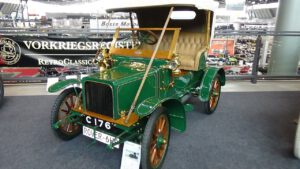
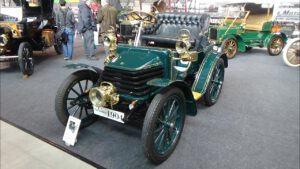
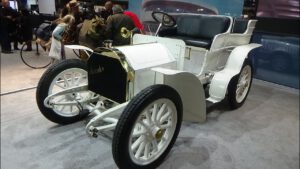
1914 Ford Model T Speedster – Exterior and Interior – Oldtimer-Meeting Baden-Baden 2022
Few cars have accumulated as many nicknames and cultural references as the Ford Model T. Perhaps the most famous is “Tin Lizzy,” a name that captured both the car’s humble construction and its endearing reliability. By the mid-1910s, the Ford Model T had become a familiar sight across cities, towns, and rural areas, embedding itself deeply into everyday culture.
Technical Details:
By 1914, the Ford Model T had already become a defining presence on roads in the United States and beyond. From a technical perspective, the Ford Model T was conceived not as a complex or luxurious machine, but as a robust and efficient means of transportation that could be produced in very large numbers. It was powered by a gasoline engine, reflecting the technological direction Henry Ford believed most practical for mass mobility. What truly distinguished the Model T was not a single mechanical innovation, but the way it was manufactured.
Ford fundamentally reworked industrial production by introducing a moving assembly line. Instead of skilled workers building entire cars from start to finish, each worker performed one specific task as vehicles passed along the line. This dramatically increased output and reduced production time per vehicle. The efficiency gains translated directly into cost savings. While the Ford Model T initially sold for 850 dollars, continued refinements in production methods brought the price down to 290 dollars by 1915. This pricing strategy, combined with high production volume, made the car accessible to a broad segment of the population. The technical story of the 1914 Ford Model T is therefore inseparable from its manufacturing process, which reshaped the economics of car production and laid the groundwork for modern industrial assembly.
- Manufacturer: Ford Motor Company
- Model name: Ford Model T Speedster
- Year of manufacturing: 1914
Design:
The design of the 1914 Ford Model T reflected its utilitarian mission. Its form followed function, prioritizing simplicity, durability, and ease of manufacture. The body was straightforward, with clean, uncomplicated lines that avoided unnecessary ornamentation. Although Henry Ford is famously associated with the statement that customers could have the Ford Model T in any color as long as it was black, the reality was more nuanced. Before 1913, the Ford Model T was available in colors such as green, red, blue, and gray. By the time of the 1914 model year, black had become the dominant choice, largely because it dried faster and better suited the high-speed production process.
Visually, the Ford Model T conveyed practicality rather than status. Its appearance was familiar and reassuring rather than striking, reinforcing its role as an everyday tool. The interior followed the same philosophy, offering only what was necessary for driving. Controls and fittings were designed to be functional and easy to produce, rather than decorative. This restrained design language helped the Model T appeal to first-time car buyers who valued reliability and affordability over stylistic experimentation.
Historical Significance:
The Ford Model T sits at the center of a broader transformation in both the automotive industry and American society. At the beginning of the 20th century, the United States, with its vast geography and growing economy, provided fertile ground for automotive innovation. Many inventors and companies attempted to establish themselves, but few achieved lasting success. Henry Ford emerged as one of the most influential figures of this period, not only through technical ingenuity but through his understanding of production and business.
Ford’s vision was clear: to build a car that ordinary people could afford. The Model T became the realization of that idea. By drastically reducing prices through mass production, Ford enabled motorization on a scale previously unimaginable. In 1915 alone, one million Americans were able to purchase a Ford Model T. When production finally ended in 1927, more than 15 million units had been sold, making it the most widely sold car in the world at that time. The 1914 Ford Model T represents the moment when the automobile ceased to be a luxury item and became a central element of daily life for millions.
Quirks and Pop Culture:
Few cars have accumulated as many nicknames and cultural references as the Ford Model T. Perhaps the most famous is “Tin Lizzy,” a name that captured both the car’s humble construction and its endearing reliability. By the mid-1910s, the Ford Model T had become a familiar sight across cities, towns, and rural areas, embedding itself deeply into everyday culture.
Its widespread adoption meant that it often appeared in anecdotes, cartoons, and popular stories of the time, symbolizing modernity and independence. The Ford Model T also became a shared experience across social classes, driven by farmers, workers, and professionals alike. This universality helped cement its status not just as a product, but as a cultural reference point. Even decades later, the Ford Model T remains shorthand for the dawn of mass mobility.
Display and preservation:
The vehicle was exhibited at the Oldtimer-Meeting Baden-Baden in 2022. Set in the elegant spa gardens of Baden-Baden, this open-air event is one of Germany’s most atmospheric classic car gatherings. The 2022 edition marked the 46th year of the meeting and featured over 350 carefully selected vintage vehicles from across Europe. With its picturesque backdrop and festive ambiance, the event draws thousands of visitors who stroll among historic automobiles, enjoy live music, and take in themed displays. In 2022, American classics and convertibles were especially well represented, reflecting the event’s continued celebration of both international and domestic automotive heritage.
Conclusion:
The 1914 Ford Model T stands as a pivotal chapter in automotive history. Technically straightforward but industrially revolutionary, it demonstrated how large-scale production could transform society. Its simple, purposeful design supported Ford’s ambition to make car ownership widely accessible. Historically, it marked the success of Henry Ford’s vision and permanently altered how automobiles were built and sold. With its enduring nickname and cultural presence, the Ford Model T became more than a machine—it became a symbol of an era. The 1914 version captures this moment clearly, reflecting the point at which the automobile truly became a vehicle for the masses.