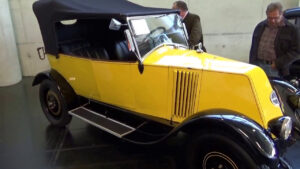
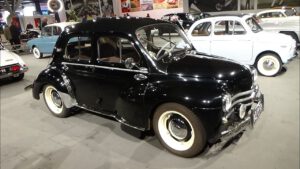
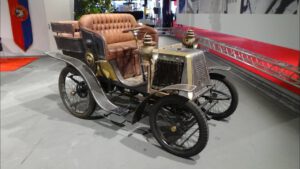
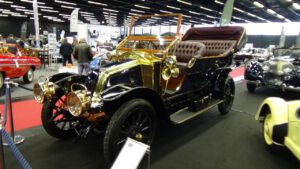
1909 – Renault V1 20-30 Cape Top Victoria – Exterior and Interior – Classic Expo Salzburg 2015
At the beginning of the 20th century, Renault was already shaping a recognizable technical identity, long before mass production defined the industry. The Renault V1 20–30 HP belongs to a period when automobiles were still closely linked to carriage-building traditions. Its Cape Top Victoria body captures this transition, combining early automotive engineering with design elements inherited from horse-drawn vehicles.
Technical Details
The Renault V1 20–30 HP of 1909 was built around a front-mounted inline four-cylinder engine, typical of Renault’s upper-range vehicles of the period. Displacement is generally cited in the range of approximately 3.5 to 4.5 liters, producing between 20 and 30 horsepower depending on tuning and specification. This level of output positioned the car within the higher tiers of early touring automobiles, capable of sustained road use beyond short urban journeys.
Power was transmitted to the rear wheels via a manual gearbox, usually with three or four forward gears, and a driveshaft—an important Renault innovation at the time, replacing the chain-drive systems still used by many competitors. This shaft-driven layout improved reliability and reduced maintenance, especially on longer journeys.
A defining technical feature of Renault cars of this era was the placement of the radiator behind the engine, rather than at the front. This influenced both cooling airflow and the vehicle’s external appearance, resulting in a distinctive, often sloped or vertical front hood without a conventional front grille.
The chassis followed a ladder-frame construction with rigid axles and leaf spring suspension. Braking systems were mechanically operated, typically acting on the rear wheels and sometimes supplemented by transmission braking. Overall, the engineering emphasized durability and mechanical simplicity, suited to the varied and often poor road conditions of the time.
- Manufacturer: Renault
- Model name: Renault V1 20–30 HP Cape Top Victoria
- Year of manufacturing: 1909
Design
The Cape Top Victoria body style directly reflects the influence of carriage design on early automobiles. The term “Victoria” refers to a specific type of horse-drawn carriage, typically characterized by a driver positioned at the front and passengers seated under a partially enclosed roof. In the Renault V1, this concept was adapted into an automotive form.
The “Cape Top” refers to a folding or partial roof covering the passenger compartment, offering some protection from the elements while maintaining an open-air experience. The rear seating area was often more refined and sheltered, while the driver’s position remained more exposed, reinforcing the chauffeur-driven nature of the vehicle.
Externally, the car featured large, spoked wheels, separate fenders, and prominent running boards. The hood was long and relatively flat, reflecting the engine placement and Renault’s rear-radiator layout. Lighting was typically provided by early electric or acetylene lamps mounted externally.
Inside, materials and layout emphasized craftsmanship rather than standardization. Upholstery, trim, and fittings were often tailored to customer specifications, as production at this time involved a high degree of manual assembly. The overall design conveyed a sense of transition: no longer a carriage, but not yet a fully modern automobile in the later sense.
Historical Significance
By 1909, Renault had already established itself as a major force in the early automotive industry. Founded by Louis Renault in 1899, the company quickly distinguished itself through technical innovation, including the widespread adoption of the driveshaft and contributions to gearbox development.
The Renault V1 20–30 HP sits within a broader lineup of early Renault models that helped define the brand’s reputation for engineering reliability and practical solutions. At a time when many manufacturers were still experimenting with basic layouts, Renault had settled on a coherent technical philosophy that would influence its vehicles for years.
This period also reflects the structure of the early automotive market, where cars were often sold as chassis to be bodied by specialized coachbuilders. The Cape Top Victoria configuration illustrates how manufacturers and coachbuilders collaborated to meet customer preferences, blending engineering with bespoke design.
The outbreak of the First World War just a few years later would significantly alter the trajectory of automotive development. Vehicles like the Renault V1 therefore represent one of the last phases of pre-war luxury motoring, before industrialization and standardization reshaped production.
Quirks and Pop Culture
One of the most distinctive quirks of the Renault V1 is its retention of carriage-derived terminology and layout. Terms such as “Victoria” and “Cape Top” are direct references to horse-drawn vehicles, highlighting how early motorists understood and categorized automobiles through familiar concepts.
The chauffeur-driven arrangement is another notable feature. In contrast to later cars designed for owner-drivers, vehicles like the Renault V1 often separated driver and passengers both physically and socially, reflecting the class structures of the time.
Renault vehicles from this era also gained visibility through public events and early motorsport, helping to establish the brand’s reputation. While the Renault V1 itself is not tied to a specific pop culture moment, it belongs to a generation of cars that defined the visual and social identity of early motoring.
Display and preservation
This car was filmed at the Classic Expo Salzburg 2015, Austria’s leading platform for classic vehicle preservation and presentation. With over 250 exhibitors from eleven nations across 40,000 square meters, the event combined commercial exchange with historical appreciation. Beyond the extensive parts market and private sales hall, special displays—such as historic emergency vehicles and a dedicated Jaguar anniversary exhibition—added thematic depth. Live elements like the Salz & Öl Rallye brought motion into the experience, echoing past eras. The integration of auctions, exhibitions, and active participation illustrated how preservation thrives through both display and continued engagement.
Conclusion
The 1909 Renault V1 20–30 HP Cape Top Victoria stands as a clear example of the transitional nature of early automobiles. Technically, it combined a relatively advanced drivetrain with conventional chassis construction. In design, it preserved strong links to carriage-building traditions, particularly in its Victoria body style and partial roof configuration. Historically, it reflects Renault’s early leadership in engineering and the broader structure of the pre-war automotive market. As such, it offers insight into a formative period when the automobile was still defining its identity.