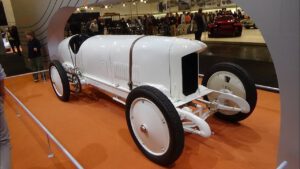
1909 Benz Blitzen-Benz – Techno Classica Essen 2015
In 1909, one car briefly redefined what “fast” meant. Built not for everyday roads but for outright speed, the Blitzen-Benz pushed automotive engineering into territory that few had imagined possible at the time. Its achievements were not incremental—they were headline-making demonstrations of what internal combustion could deliver.
Technical Details
The 1909 Blitzen-Benz was engineered as a purpose-built high-speed machine, centered around an exceptionally large-displacement inline four-cylinder engine. The engine measured 21.5 liters (21,504 cc), an enormous capacity even by early 20th-century standards, and produced approximately 200 horsepower. This output made it one of the most powerful automobiles of its era, far exceeding typical road cars of the time.
The engine used overhead valves, a hallmark of Benz engineering, and was designed to deliver sustained high-speed performance rather than flexibility. Power was transmitted to the rear wheels via a chain-drive system, a common solution for high-output vehicles of the period due to its robustness. The chassis was built on a reinforced ladder frame, with minimal bodywork to reduce weight and aerodynamic resistance. Suspension relied on semi-elliptic leaf springs, while braking was handled by mechanical drum systems, which were relatively basic given the performance potential of the car.
- Manufacturer: Benz & Cie.
- Model name: Blitzen-Benz (often referred to as Benz 200 hp)
- Year of manufacturing: 1909
Design
The design of the Blitzen-Benz followed a strictly functional logic shaped by its intended purpose: speed. The car featured a long, narrow body dominated by the massive engine housed under an elongated hood. The driver and mechanic sat exposed in a simple, open cockpit positioned far to the rear, emphasizing the mechanical dominance of the front section.
Its proportions were extreme even by contemporary standards. Large spoked wheels, minimal body panels, and a tapered tail section contributed to reducing drag, although aerodynamic science was still in its infancy. The radiator at the front was prominent and upright, ensuring sufficient cooling for the oversized engine during high-speed runs. There was no attempt at comfort or ornamentation; every design decision was oriented toward performance.
Historical Significance
The Blitzen-Benz became one of the most important early record-breaking cars in automotive history. In 1909, it set a land speed record of approximately 202.7 km/h (126 mph), becoming the first automobile to exceed 200 km/h. This achievement took place at Brooklands in England and marked a turning point in how speed was perceived in the automotive world.
The car’s reputation grew further when it was taken to the United States, where driver Barney Oldfield achieved additional speed records, including a run of 211 km/h (131 mph) at Daytona Beach in 1910. These performances established the Blitzen-Benz as the fastest car in the world at the time, a title it held for several years.
Beyond the records themselves, the car demonstrated the potential of large-displacement engines and helped solidify Benz’s reputation as a technically capable and ambitious manufacturer. It also reflected a broader trend in early automotive development, where extreme machines were used to capture public attention and prove engineering capabilities.
Quirks and Pop Culture
The name “Blitzen-Benz” translates roughly to “Lightning Benz,” a nickname that captured both the car’s speed and its dramatic presence. It was not an official factory designation at first but quickly became widely adopted due to media coverage of its record attempts.
The car’s appearances at events and exhibitions made it a spectacle in its own right. In the United States, it was often promoted as a demonstration of technological progress, drawing large crowds eager to witness unprecedented speeds. Drivers like Barney Oldfield became closely associated with the car, adding a human element to its mechanical achievements.
Another notable quirk is the sheer scale of its engine. With over 21 liters of displacement, it remains one of the largest engines ever fitted to an automobile, highlighting the brute-force engineering approach typical of early speed record attempts.
Display and preservation
This car was filmed at the Techno Classica Essen 2015. Held from April 15 to 19, the 27th edition of the motor fair transformed the Essen showgrounds into a vibrant hub of automotive heritage. With around 190,000 visitors, the event showcased an extraordinary spectrum of classic and prestige vehicles across both indoor halls and open-air spaces. Over 1,250 exhibitors and 220 clubs highlighted their restoration work, rare parts, and preservation expertise. Numerous anniversaries—from the Porsche 356 to the Citroën DS—added historical depth, reinforcing the fair’s role as a global marketplace and living archive of classic motoring culture.
Conclusion
The 1909 Blitzen-Benz represents a decisive moment in the history of automotive speed. Technically, it combined an enormous engine with a straightforward but robust chassis, prioritizing power above all else. Its design was shaped entirely by function, resulting in a striking and unconventional form. Historically, its record-breaking performances redefined expectations and demonstrated the capabilities of early automobiles. More than a curiosity, the Blitzen-Benz stands as a clear statement of intent from the early automotive industry: speed would be one of its defining ambitions.