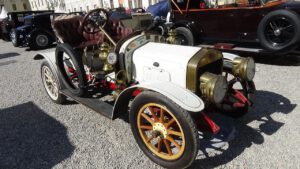
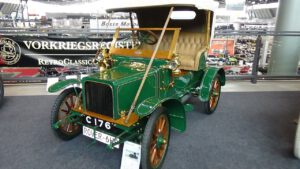
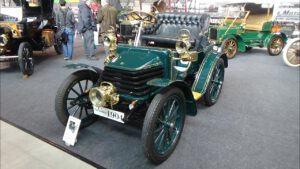
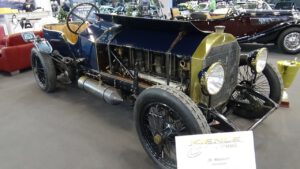
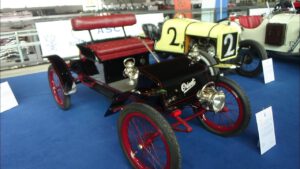
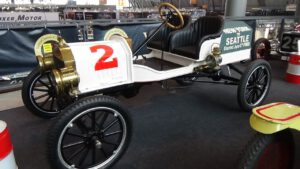
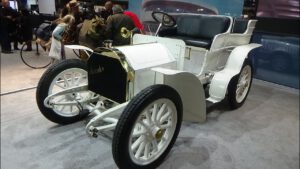
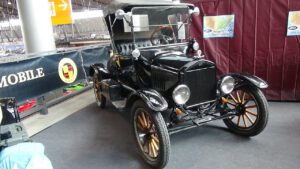
1908 Delage Phaeton Sport J – Retro Classics meets Barock Ludwigsburg 2017
Refinement and performance rarely appeared together in early 20th-century automobiles, yet the Delage Type J Phaeton Sport aimed to balance both. Produced during a period when French manufacturers were among the most technically advanced in Europe, this model reflects a shift toward more powerful yet still elegant touring cars. It was designed not only for transport, but also to demonstrate engineering competence in an increasingly competitive market.
Technical Details
The Delage Type J Phaeton Sport, introduced in the early 1910s, was equipped with a front-mounted inline four-cylinder gasoline engine. Displacement figures varied slightly depending on specification, but were typically in the range of approximately 2.1 to 2.5 liters, delivering around 10 to 12 horsepower in taxation rating (with actual output somewhat higher in real terms).
The engine featured side valves, a common configuration of the period, prioritizing reliability and ease of maintenance over peak efficiency. Power was transmitted to the rear wheels through a manual gearbox and driveshaft, reflecting the industry’s gradual move away from chain-driven systems. This transition marked a step toward more durable and refined drivetrains.
The chassis was built on a steel ladder frame, with rigid axles and semi-elliptic leaf springs providing suspension. Braking was mechanical and typically applied to the rear wheels, consistent with early 1910s engineering standards. Compared to earlier vehicles, the Delage Type J offered improved structural integrity and more predictable handling, particularly at higher speeds.
- Manufacturer: Delage
- Model name: Delage Type J Phaeton Sport
- Year of manufacturing: 1912–1914
Design
The design of the Delage Type J Phaeton Sport reflected the emerging identity of early touring cars. The “phaeton” body style referred to an open, lightweight configuration with two rows of seating and minimal weather protection. The “Sport” designation indicated a slightly more performance-oriented character, often expressed through lighter bodywork and cleaner lines.
Externally, the car featured a long hood to accommodate the front-mounted engine, flowing into a relatively low passenger compartment compared to earlier upright designs. The absence of a fixed roof gave the car an open and airy appearance, while folding fabric tops could be deployed when needed.
Large spoked wheels and pronounced fenders emphasized its road-going capability, while the radiator at the front carried a distinctive Delage identity. The interior remained functional but showed early signs of refinement, with more attention paid to seating arrangement and driving ergonomics than in earlier vehicles. Overall, the design conveyed a balance between utility and emerging automotive style.
Historical Significance
The Delage Type J belongs to a period when Delage was establishing itself as a serious competitor in both touring and racing segments. Founded by Louis Delage in 1905, the company quickly gained recognition for its engineering quality and involvement in motorsport.
By the early 1910s, Delage was producing a range of vehicles that combined reliability with increasing performance. The Type J contributed to this reputation, offering customers a capable touring car with sporting characteristics. It also reflects the broader evolution of the automobile from a purely functional machine into a product with distinct market positioning—luxury, sport, or utility.
This period was interrupted by the First World War, which halted civilian automobile production across much of Europe. As a result, models like the Type J represent the final phase of pre-war automotive development, just before major technological and industrial changes reshaped the industry.
Quirks and Pop Culture
The term “Phaeton” itself is a historical reference to lightweight, open horse-drawn carriages, emphasizing the continuity between early automobiles and their predecessors. In the case of the Delage Type J, this naming highlights its intended use as a stylish yet practical touring vehicle.
Unlike later sports cars, the “Sport” designation did not imply extreme performance, but rather a lighter and more responsive driving experience compared to heavier touring models. This distinction reflects how early manufacturers communicated performance before standardized metrics became common.
While the Delage Type J does not feature prominently in modern popular culture, Delage as a brand is frequently associated with early Grand Prix racing and French automotive prestige. Vehicles like the Type J contributed to this broader image, even if they remained in the background compared to dedicated racing machines.
Display and preservation
This car was filmed at the 2017 edition of Retro Classics meets Barock in Ludwigsburg. Held on June 17 and 18, the event attracted around 20,000 visitors to the courtyard of Ludwigsburg Palace, where approximately 100 classic automobiles were presented. Highlights included a special showcase dedicated to Delage, celebrating the marque’s elegance and racing pedigree, as well as the iconic Borgward Isabella Coupé, marking its 60th anniversary. Complemented by guided tours and themed events, the exhibition emphasized both historical context and careful preservation.
Conclusion
The Delage Type J Phaeton Sport represents a transitional stage in automotive history, where performance, reliability, and design began to converge. Its four-cylinder engine and shaft-driven layout illustrate the technical direction of the early 1910s, while its open phaeton body reflects evolving tastes in style and usability. Historically, it forms part of Delage’s rise as a respected manufacturer, bridging the gap between early experimentation and the more defined automotive categories that would emerge after the First World War.