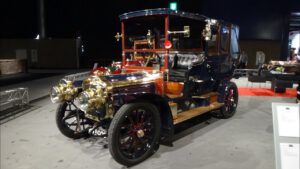
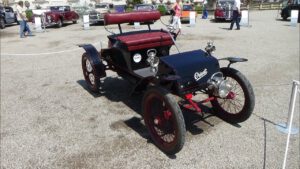
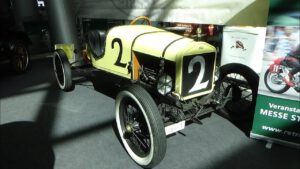
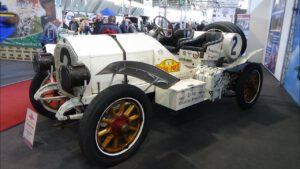
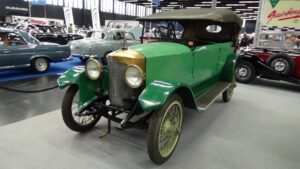
1908 – American LaFrance Funkenblitz – Retro Classics Stuttgart 2015
Before standardized race cars and regulated circuits defined motorsport, machines like the American LaFrance “Funkenblitz” pushed the limits of speed with little precedent to follow. Built for outright performance rather than practicality, it became closely associated with exhibition racing and early speed contests. Its name—derived from German, meaning “spark lightning”—captured both its purpose and its reputation.
Technical Details
The American LaFrance Funkenblitz was based on a large-displacement engine originally developed for fire-fighting equipment by American LaFrance. Like many early racing specials, it relied on adapting industrial-grade components for speed rather than designing a purpose-built racing engine from scratch.
The power unit was a massive inline four-cylinder engine with a displacement estimated at well over 10 liters, delivering extremely high torque. Power output figures are not consistently documented, but contemporary accounts emphasize its ability to produce strong acceleration and sustained high speeds for the era. The engine was mounted at the front and transmitted power to the rear wheels via a shaft drive, a more advanced solution compared to earlier chain-driven systems.
The chassis was simple and heavy, reflecting its origins in commercial vehicle engineering. Suspension consisted of rigid axles and leaf springs, prioritizing strength over ride quality or handling finesse. Braking systems were minimal, typically acting only on the rear wheels and requiring significant driver skill to manage at speed.
Cooling and fuel delivery were equally straightforward, relying on large radiators and basic carburetion systems. The technical philosophy of the Funkenblitz was not refinement, but raw mechanical force—delivering as much power as possible within the constraints of early 20th-century engineering.
- Manufacturer: American LaFrance
- Model name: American LaFrance Funkenblitz
- Year of manufacturing: 1908
Design
Visually, the Funkenblitz was defined by function and mechanical exposure. The long, open chassis prominently displayed the oversized engine, with minimal bodywork separating driver and machine. Its proportions were dominated by the engine length, resulting in an elongated hood and a compact driver position set far to the rear.
The absence of aerodynamic considerations is striking by modern standards. The upright seating position, exposed wheels, and lack of streamlined surfaces reflected an era when airflow was not yet a primary design factor. Instead, the focus was on accessibility and mechanical simplicity.
Large spoked wheels and a high ground clearance gave the car a rugged stance, inherited from its commercial origins. The driver’s cockpit was minimal, offering little protection and only essential controls. Steering wheels were large and thin, requiring physical effort to operate, especially at speed.
Overall, the design communicated power and immediacy rather than elegance. Every visible element served a mechanical purpose, reinforcing the car’s identity as a tool for speed rather than a refined automobile.
Historical Significance
The American LaFrance Funkenblitz belongs to a formative period in motorsport, when the boundaries between engineering experimentation and competition were still fluid. Built at a time when purpose-built racing cars were rare, it exemplifies the practice of modifying existing machinery—often from industrial or commercial applications—for high-speed use.
Its association with early racing drivers, including figures such as Barney Oldfield, highlights its role in popularizing speed events in the United States. Oldfield, one of the first American racing celebrities, used powerful and unconventional machines to attract public attention, and cars like the Funkenblitz were central to that effort.
The vehicle also illustrates a transitional phase in automotive engineering. While it delivered impressive performance for its time, it lacked the balance and specialization that would later define racing cars. Within a few years, purpose-built designs began to replace such hybrids, incorporating lighter materials, improved weight distribution, and more sophisticated handling characteristics.
As such, the Funkenblitz represents both the ambition and the limitations of early racing technology. It stands at the intersection of industrial engineering and emerging motorsport, capturing a moment when speed was pursued through sheer mechanical scale.
Quirks and Pop Culture
One of the most distinctive aspects of the Funkenblitz is its name. “Funkenblitz,” meaning “spark lightning,” reflects the fascination with speed and electricity-like power that characterized early automotive culture. The use of a German term also points to the international influences present in the automotive world at the time.
Another notable feature is its origin. Being derived from fire-engine technology, the car carried a sense of rugged reliability unusual for racing machines. This gave it a dual identity: part industrial machine, part speed spectacle.
Cars like the Funkenblitz were often used in exhibition races and demonstrations rather than formal competitions. These events attracted large crowds, turning drivers into public figures and helping to establish motorsport as a form of entertainment. The raw, sometimes unpredictable behavior of such machines added to their appeal, even as it underscored the risks involved.
Display and preservation
This car was filmed at the Retro Classics Stuttgart 2015, held from March 26 to 29. The show set new standards with an expanded 120,000 square meters of exhibition space. A total of 1,430 exhibitors and more than 87,000 visitors filled eight halls, creating a vibrant marketplace where nearly half of attendees made purchases. Strong presences from Mercedes-Benz and Porsche added prestige, with Porsche unveiling rare prototypes. Special displays ranged from BMW M5 anniversaries to American classics with roaring V8 engines.
Conclusion
The 1908 American LaFrance Funkenblitz stands as a vivid example of early motorsport experimentation. Its massive engine, simple chassis, and minimal design reflect a period when speed was achieved through scale and ingenuity rather than precision engineering.
While technically crude by later standards, it played a role in shaping public interest in racing and demonstrated the potential of the automobile as a high-performance machine. Connected to figures like Barney Oldfield and rooted in industrial engineering, the Funkenblitz bridges the gap between utility vehicles and the specialized race cars that would soon follow.