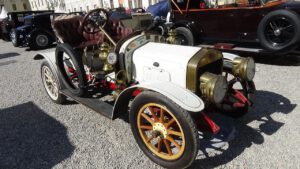
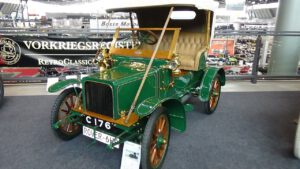
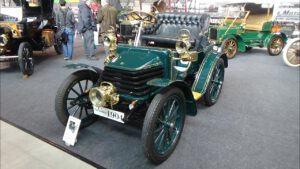
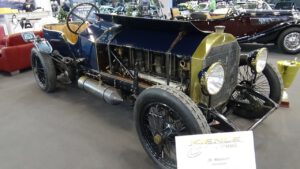
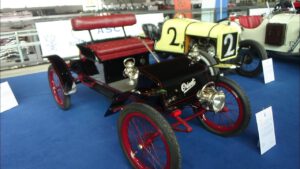
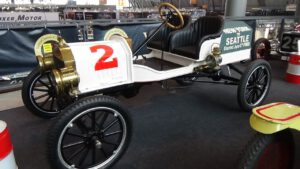
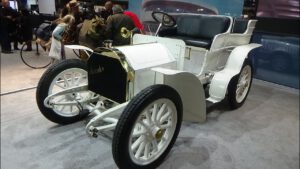
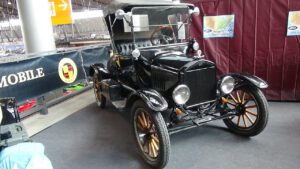
1907 – 1915 Mercedes Maybach racing car – Retro Classics Stuttgart 2018
Developed in an era when engineering experimentation often took precedence over standardization, the racing cars created by Wilhelm Maybach for Daimler-Motoren-Gesellschaft between 1907 and 1915 represent a technically ambitious chapter in early motorsport. These machines were not defined by a single model name but by a continuous process of refinement, combining increasing engine power with evolving chassis concepts. They reflect a period when racing served as a testing ground for ideas that would later influence production vehicles.
Technical Details
The Mercedes racing cars developed under Wilhelm Maybach during this period were powered by large-displacement inline four-cylinder engines, often exceeding 10 liters and, in some cases, reaching well beyond 12 liters. Power outputs varied depending on specification and year but typically ranged between 100 and over 150 horsepower—significant figures for the time.
A defining technical feature was the use of overhead valve (OHV) configurations, which improved breathing efficiency compared to earlier engine designs. Ignition systems, carburetion, and cooling were continuously refined to handle the demands of sustained high-speed operation. Power was transmitted to the rear wheels through manual gearboxes, generally with multiple forward ratios, allowing better adaptation to racing conditions than earlier, simpler systems.
The chassis followed a conventional ladder-frame construction but was strengthened to cope with increased engine output and racing stresses. Suspension relied on rigid axles with leaf springs, prioritizing durability over comfort. Braking systems were mechanical and relatively limited in effectiveness, requiring drivers to anticipate stopping distances carefully at higher speeds. These cars were capable of exceeding 120 km/h, placing them among the fastest machines of their era.
- Manufacturer: Daimler-Motoren-Gesellschaft
- Model name: Mercedes Maybach racing cars (various competition models)
- Year of manufacturing: 1907–1915
Design
The design of these racing cars was shaped almost entirely by function. Long, narrow bodies accommodated the large engines, resulting in extended hoods that dominated the vehicle’s proportions. The driver and mechanic typically sat in an open cockpit positioned toward the rear, with minimal protection from wind or debris.
The exterior was stripped of unnecessary elements. Body panels were lightweight and often made of metal shaped directly over the frame. Large spoked wheels and narrow tires reflected the limitations of tire technology at the time. Cooling requirements led to prominent radiators at the front, often featuring the emerging Mercedes identity.
Visually, these cars conveyed mechanical purpose rather than elegance. Their proportions and exposed components highlighted the engineering beneath, giving them a raw and direct character typical of early racing machines.
Historical Significance
Between 1907 and the outbreak of the First World War in 1914, motor racing played a central role in the development of automotive technology. Under the technical leadership of Wilhelm Maybach, Daimler-Motoren-Gesellschaft used racing as a platform to test and refine high-performance engines and chassis systems.
These vehicles contributed to the growing reputation of the Mercedes name in international competition. Racing successes during this period helped establish German engineering as a serious contender against French and Italian manufacturers, who had dominated earlier events.
The years leading up to 1914 saw increasing technical sophistication in racing cars, with improvements in engine efficiency, reliability, and overall vehicle performance. The work carried out on these Mercedes racing machines influenced later developments, including more advanced engine configurations and improved production models. The interruption caused by the First World War brought this phase of development to a halt, marking the end of an important early chapter in motorsport history.
Quirks and Pop Culture
One notable aspect of early Mercedes racing cars was the presence of a riding mechanic alongside the driver. This second crew member monitored engine performance, managed fuel pressure, and assisted with on-the-fly repairs—an essential role in an era when mechanical reliability was far from guaranteed.
These racing machines also predate the later “Silver Arrow” legend, yet they laid the groundwork for it. The emphasis on engineering precision and competitive performance would later become central to Mercedes-Benz’s identity in motorsport.
While these cars do not appear frequently in modern popular culture, they are often referenced in historical accounts of early Grand Prix racing. Their raw performance, combined with minimal safety measures, highlights the risks taken by drivers and teams during the formative years of motorsport.
Display and preservation
This car was filmed at the 18th edition of Retro Classics Stuttgart in 2018. This is one of Europe’s premier classic car gatherings, attracting around 87,000 visitors and spread across 140,000 square meters. The exhibition offered a rich blend of international dealers, clubs, specialists, and parts suppliers. Unique highlights included the Neo Classics segment, showcasing modern coachbuilt and one-off creations, alongside themed halls such as the chrome-filled American Way of Drive. From pre-war automotive artistry to rare Soviet state limousines, the event celebrated preservation through diversity, craftsmanship, and historical depth.
Conclusion
The Mercedes Maybach racing cars built between 1907 and 1915 represent a formative period in automotive engineering and competition history. Technically advanced for their time, they combined large-displacement engines with evolving chassis designs to achieve impressive performance. Their functional design reflected the demands of racing, while their historical role underscores the importance of motorsport as a driver of innovation. As early expressions of Mercedes engineering under Wilhelm Maybach, these cars helped shape both the company’s reputation and the broader trajectory of performance automobile development.