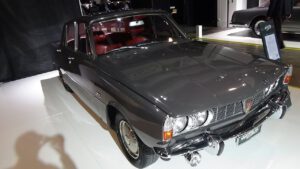
1905 Rover 6HP – Exterior and Interior – Retro Classics Stuttgart 2022
At the beginning of the twentieth century, the automobile industry was still defining the basic architecture of the modern car. British manufacturers were experimenting with compact, mechanically simple vehicles that could be produced reliably and used on increasingly busy roads. The Rover 6HP belongs to this formative phase, when the company was transitioning from bicycle production to the construction of motor vehicles.
Technical Details
The 1905 Rover 6HP was a small petrol-powered automobile designed around a simple but robust mechanical layout typical of early twentieth-century British cars. At its heart was a front-mounted internal combustion engine producing approximately 6 horsepower, which gave the model its name. Engines in this class were generally single-cylinder or twin-cylinder units with relatively low rotational speeds and modest displacement. The Rover engine was water-cooled and designed for durability rather than high performance.
Power from the engine was transmitted to the rear wheels through a mechanical drivetrain that typically included a manual gearbox and chain or shaft drive, depending on the specific configuration used in Rover models of the period. By the early 1900s, Rover had begun moving toward more standardized automotive layouts, including front-mounted engines and rear-wheel drive, which would later become a defining configuration in the industry.
The chassis consisted of a steel ladder frame supporting rigid axles at both the front and rear. Suspension relied on semi-elliptic leaf springs, a design inherited from carriage construction but well suited to the rough road surfaces common in the early automobile era. Braking systems were mechanical and relatively simple, usually acting on the rear wheels or transmission.
Performance figures were modest by modern standards. Vehicles in the 6-horsepower class generally reached top speeds in the range of 30 to 40 km/h, depending on road conditions and body configuration. However, for the time this represented a practical level of motorized mobility for short-distance travel and rural transportation.
- Manufacturer: Rover Company
- Model name: Rover 6HP
- Year of manufacturing: 1905
Design
The design of the Rover 6HP reflected the transitional character of early automobiles, which still closely resembled horse-drawn carriages. The body sat high above the chassis and was typically open, offering little protection from weather aside from optional folding tops or canvas covers.
Large spoked wheels with narrow tires dominated the vehicle’s appearance, contributing to a tall and lightweight silhouette. The long wheelbase and upright seating arrangement emphasized practicality rather than stylistic refinement. Many examples used a two-seat or four-seat configuration, depending on the body style fitted by the manufacturer or coachbuilder.
The driver’s position was located at the front of the vehicle, and by this period steering wheels had largely replaced the earlier tiller steering systems used in the 1890s. The dashboard was minimal, usually consisting of a few basic controls and mechanical gauges.
Externally, the car displayed the mechanical components openly. The engine sat beneath a simple bonnet, while lamps mounted on the sides of the body provided illumination for night driving. These lamps were often powered by oil or acetylene gas rather than electricity. Overall, the Rover 6HP maintained the craftsmanship traditions of carriage builders while gradually adopting the structural forms that would define the automobile.
Historical Significance
The Rover Company had been founded in 1878 in Coventry, England, initially producing bicycles. Like several other British manufacturers of the period, Rover entered the automobile field at the turn of the twentieth century as demand for motorized transport began to grow.
The Rover 6HP represents part of the company’s early automotive experimentation during a period when technical standards were still evolving. Early Rover cars were designed to be reliable and relatively straightforward to maintain, helping establish the brand’s reputation for engineering solidity.
In the broader context of British automotive history, vehicles like the Rover 6HP illustrate the gradual shift from small-scale mechanical experimentation to more structured automobile production. By the early twentieth century, manufacturers were beginning to standardize layouts, with front-mounted engines and rear-wheel drive becoming increasingly common.
This period also coincided with the expansion of road infrastructure and growing public acceptance of motor vehicles. Cars such as the Rover 6HP were among the machines that helped introduce everyday motorists to the possibilities of independent travel without reliance on horses or railways.
Quirks and Pop Culture
Early automobiles like the Rover 6HP often attracted considerable public attention simply because they were rare. At the beginning of the twentieth century, motor vehicles were still an unusual sight on public roads, and their mechanical operation fascinated many observers.
Driving such vehicles required a degree of technical knowledge and physical effort. Starting the engine typically involved hand-cranking, and drivers needed to manage fuel, lubrication, and ignition controls manually. These characteristics contributed to the perception of early motorists as mechanically skilled enthusiasts rather than casual drivers.
Today, surviving examples of early Rover vehicles occasionally appear at historic motoring events and vintage car rallies in the United Kingdom. Their exposed mechanical components and carriage-like proportions provide a visual reminder of how experimental and handcrafted early automobiles were compared with later mass-produced cars.
Display and preservation
The vehicle was exhibited at the Retro Classics Stuttgart in 2022. This car show is one of the major events on the classic car calendar in Germany. In 2022, it took place across five exhibition halls. Visitors can enjoy special showcases, hunt for rare parts and books, and buy cars—both private sellers and dealers offer a wide range of classic and youngtimer vehicles. In 2022, there was a noticeable increase in low-mileage youngtimers and classic cars.
Conclusion
The 1905 Rover 6HP represents a key moment in the early development of the automobile. Combining a modest petrol engine with carriage-derived chassis construction, it illustrates the transitional phase between horse-drawn vehicles and the standardized motor cars that would emerge later in the century. As one of Rover’s early automotive efforts, the model contributed to establishing the company’s reputation for dependable engineering. Today, it stands as a representative example of the pioneering era of British motoring.