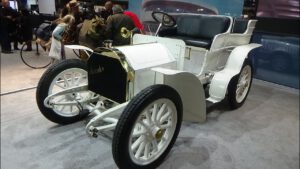
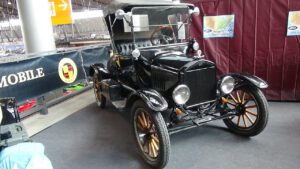
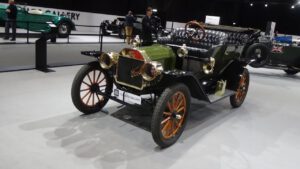
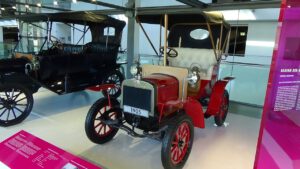
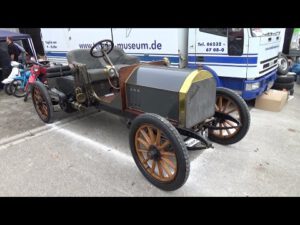
1905 Laurin & Klement Typ A – Zeithaus Autostadt Wolfsburg 2020
At the beginning of the 20th century, the transition from motorcycles to automobiles was not always a clean break. The Laurin & Klement Typ A reflects exactly this moment, combining lightweight engineering with emerging automotive principles. It was not designed as a luxury object, but as a practical step toward accessible motorized transport.
Technical Details
Technically, the Laurin & Klement Typ A followed the “voiturette” concept, emphasizing compact size and relatively simple construction. It was powered by a two-cylinder, water-cooled engine mounted at the front, with a displacement of approximately 1,005 cc. Output is generally cited at around 7 horsepower, which was sufficient to reach speeds of roughly 40 km/h—adequate for early 20th-century road conditions.
Power was transmitted to the rear wheels via a manual transmission, typically with two forward gears and a chain-drive system, a solution still common in this transitional phase of automotive engineering. The chassis was of ladder-frame construction, supporting a lightweight open body. Suspension relied on leaf springs, while braking systems were basic, usually acting on the rear wheels only.
The overall engineering approach reflected Laurin & Klement’s background in motorcycle production: emphasis on low weight, mechanical simplicity, and ease of operation rather than complexity or high output.
- Manufacturer: Laurin & Klement
- Model name: Laurin & Klement Typ A
- Year of manufacturing: 1905
Design
In design terms, the Laurin & Klement Typ A retained clear visual links to earlier carriage construction while introducing a more cohesive automotive layout. The body was open and compact, typically configured as a two-seater with minimal protection from the elements. A simple bench seat and exposed controls defined the interior, with functionality taking precedence over comfort.
The proportions were upright and narrow, with large spoked wheels and thin tires suited to unpaved roads. The front-mounted engine was covered by a modest bonnet, signaling a shift toward the now-standard front-engine layout. Unlike earlier motorized carriages, the Typ A presented a more unified structure, with body and chassis integrated into a single coherent form.
Visually, it conveyed practicality and lightness rather than status. There was little ornamentation, and surfaces were kept simple. This clarity of purpose aligned with its role as an entry-level automobile in a still-developing market.
Historical Significance
The Laurin & Klement Typ A played a central role in the early automotive history of Central Europe. The company Laurin & Klement, founded in 1895 in Mladá Boleslav, initially built bicycles and later motorcycles before moving into car production. The Typ A, introduced in 1905, was among its first true automobiles and marked the company’s transition into a full-scale car manufacturer.
The vehicle proved commercially successful, particularly within the Austro-Hungarian Empire, where demand for small, reliable cars was growing. It helped establish Laurin & Klement as a credible competitor to other early European manufacturers. The Typ A’s relatively accessible design and price positioned it as a practical alternative to larger, more expensive automobiles.
This model also laid the groundwork for the company’s future development. Laurin & Klement would expand its range and technical capabilities in the following years, eventually merging with Škoda Works in 1925. Through this lineage, the Typ A can be seen as an early ancestor of what would become Škoda Auto.
Quirks and Pop Culture
One of the notable aspects of the Laurin & Klement Typ A is how closely it reflects the technological transition from motorcycles to cars. The company’s engineering mindset carried over clearly: lightweight construction, chain drive, and modest power output all echo motorcycle design principles. This makes the Typ A an interesting hybrid in historical terms—neither fully a carriage-derived automobile nor entirely a motorcycle evolution.
Unlike later iconic cars, the Typ A did not achieve widespread recognition in popular culture or film. Its importance lies more in its role as a practical vehicle that contributed to everyday mobility in its time. Surviving examples are now rare and are typically found in museums or specialized collections, where they represent the early phase of automotive development in Central Europe.
Display and preservation
This car was filmed at the Zeithaus at Autostadt in Wolfsburg. The museum offers a distinctive journey through more than 130 years of automotive history. Its brand-independent collection features over 260 vehicles from more than 60 manufacturers, highlighting milestones in design, engineering, and production. A central feature is the striking “Rack,” where selected icons are displayed like exhibits in a glass cabinet, illustrating key phases of development. Complemented by rotating exhibits and artistic staging, the museum connects classic automobiles with contemporary design perspectives. This thoughtful presentation preserves not only the vehicles themselves, but also the cultural and technological evolution they represent.
Conclusion
The 1905 Laurin & Klement Typ A illustrates a key transitional stage in automotive history. Technically simple yet effective, it combined a small two-cylinder engine with lightweight construction and straightforward mechanical solutions. Its design moved beyond carriage influences toward a more unified automobile form, while its historical role helped establish Laurin & Klement as a significant manufacturer. As an early and accessible voiturette, it contributed to the broader shift from experimental machines to practical motor vehicles, securing its place in the foundations of European automotive development.