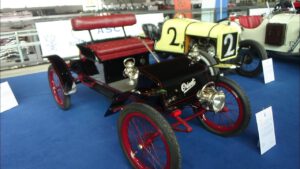
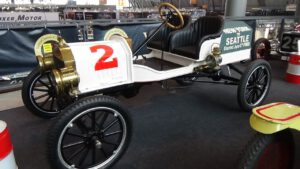
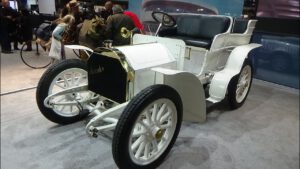
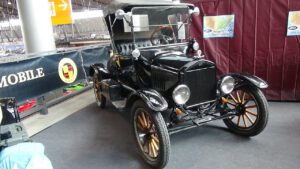
1904 Wolseley 6HP – Retro Classics Stuttgart 2018
At the beginning of the 20th century, the British automotive industry was still defining its identity, balancing influences from continental Europe with domestic engineering traditions. The 1904 Wolseley 6HP reflects this formative phase, combining relatively advanced mechanical ideas with a design still closely tied to horse-drawn vehicles. It was a modest car in terms of power, yet representative of how manufacturers approached reliability and usability in the early years of motoring.
Technical Details
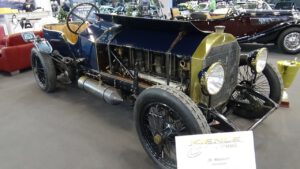
The 1904 Wolseley 6HP was equipped with a small-displacement engine, typically a single-cylinder or early twin-cylinder gasoline unit, producing approximately 6 horsepower. This output placed it firmly within the lower end of the market, intended for short-distance travel rather than speed or endurance. One of Wolseley’s distinguishing engineering traits during this period was its use of horizontal engines, a layout that differed from the vertical configurations increasingly adopted by other manufacturers.
Power was transmitted to the rear wheels through a relatively simple drivetrain, often using chain drive, which was still common before the widespread adoption of shaft-driven systems. The transmission offered limited gear ratios, reflecting the vehicle’s low-speed operating profile. Cooling systems were basic, and ignition relied on early magneto or battery-based solutions typical of the era.
The chassis construction followed a straightforward ladder-frame design, with rigid axles and leaf spring suspension. Braking systems were mechanical and primarily acted on the rear wheels, requiring careful driving technique. Overall, the technical philosophy emphasized durability and simplicity, ensuring that the car could be operated and maintained with limited technical infrastructure.
- Manufacturer: Wolseley Motor Company
- Model name: Wolseley 6HP
- Year of manufacturing: 1904
Design
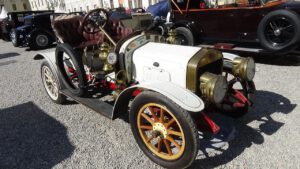
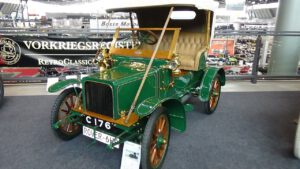
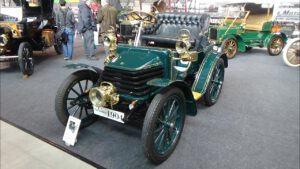
The design of the 1904 Wolseley 6HP retained a strong visual connection to carriage-building traditions. The body was typically open and lightly constructed, mounted on a visible chassis with separate fenders and exposed mechanical components. Seating arrangements resembled those of horse-drawn vehicles, with upright benches and minimal enclosure.
Large, narrow wheels were designed to cope with uneven road surfaces, while the overall proportions remained tall and relatively narrow. The absence of a fully integrated body gave the vehicle a segmented appearance, with distinct separation between engine compartment, passenger area, and running gear.
Interior features were minimal, focusing on essential controls rather than comfort or decoration. The driving position was simple and direct, reflecting the expectations of early motorists who were often mechanically inclined. The design communicated practicality and familiarity, easing the transition from horse-drawn transport to motorized mobility.
Historical Significance
The Wolseley 6HP was produced during a period when the Wolseley Motor Company was establishing itself as one of Britain’s key automotive manufacturers. Originally linked to the Wolseley Sheep Shearing Machine Company, the firm had diversified into automobiles at the turn of the century, bringing engineering experience from other industries into vehicle production.
By 1904, Wolseley had already gained a reputation for innovative engineering solutions, particularly under the influence of early designers such as Herbert Austin. The company’s willingness to experiment with engine layouts and mechanical systems contributed to its standing within the British market.
The Wolseley 6HP model represents the entry-level segment of this strategy, offering a relatively accessible vehicle at a time when car ownership was still limited to a small portion of the population. While it did not introduce groundbreaking innovations, it played a role in expanding the practical use of automobiles in Britain, particularly for private owners seeking reliable short-distance transport.
Quirks and Pop Culture
One of the more unusual aspects of early Wolseley vehicles, including the Wolseley 6HP, was the use of horizontal engines. This design choice, inherited from earlier engineering practices, gave the car a distinctive mechanical layout compared to many contemporaries that were transitioning to vertical engine configurations.
The Wolseley 6HP also reflects a broader cultural moment when automobiles were still novelties. Owners were often pioneers in their communities, and vehicles like this would have attracted attention simply by operating on public roads. The driving experience itself—open to the elements, mechanically direct, and relatively slow—differs significantly from later automotive norms.
Although the model does not feature prominently in modern popular culture, it is frequently referenced in historical collections and museums as an example of early British automotive engineering. Its presence in such contexts highlights its value as a representative artifact rather than a widely celebrated icon.
Display and preservation
This car was filmed at the 18th edition of Retro Classics Stuttgart in 2018. This is one of Europe’s premier classic car gatherings, attracting around 87,000 visitors and spread across 140,000 square meters. The exhibition offered a rich blend of international dealers, clubs, specialists, and parts suppliers. Unique highlights included the Neo Classics segment, showcasing modern coachbuilt and one-off creations, alongside themed halls such as the chrome-filled American Way of Drive. From pre-war automotive artistry to rare Soviet state limousines, the event celebrated preservation through diversity, craftsmanship, and historical depth.
Conclusion
The 1904 Wolseley 6HP illustrates the transitional nature of early automobile development in Britain. Technically simple yet thoughtfully engineered, it combined modest power with practical construction suited to the conditions of its time. Its design remained closely tied to carriage traditions, while its historical role reflects the gradual expansion of car ownership in the early 20th century. As part of Wolseley’s early lineup, the Wolseley 6HP provides insight into how manufacturers balanced innovation and familiarity during the formative years of the automotive industry.