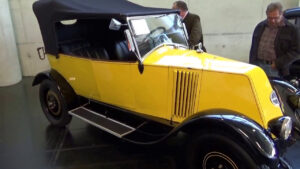
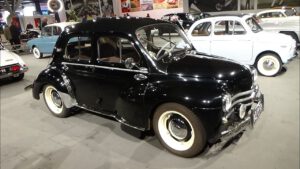
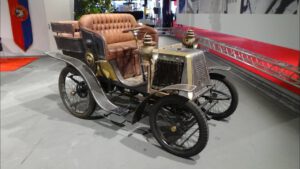
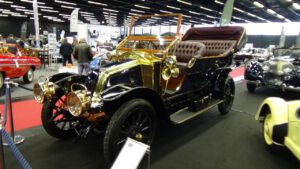
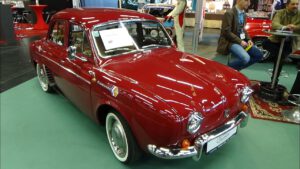
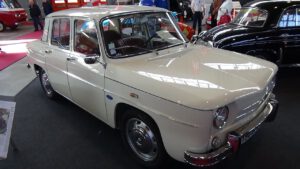
1901 – Renault Type D – Exterior and Interior – Auto Show AutoRAI Amsterdam 2015
At the dawn of the automobile, Renault was already experimenting with layouts that would soon become industry standards. The Renault Type D, introduced in 1901, belongs to a generation of vehicles where engineering decisions were still fluid, yet increasingly purposeful. Compact, mechanically simple, and clearly distinct from carriage-based predecessors, it reflects how quickly the automobile was establishing its own identity.
Technical Details
The 1901 Renault Type D was powered by a front-mounted single-cylinder engine, with displacement commonly cited around 400 to 500 cc. Output was modest, typically in the range of 3 to 4.5 horsepower, but sufficient for the lightweight construction and intended use of the vehicle. The engine’s simplicity contributed to ease of maintenance, a crucial factor at a time when automotive infrastructure was still minimal.
Power was transmitted to the rear wheels via a manual gearbox and, importantly, a driveshaft rather than chains. This shaft-drive system was one of Renault’s defining technical contributions in its early years, offering improved reliability and reduced maintenance compared to chain-driven competitors.
The chassis followed a basic ladder-frame construction, with rigid axles and leaf spring suspension. Steering was mechanical and direct, while braking systems were rudimentary, typically acting on the transmission or rear wheels. As with many vehicles of this era, the focus was on functional mobility rather than refinement or comfort.
A distinctive Renault feature of the time was the rear-mounted radiator, positioned behind the engine rather than at the front. This influenced both cooling efficiency and the external shape of the vehicle, giving the front end a characteristic, grille-less appearance.
- Manufacturer: Renault
- Model name: Renault Type D
- Year of manufacturing: 1901
Design
The design of the Renault Type D illustrates a clear departure from horse-drawn carriage forms, even though some visual elements remain. The body was compact and upright, with an open configuration that exposed both driver and passengers to the elements. Seating was simple, often arranged in a bench format, reflecting the utilitarian nature of early motoring.
Externally, the vehicle featured narrow, spoked wheels and separate fenders, with a minimal body structure mounted on the chassis. The absence of a conventional front radiator allowed for a clean and relatively flat hood line, distinguishing Renault from many contemporaries who were beginning to adopt front-mounted cooling systems.
Lighting, when fitted, was typically provided by acetylene or oil lamps mounted externally. Controls were basic, with limited instrumentation, and the driving position required familiarity with early automotive operation rather than intuitive use. Overall, the design emphasized function and mechanical accessibility over comfort or visual refinement.
Historical Significance
The Renault Type D emerged during a formative period for the company and the automotive industry as a whole. Founded in 1899 by Louis Renault, the company quickly established itself through technical innovation and participation in early competitions.
Models like the Renault Type D played a crucial role in refining Renault’s engineering philosophy. The adoption of the driveshaft, in particular, became a defining feature and influenced broader industry trends. At a time when many manufacturers still relied on chain drive, Renault’s approach offered a more durable and practical solution.
The early 1900s were marked by rapid experimentation, with manufacturers exploring different engine configurations, drivetrain layouts, and body styles. The Renault Type D represents a step toward standardization, combining a front-mounted engine, rear-wheel drive, and a coherent mechanical layout that would later become conventional.
As one of Renault’s early production models, the Renault Type D contributed to establishing the brand’s reputation for practical engineering and reliability. It also reflects the transition from experimental machines to more systematically produced automobiles, even if production volumes remained low by later standards.
Quirks and Pop Culture
One of the defining quirks of the Renault Type D is its simplicity. With minimal controls, limited instrumentation, and direct mechanical systems, driving required a level of engagement and understanding that modern vehicles no longer demand. This hands-on character is often highlighted in historical demonstrations and restorations.
The rear-mounted radiator is another notable feature, setting Renault apart visually and technically from many early competitors. This design choice became part of the brand’s identity in its formative years.
Although the Renault Type D itself is not widely represented in modern media, it belongs to a class of early automobiles that symbolize the origins of motoring. Vehicles like this often appear in museum collections and historical exhibitions, serving as tangible reminders of the industry’s beginnings.
Display and preservation
This car was shown at the AutoRAI Amsterdam 2015, which demonstrated how classic cars can be effectively preserved within a broader automotive context. Welcoming nearly 292,000 visitors, the Netherlands’ largest auto show presented over 500 vehicles from 49 brands at the RAI exhibition centre. While the focus leaned toward contemporary models and new releases, the dedicated “classic car square” ensured historical vehicles remained an integral part of the narrative. Complemented by themed areas such as the Race Hall and InnovationLab, the event highlighted the continuity between past and present—showing that preservation thrives when heritage is integrated into the evolving world of mobility.
Conclusion
The 1901 Renault Type D stands as an example of early automotive engineering moving toward greater coherence and practicality. Its single-cylinder engine, shaft-drive system, and simple chassis reflect a focus on reliability and usability in a challenging environment. In design, it bridges the gap between carriage-inspired forms and purpose-built automobiles. Historically, it contributes to Renault’s early identity as an innovator, particularly through the adoption of the driveshaft. As such, the Renault Type D offers insight into a period when the fundamentals of the automobile were still being defined.