1886 Benz Patent-Motorwagen – Retro Classics Stuttgart 2018
Few vehicles can be tied so directly to the origin of the automobile as the Benz Patent-Motorwagen. Built in 1886, it was not an evolution of an existing carriage but a completely new concept—designed from the outset as a self-propelled machine. Its significance lies not in performance or comfort, but in the fact that it established the fundamental idea of the automobile.
Technical Details
The 1886 Benz Patent-Motorwagen was powered by a rear-mounted single-cylinder four-stroke gasoline engine with a displacement of approximately 954 cc. It produced around 0.75 horsepower, a modest output even by early standards, but sufficient to propel the lightweight vehicle at speeds of up to about 16 km/h under ideal conditions.
The engine used an electric ignition system and a surface carburetor, an early solution for fuel-air mixture preparation. Power was transmitted to the rear wheels via a belt and chain system, reflecting the experimental nature of drivetrain engineering at the time. The vehicle featured a tubular steel frame, which kept weight low and contributed to structural simplicity.
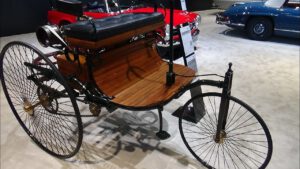
A notable technical feature was its differential gear, allowing the two driven rear wheels to rotate at different speeds—an essential innovation for cornering that would become standard in all later automobiles. Steering was handled through a rack-and-pinion system controlling a single front wheel, giving the Motorwagen its distinctive three-wheel configuration. Braking was rudimentary, consisting of a manually operated system acting on the rear wheels.
- Manufacturer: Benz & Cie.
- Model name: Benz Patent-Motorwagen
- Year of manufacturing: 1886
Design
The design of the Benz Patent-Motorwagen reflects its origin as a purpose-built machine rather than a modified carriage. Its three-wheel layout—two large rear wheels and a single steerable front wheel—was chosen partly to avoid the complexities of steering a four-wheeled vehicle with the technology available at the time.
The frame was constructed from steel tubing, forming a lightweight and open structure. Large wire-spoked wheels resembled those of contemporary bicycles rather than horse-drawn carriages, emphasizing the vehicle’s experimental character. The engine was mounted horizontally at the rear, fully exposed, with visible belts, chains, and mechanical components.
The seating arrangement was simple, consisting of a bench mounted above the rear axle. There was no enclosure, no weather protection, and minimal instrumentation. Every aspect of the design was dictated by function and feasibility, resulting in a machine that appears radically different from later automobiles but logically constructed for its purpose.
Historical Significance
The Benz Patent-Motorwagen is widely regarded as the world’s first practical automobile. In 1886, Benz & Cie. officially patented the vehicle, marking the birth of the gasoline-powered car. Unlike earlier experimental vehicles, it was designed as a complete system, integrating engine, chassis, and drivetrain into a coherent whole.
A crucial moment in its history came in 1888, when Bertha Benz undertook the first long-distance journey by automobile, traveling from Mannheim to Pforzheim and back. This journey demonstrated the practicality of the Motorwagen and addressed technical challenges along the way, including fuel supply and braking improvements. Her trip is often cited as the first real-world test of the automobile.
The Motorwagen laid the foundation for the modern automotive industry. Its basic principles—internal combustion engine, powered drivetrain, and independent vehicle design—became the blueprint for future developments. It also marked the beginning of Germany’s central role in automotive innovation.
Quirks and Pop Culture
One of the most notable aspects of the Benz Patent-Motorwagen is its association with Bertha Benz’s pioneering journey, which has become a defining story in automotive history. Her problem-solving during the trip—such as inventing the first brake lining and sourcing fuel from a pharmacy—has contributed to the vehicle’s enduring legacy.
The Motorwagen’s three-wheel design is another defining quirk. While later automobiles universally adopted four wheels, this early configuration highlights the experimental nature of the invention phase. It also reflects the technical limitations and engineering decisions of the time.
Today, the Benz Patent-Motorwagen is frequently displayed in museums and historical exhibitions as a symbol of technological innovation. It is less a collectible car in the traditional sense and more an artifact representing the beginning of motorized transport.
Display and preservation
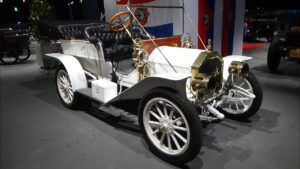
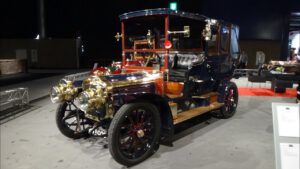
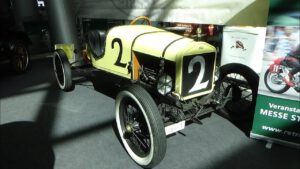
This car was filmed at the 18th edition of Retro Classics Stuttgart in 2018. This is one of Europe’s premier classic car gatherings, attracting around 87,000 visitors and spread across 140,000 square meters. The exhibition offered a rich blend of international dealers, clubs, specialists, and parts suppliers. Unique highlights included the Neo Classics segment, showcasing modern coachbuilt and one-off creations, alongside themed halls such as the chrome-filled American Way of Drive. From pre-war automotive artistry to rare Soviet state limousines, the event celebrated preservation through diversity, craftsmanship, and historical depth.
Conclusion
The 1886 Benz Patent-Motorwagen stands as the starting point of automotive history. Technically simple but conceptually groundbreaking, it introduced the essential elements of the modern automobile. Its design reflects a pure engineering solution to the challenge of self-propelled transport, free from earlier carriage conventions. Historically, it marks the moment when the automobile became a practical reality. More than any later development, the Motorwagen defines the origin of the car as we understand it today.