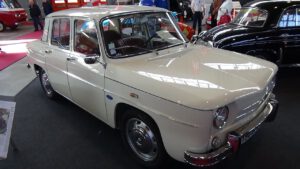
1954 Citroen 11 CV Traction Avant – Oldtimer-Meeting Baden-Baden 2021
The Traction Avant paved the way for large-scale production of front-wheel-drive vehicles equipped with monocoque construction. Its technical coherence, durability, and dynamic advantages established a template that influenced generations of Citroën models.
Technical Details:
The Citroën 11CV Traction Avant is defined above all by its drivetrain concept, which gave the model its name and lasting reputation. In France, front-wheel drive quickly became synonymous with Citroën itself, leading to the enduring nickname “Traction,” and later the pleonastic but famous term “Traction Avant.” While front-wheel drive was the headline innovation, the true technical leap lay in the combination of multiple advanced solutions within a single production vehicle.
Alongside front-wheel drive, the Traction Avant featured a self-supporting monocoque structure—an idea patented by Vincenzo Lancia in 1918—hydraulic brakes, and independent suspension on all four wheels. This technically coherent package delivered road-holding behavior that surpassed most contemporaries, particularly in difficult conditions. Power for the 11CV came from a front-mounted four-cylinder inline engine with a displacement of 1,911 cc, producing between 56 and 63 horsepower depending on specification, and achieving top speeds between 115 and 130 km/h.
By the early 1950s, the design was approaching its twentieth anniversary. In response to declining sales caused by persistent rumors of a high-tech successor, Citroën introduced a major technical update in 1954 for the range-topping version. The six-cylinder 15 CV could now be ordered with a hydropneumatically suspended rear axle. This configuration, known as the 15/6H, represented a forward-looking bridge toward Citroën’s future suspension philosophy.
- Manufacturer: Citroën
- Model Name: Citroën 11CV Traction Avant
- Year of Manufacturing: 1954
Design:
Visually, the Citroën Traction Avant broke entirely with conventional automotive aesthetics of the 1930s and beyond. Its body followed the principles of Streamline Moderne, resulting in a fully aerodynamic silhouette that immediately set it apart from traditional rear-wheel-drive sedans. The smooth, flowing lines were not merely decorative but functionally tied to the car’s low stance and integrated construction.
Initially available only as a sedan, the Traction Avant presented a modern and unmistakable profile that prevented any confusion with more conservative competitors. Its design was the work of Flaminio Bertoni, whose approach emphasized clarity of form and technical honesty. In 1954, the range expanded visually with the introduction of a six-window body configuration, giving the limousine a lighter appearance and improved cabin ambiance. This evolution reinforced the model’s appeal without abandoning its iconic silhouette.
Historical Significance:
The Citroën Traction Avant was produced continuously from 1934 until 1957, an extraordinary lifespan for a car built around such radical ideas. From its launch, it embodied André Citroën’s determination to leap ahead of the competition through engineering rather than incremental change. Continuous development under the guidance of engineer André Lefèbvre ensured that the car remained relevant despite its unconventional architecture.
The Traction Avant paved the way for large-scale production of front-wheel-drive vehicles equipped with monocoque construction. Its technical coherence, durability, and dynamic advantages established a template that influenced generations of Citroën models. Over its long career, the Traction evolved rather than aged, remaining a viable and competitive automobile until it was finally replaced in spirit by the equally revolutionary DS.
Quirks and Pop Culture:
The Citroën 11CV Traction Avant carved out a unique place in popular culture as the definitive French sedan of its era. Crime novelist Georges Simenon famously equipped his fictional detective, Chief Inspector Maigret, with a Citroën 11—a deliberate choice reflecting the car’s image of authority, efficiency, and urban toughness.
Its popularity extended across social boundaries. Police forces, criminals, and members of the French Resistance all favored the Traction for the same reasons: strong performance, exceptional handling, and reliability. During the Second World War, it became an emblematic vehicle of the Resistance, further cementing its mythic status. Thanks to constant technical refinement and a reputation built on real-world capability, the Traction Avant enjoyed an unusually long production run, totaling approximately 760,000 units.
Display and preservation:
The vehicle was exhibited at the Oldtimer-Meeting Baden-Baden in 2021. This event, held annually in the spa town’s Kurpark and along the Kaiserallee, is one of Germany’s most picturesque classic car gatherings. In 2021, the 44th edition featured 300 vintage vehicles from 80 different brands, including rare models. The event embraced a 1970s theme, showcasing over 40 vehicles from that era. An innovative highlight was the “automobile fashion show,” where models presented current fashion trends while riding in open-top classic cars through the park. The event concluded with the traditional Concours d’élégance, awarding 120 prizes across 15 categories.
Conclusion:
The 1954 Citroën 11CV Traction Avant stands as a mature expression of one of the most influential car designs of the 20th century. By uniting front-wheel drive, monocoque construction, hydraulic braking, and independent suspension, Citroën created a vehicle whose handling and stability redefined expectations. Updates such as the hydropneumatic rear suspension and the six-window body demonstrated the brand’s commitment to evolution rather than replacement. Both a technological milestone and a cultural icon, the Traction Avant remains a cornerstone of Citroën’s identity and automotive history as a whole.