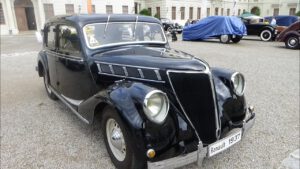
1952 Citroen 11CV Traction Avant – Retro Classics Stuttgart 2022
The Traction Avant’s combination of advanced technology and exceptional road holding earned it an enduring reputation—and a notorious nickname. Its ability to maintain grip on slippery or snow-covered roads made it particularly appealing to criminals, giving rise to the enduring moniker “berline des gangsters.”
Technical Details:
The Citroën 11CV Limousine (Traction Avant) represents one of the most technically advanced mass-produced cars of its time. Built within the broader Traction Avant production run from 1934 to 1957, it featured a front-mounted, four-cylinder inline engine driving the front wheels—an unconventional solution at the time. The engine displaced 1,911 cc and delivered 56 horsepower at 3,800 rpm, later reaching up to 63 horsepower at 4,000 rpm in higher-output versions. This allowed for a top speed ranging between 115 and 130 km/h, depending on configuration.
Equally revolutionary was the car’s construction. The 11CV employed a self-supporting monocoque steel body rather than a separate chassis, reducing weight and increasing rigidity. Combined with front-wheel drive, overhead-valve engines, and compact torsion bar suspension, this layout provided exceptional road holding and stability. These technologies, rare or nonexistent elsewhere at the time, gave the Traction Avant its famous handling characteristics. Customers could choose from three wheelbase lengths and numerous body variants. Total production reached an impressive 530,315 units, underlining the model’s technical credibility and commercial success.
- Manufacturer: Citroën
- Model Name: Citroën 11CV Limousine (Traction Avant)
- Year of Manufacturing: 1952
Design:
The design of the Citroën 11CV Limousine (Traction Avant) was inseparable from its engineering philosophy. One of its most significant innovations was its all-steel monocoque body, produced under a patent by the American Budd company. This construction allowed the car to sit extremely low, resulting in a low center of gravity that directly influenced its poised and confident stance on the road.
Visually, the Traction Avant projected solidity and restraint rather than flamboyance. Its elongated body, four-door limousine format, and steel-panel construction emphasized function over fashion. In 1952, important design updates refreshed the model without altering its identity. At the Paris Motor Show, a new rectangular rear trunk was introduced. Summer updates brought four redesigned indicators, a new instrument layout, and a light-colored metal trim along the top of the dashboard. Later in the year, a domed trunk lid appeared alongside fully redesigned upholstery and a two-tone dashboard, transforming the interior into a brighter, more welcoming space. The result was a car that balanced technical rigor with understated elegance.
Historical Significance:
The Citroën Traction Avant marked a turning point not only for the brand but for the entire French automotive industry. When competition intensified in 1934, André Citroën turned to two exceptional collaborators: engineer André Lefebvre and designer Flaminio Bertoni. Together, they created a vehicle that would redefine automotive engineering. As its name indicates, the Traction Avant was driven by its front wheels—a novelty in France at the time, even if not entirely unprecedented elsewhere in Europe and the United States.
The Traction Avant range initially included four-cylinder 7 CV and 11 CV models, later supplemented by the six-cylinder 15 CV. Despite its technical brilliance, the project proved financially disastrous for André Citroën. Heavy investments in a new factory nearly ruined the company, forcing it into bankruptcy before the model could fully establish itself. Michelin took over Citroën in early 1935, continued production, and ultimately reaped the rewards. After the war, production resumed and continued until 1957, by which time the Citroën DS had already taken center stage.
Quirks and Pop Culture:
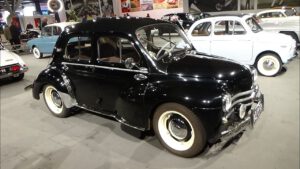
The Traction Avant’s combination of advanced technology and exceptional road holding earned it an enduring reputation—and a notorious nickname. Its ability to maintain grip on slippery or snow-covered roads made it particularly appealing to criminals, giving rise to the enduring moniker “berline des gangsters.” Often painted black, the 11CV Traction Avant became synonymous with cinematic chases and underworld legends.
During World War II, the Traction Avant’s story took on a dramatic dimension. Adopted by the French army and later requisitioned by German forces, it served across vastly different terrains. It became the iconic vehicle of the French Resistance, famously marked with large “FFI” letters on its doors during the Liberation.
It appears in the background of classic Franco-Belgian comics such as The Adventures of Tintin, alongside other Citroën icons like the 2CV and H Van.
Display and preservation:
The vehicle was exhibited at the Retro Classics Stuttgart in 2022. This car show is one of the major events on the classic car calendar in Germany. In 2022, it took place across five exhibition halls. Visitors can enjoy special showcases, hunt for rare parts and books, and buy cars—both private sellers and dealers offer a wide range of classic and youngtimer vehicles. In 2022, there was a noticeable increase in low-mileage youngtimers and classic cars.
Conclusion:
The 1952 Citroën 11CV Limousine (Traction Avant) stands as a masterpiece of functional modernism. With its front-wheel drive, monocoque body, low center of gravity, and outstanding road manners, it was decades ahead of its time. Enhanced in 1952 with thoughtful design updates, it remained commercially successful thanks to its exceptional value, practicality, and durability. Revered by engineers, embraced by everyday motorists, and immortalized in history and pop culture alike, the 11CV (Traction Avant) remains one of the most influential cars Citroën has ever produced.